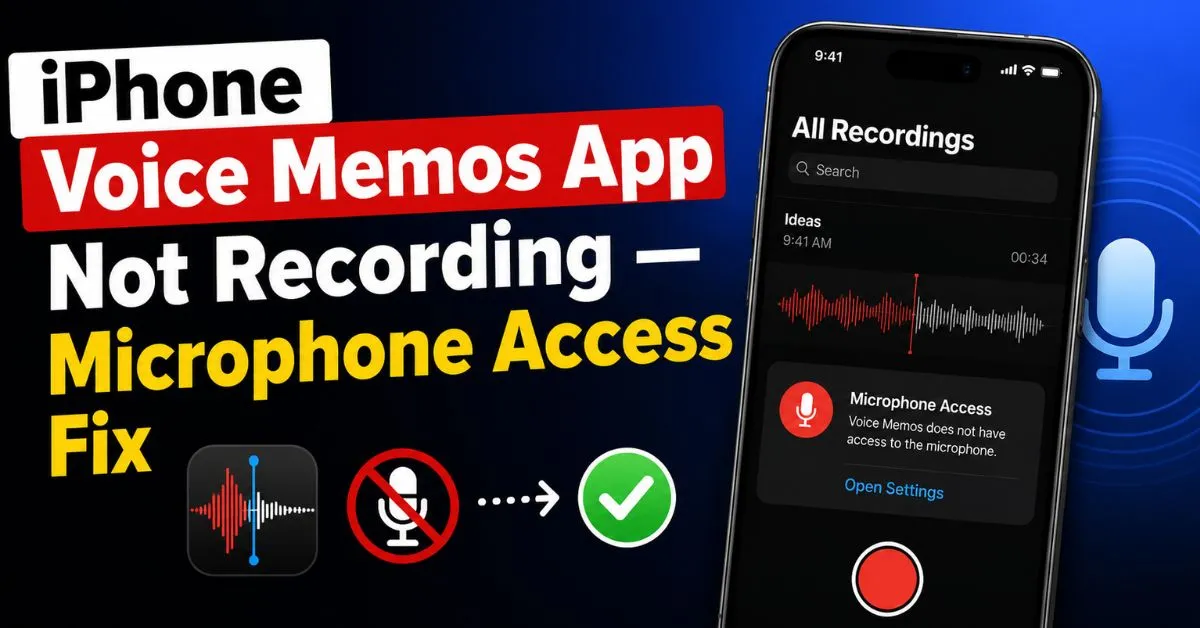
Fix: iPhone Voice Memos Not Recording (Microphone Access) I’ve been behind the repair desk for over a decade, and if there’s one thing I’ve learned, it’s that technology loves to fail at the exact moment you need it most. I remember a frantic client coming into my shop last Tuesday. She was a journalist who had just sat through a forty-minute interview, only to realize the iPhone Voice Memos app had recorded absolutely nothing. The waveform was a flat, mocking line.
She thought her phone was broken. I suspected something else.

When your iPhone refuses to record audio—or when the record button sits there, greyed out and unresponsive—it’s rarely a “broken” phone in the traditional sense. More often, it’s a software tug-of-war happening behind the scenes. Whether it’s a privacy setting gone rogue or a “phantom” Bluetooth device stealing your audio stream, the fix is usually just a few taps away.
Let’s get your mic back online.
Introduction: Why Your Voice Memos Stopped Working
It’s an incredibly sinking feeling. You press record, you see the timer ticking, but there’s no movement in the audio visualizer. Or worse, the button simply won’t depress. I’ve seen two main “flavors” of this failure in my years as a tech.
First, there’s the Silent Waveform. This is where the app thinks it’s recording, but it’s pulling audio from a source that isn’t your voice (like a pair of AirPods sitting in a gym bag three rooms away).
Second, there’s the Total Lockout. This is usually a permissions issue where the app is legally—well, digitally—forbidden from “hearing” anything because of iOS Privacy Settings.
Before we dive into the deep software menus, do me a favor: take off your phone case. I can’t tell you how many “hardware repairs” I’ve performed that were actually just a thick, third-party rugged case blocking the tiny microphone mesh at the bottom of the iPhone. If that mesh is clogged with pocket lint or obstructed by plastic, your recordings will sound like they were filmed underwater—if they record at all.

The Core Fix: Granting Microphone Access
Most people assume that because Voice Memos is a “native” Apple app, it has an all-access pass to your hardware. It doesn’t. Since the introduction of more robust iOS Privacy Settings, even Apple’s own apps can have their permissions revoked by a system glitch or an accidental tap.
Navigating to Privacy & Security
If your record button is greyed out, this is the first place I go.
- Open Settings.
- Scroll down to Privacy & Security.
- Tap on Microphone.
- Find Voice Memos in the list.
If the toggle is off, there’s your culprit. But here’s a pro tip from the repair trenches: The Toggle Reset. Even if the switch is “On,” flip it off, wait ten seconds, and flip it back on. This forces the iOS TCC (Transparency, Consent, and Control) database to re-register the permission. I’ve seen this fix “permission loops” where the app thinks it has access but the system isn’t actually delivering the audio data.
Screen Time: The Hidden Gatekeeper
I once spent an hour diagnosing a teenager’s iPhone only to realize his parents had locked down microphone changes via Screen Time Restrictions. If the microphone toggle is greyed out in Privacy settings, go to Settings > Screen Time > Content & Privacy Restrictions. Look for the “Microphone” section and ensure it is set to “Allow Changes.” If “Don’t Allow Changes” is checked, the Voice Memos app will be stuck in whatever state it was in when the restriction was applied.
Software Conflicts: What Else is Using Your Mic?
iOS is generally great at managing audio, but it’s not perfect. Only one “primary” app can control the microphone’s hardware at a high-priority level.
The ‘Phantom’ Bluetooth Connection
This is the number one cause of “silent” recordings I see. You’re in your kitchen, you start a voice memo, but your iPhone is still connected to your car in the driveway or a Bluetooth speaker in the basement. The iPhone is dutifully “recording,” but it’s listening to the microphone on your dashboard or the empty basement.
Swipe down to open the Control Center. Look at the top right corner of the “Now Playing” box. If you see a Bluetooth icon or anything other than “iPhone,” your audio is being routed elsewhere. Tap that icon and force it back to “iPhone.”
Siri Interference
Siri is always listening for that “Hey Siri” wake word. Occasionally, the Siri daemon (the background process) hangs and refuses to release the microphone “lock.” Try this: Go to Settings > Siri & Search and temporarily turn off “Listen for ‘Hey Siri’.” Now, try recording a voice memo. If it works, you know Siri was the one hogging the input. You can turn it back on after a quick Force Restart.
Background App Hijacking
Apps like Zoom, Microsoft Teams, or even certain mobile games with voice chat can “hijack” the audio engine. Even if you aren’t actively in a call, if the app is suspended in a state where it’s “waiting” for audio, Voice Memos might get pushed to the back of the line. Double-tap your home button (or swipe up and hold) to enter the App Switcher and flick away any app that might even remotely use the microphone.
Expert Insight: The ‘AirPlay’ Trap If you are currently mirroring your screen to a Mac or an Apple TV via AirPlay, the Voice Memos app will often disable recording to prevent audio loops. Always check your Control Center to ensure Screen Mirroring is turned off before you start an important session.
Hands-On Troubleshooting: Storage and System Glitches
Sometimes the issue isn’t about the microphone at all; it’s about where the data is supposed to go.
The Voice Memo ‘Optimized Storage’ Trap
If your iPhone Storage is nearly full, iOS starts to behave erratically. Voice Memos are unique because they sync heavily with iCloud. If you have “Optimize Mac Storage” or similar iCloud features enabled, the app might struggle to create a new local file if there isn’t enough “buffer” space on your device.
I recommend keeping at least 2GB of free space. If you’re redlining your storage, delete a few 4K videos and try recording again. You’d be surprised how often a “mic fix” is actually a “file system fix.”
Offloading vs. Deleting
If the app is still glitching, don’t just delete it—you might lose your saved memos. Instead, go to Settings > General > iPhone Storage > Voice Memos and tap Offload App. This deletes the app’s “brain” (the binaries) but keeps your “memories” (the recordings). Once offloaded, tap “Reinstall.” This gives you a fresh, bug-free version of the app from the App Store without the risk of data loss.
Hardware Diagnostics: Is Your Mic Physically Damaged?
If you’ve done the “Toggle Reset,” checked Bluetooth, and cleared your storage, we need to see if the hardware is actually alive.
The iPhone actually has multiple microphones. The Voice Memos app typically uses the bottom microphone (next to the charging port). However, if you use the “Enhanced Recording” feature or have the phone in certain orientations, it might switch.
The Diagnostic Test:
- Open the Camera app.
- Record a video using the rear camera while talking.
- Record a second video using the front (selfie) camera.
- Play them back.
If the audio is clear on the selfie video but silent on the rear video (or vice versa), you have a failing microphone module. If both are silent, it’s likely a logic board issue or a total audio IC failure—a common problem on older models like the iPhone 7, but rarer on newer ones.
The “Bottom” Mic Test: Open the Voice Memos app and very gently rub your finger over the speaker grille at the bottom of the phone. If you see the waveform jump significantly, the hardware is sensing input, and your issue is definitely software-related (likely a gain-control bug or a “silent” routing issue).
Common Pitfalls to Avoid
In my experience, users often overlook the simplest things while searching for complex solutions.
- Ignoring iOS Updates: I know, those update notifications are annoying. But Apple frequently pushes “silent” fixes for the audio engine in point-releases (like moving from 17.4 to 17.4.1). If you’re three versions behind, you’re fighting bugs that have already been patched.
- Dirty Ports: I’ve used a toothpick to pull out a literal sweater’s worth of lint from a microphone port. If you work in construction or keep your phone in a dusty pocket, that “not recording” issue is likely just a physical plug of debris.
- Control Center Oversight: Always check the Control Center for the “Orange Dot.” If you see an orange dot at the top of your screen, it means an app is currently using your mic. If you aren’t in Voice Memos, find out which app that dot belongs to and kill it.
Frequently Asked Questions
1. Why is the record button in Voice Memos greyed out?
This is almost always a permissions or restriction issue. Check Settings > Privacy & Security > Microphone first. If that’s fine, check Screen Time > Content & Privacy Restrictions. Lastly, ensure you aren’t in an active phone call or a “silent” meeting app like Zoom, as iOS will disable recording to protect privacy.
2. My Voice Memos are recording, but there is no sound when I play them back. Why?
Check your audio routing. Swipe down to the Control Center and see if your audio is being sent to a Bluetooth device or AirPlay speaker. Also, check the “Mute” switch on the side of your phone; while it shouldn’t affect playback in the app, some older iOS versions had bugs where the system volume was tied to the ringer state.
3. Will I lose my old recordings if I delete and reinstall the app?
If you simply “Delete” the app, you risk losing data if it hasn’t been backed up to iCloud. Use the “Offload App” feature in Settings > General > iPhone Storage instead. This keeps your data safe while replacing the app software.
4. Can a screen protector cause the Voice Memos app to stop recording?
Indirectly, yes. Some full-coverage screen protectors cover the “top” microphone (near the earpiece). While Voice Memos primarily uses the bottom mic, it uses the top mic for noise cancellation. If that mic is covered, the software might get “confused” by the phase cancellation and result in a silent or extremely muffled recording.
5. What should I do if my mic works in phone calls but not in Voice Memos?
This confirms your hardware is likely fine! This is a classic software conflict. Force restart your iPhone (Volume Up, Volume Down, then hold the Power button until the Apple logo appears). This clears the temporary cache of the audio engine and usually restores the link between the app and the hardware.