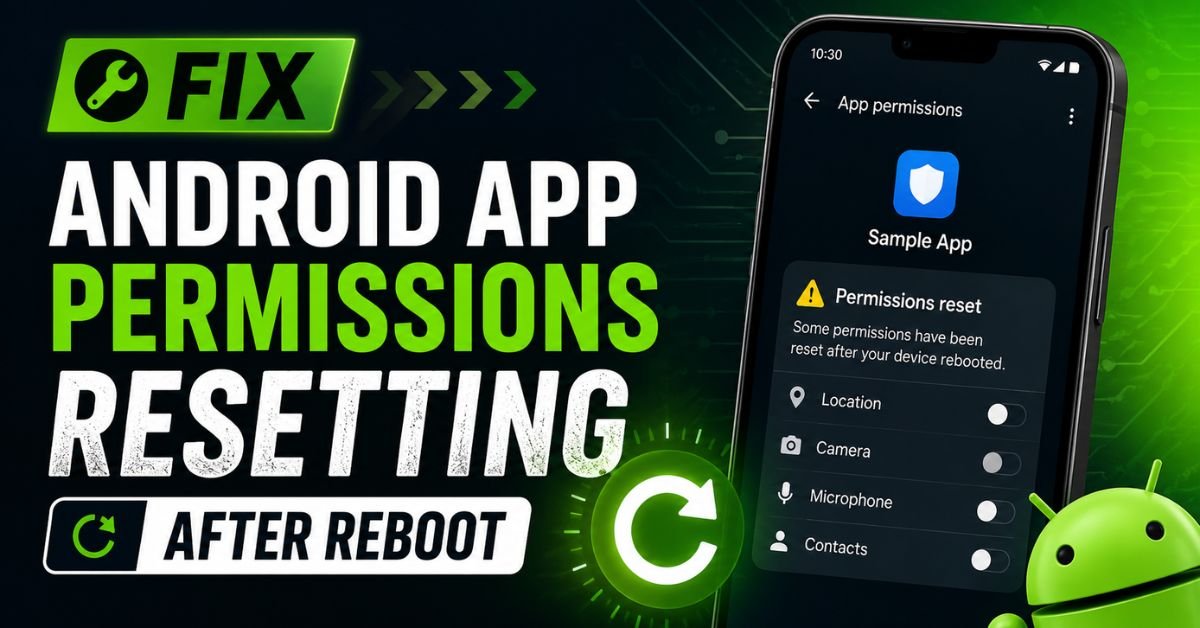
Fix Android App Permissions Resetting After Reboot (Step-by-Step).I’ve been there. You spend twenty minutes meticulously setting up your smart home dashboard or a specialized automation app, granting it every permission from “Always allow” location to full microphone access. You feel like a tech god—until you reboot your phone. Suddenly, everything is broken. The app is asking for permission again, the automation is stalled, and you’re staring at a “Permission Denied” notification like it’s a personal insult.
Last month, while testing a beta build on my Pixel 7 Pro, I realized my favorite call-recording and transcription app kept losing its storage access every single time I restarted the device. It wasn’t just a minor annoyance; it was a workflow killer. If you’re seeing your Android app permissions keep resetting after a reboot, you’re likely caught between a legitimate security feature and a system-level bug.

Let’s dive into why this happens and how we can actually make those settings stick.
Understanding the Problem: Why Android Permissions Reset
Since the release of Android 11, the Android Operating System has become significantly more aggressive about “User Privacy Settings.” The Google engineers introduced a feature called Permission Auto-reset. The logic is sound: if you haven’t used an app in a few months, why should it still have access to your camera or contacts?
However, “intended security features” and “user experience” don’t always play nice. For some users, this auto-reset logic triggers way too early—sometimes immediately after a reboot.
Symptoms: Is it a Bug or a Feature?
You’ll know you’re dealing with this if you see these signs:
- The Re-grant Loop: Every time you restart the phone, you get a barrage of “App X requires access to Storage” pop-ups.
- Background Activity Death: Apps that rely on staying active in the background suddenly stop working because their permissions were revoked.
- The “Unused” Flag: Android incorrectly flags an app you use daily as “unused” and wipes its slate clean.
We need to distinguish between the Permission Controller (the system app responsible for this) doing its job and a genuine OS bug where the database that stores these preferences gets corrupted during the shutdown sequence.
The Primary Fix: Disabling ‘Remove Permissions if App Is Unused’
This is the most common culprit. In the Android Open Source Project (AOSP) code, there’s a specific toggle designed to protect you, but it often misfires.

I found that even if an app is active, certain OEM skins (looking at you, One UI) might still flag the app’s background Application Programming Interface (API) calls as “non-usage,” leading to a reset.
How to fix it for specific apps:
- Open your Settings and go to Apps (or Manage Apps).
- Tap on the specific app that keeps losing its permissions.
- Look for the Permissions sub-menu.
- Scroll down. You will see a toggle labeled “Remove permissions if app is unused” (on newer versions) or “Unused app settings.”
- Turn this OFF.
If you have a dozen apps doing this, it’s a pain to do it one by one. While there isn’t always a “Global Off” switch in every version of Android, checking the “Safety & Privacy” section in your main settings menu sometimes allows you to view all “Auto-reset” apps in one list. This lets you bulk-protect your essential tools from the system’s overzealous cleaning.
Troubleshooting the Permission Controller System App
If the manual toggle didn’t work, we need to look at the “brain” of the operation: the Permission Controller. This is a hidden system APK that manages the logic for all access requests. Sometimes, the cache for this system app becomes fragmented—especially after an OTA (Over-The-Air) update.
The “Clean Slate” Method:
- Go to Settings > Apps.
- Tap the “See all apps” option.
- Tap the three dots in the top right corner and select “Show system”.
- Search for “Permission Controller”.
- Go to Storage & Cache.
- Tap Clear Cache. (I usually avoid “Clear Data” here unless things are truly broken, as it might force you to re-grant permissions for every app on your phone, but if the issue persists, “Clear Data” is the nuclear fix for this specific module).
After clearing the cache, restart your phone. This forces the Permission Controller to rebuild its active registry from the actual manifest files of your installed apps.
Pro Tip: The ADB Alternative For those who aren’t afraid of a command line, you can use ADB (Android Debug Bridge) to check if an app is hard-coded to reset. Connect your phone to your PC and run:
adb shell cmd app_hibernation get-state <package_name>If it returns “hibernating=true,” the system is actively killing that app’s permissions regardless of your settings. You can force-disable it using:adb shell cmd package set-permission-parts <package_name> false

OEM-Specific Settings: Samsung, Pixel, and OnePlus Variations
Not all Androids are created equal. Device Management varies wildly between a Samsung Galaxy and a Google Pixel.
Samsung (One UI)
Samsung has a feature in Device Care called “Auto-disable apps.” If you don’t open an app for a few days, One UI puts it into a “Deep Sleep” mode. This doesn’t just stop it from running; it effectively resets the app state.
- Fix: Go to Settings > Battery and Device Care > Battery > Background Usage Limits. Ensure your important apps are in the “Never sleeping apps” list.
Google Pixel
Pixels rely heavily on Google Play Protect. Occasionally, Play Protect scans an app (especially if it was sideloaded via an APK) and decides its permissions are “risky,” resetting them silently in the background. If your permissions reset and you see a Play Protect notification, you’ll need to “Enable” the app specifically within the Play Store settings.
OnePlus (OxygenOS)
OnePlus is notorious for aggressive RAM management. Their “App Boot Management” can sometimes prevent an app from registering its permission status upon reboot. Ensure your app is set to “Manual” in the Auto-launch settings.
Advanced Fix: Wiping System Cache Partition
If you’ve tried everything and the permissions still won’t stick, we are likely looking at a conflict within the System Cache Partition. This is where the OS stores temporary data, including pieces of the permission database that are accessed during the boot sequence.
I’ve seen this happen frequently after a major version jump (like moving from Android 13 to 14). Old data fragments remain, and the system gets confused about which “Privacy Settings” are current.
How to Wipe Cache Partition (No Data Loss):
- Power off your device.
- Hold the Power Button + Volume Down (this varies by model; some use Volume Up) to enter Recovery Mode.
- Use the volume buttons to navigate to “Wipe Cache Partition”.
- Press the Power button to select it.
- Warning: Do NOT select “Wipe Data/Factory Reset” unless you want to lose everything.
- Once finished, select “Reboot system now”.
This “flushes the pipes” of the OS and often resolves those weird, “janky” bugs that simple restarts can’t touch.
Common Pitfalls and Preventive Maintenance
Sometimes, the culprit isn’t the Android OS at all—it’s the third-party software we install to “help” our phones.
1. RAM Boosters and “Cleaners”
If you have an app that claims to “Speed up your phone” or “Clean your RAM,” delete it immediately. These apps often work by killing background processes and clearing temporary permission tokens. They fight against the Android system’s native resource management and are a leading cause of permission resets.
2. Work Profiles and MDM
Is your phone provided by your employer? Or do you have a “Work Profile” set up for Outlook/Slack? If so, your Mobile Security is likely managed by an MDM (Mobile Device Management) policy. These policies can be set to reset permissions every time the device reboots for security compliance. If this is the case, no amount of setting-toggling will fix it—you’ll need to talk to your IT department.
3. The App Update Loop
Occasionally, when the Google Play Store updates an app, it changes the API level the app targets. If the new version requires a different permission structure, Android may reset the old ones to ensure you’re aware of the changes. If you have “Auto-update” on, this might happen overnight, making it look like a reboot caused the issue.
4. Factory Reset: The Last Resort
I hate suggesting this, but if you’ve wiped the cache partition, toggled the “unused” settings, and cleared the Permission Controller data, and you’re still losing permissions, your OS image might be corrupted. A factory reset is the only way to re-align the system’s core databases. Just make sure your Google Photos and contacts are backed up first.
Real-Time FAQs
Q: Why do only my sideloaded APKs keep losing permissions, while Play Store apps don’t?
A: This is usually due to Google Play Protect. Because the app wasn’t “verified” by the store, Android’s security layers are more suspicious of it. Every time the system reboots, it re-scans the sideloaded APK and often defaults to the most restrictive privacy settings as a “fail-safe.”
Q: Does “Battery Optimization” affect permissions?
A: Indirectly, yes. If an app is “Optimized” or “Restricted” in the battery settings, it may not be allowed to start its background services at boot. If the service doesn’t start, the Permission Controller might flag the app as “not in use” and revoke permissions sooner than expected.
Q: Can I use a third-party app to “lock” my permissions?
A: Generally, no. On modern Android versions, permissions are handled at the kernel and system level. A third-party app would need Root access to override the Permission Controller’s decisions. I’d advise against “permission managers” as they often add more instability.
Q: I updated to Android 14 and now this is happening on every app. Is it a known bug?
A: Yes, several builds of Android 14 (especially on Pixel and certain Samsung models) had a documented issue where the “granular permissions” for photos and videos didn’t migrate correctly. Wiping the System Cache Partition as described above is the most effective fix for this specific update-related bug.
Q: Is there an ADB command to disable the auto-reset feature for all apps at once?
A: You can’t disable the entire system globally with one command without risking system stability, but you can target the hibernation service. Use adb shell device_config put app_hibernation app_hibernation_enabled false. Use this with caution, as it affects your device’s ability to save power by hibernating genuinely unused apps.
Managing Android’s evolving security landscape is a bit of a balancing act. While I appreciate the privacy focus of the Android Open Source Project, I think we can all agree that a little more “stickiness” in our settings would go a long way. Hopefully, these steps help you regain control over your device!