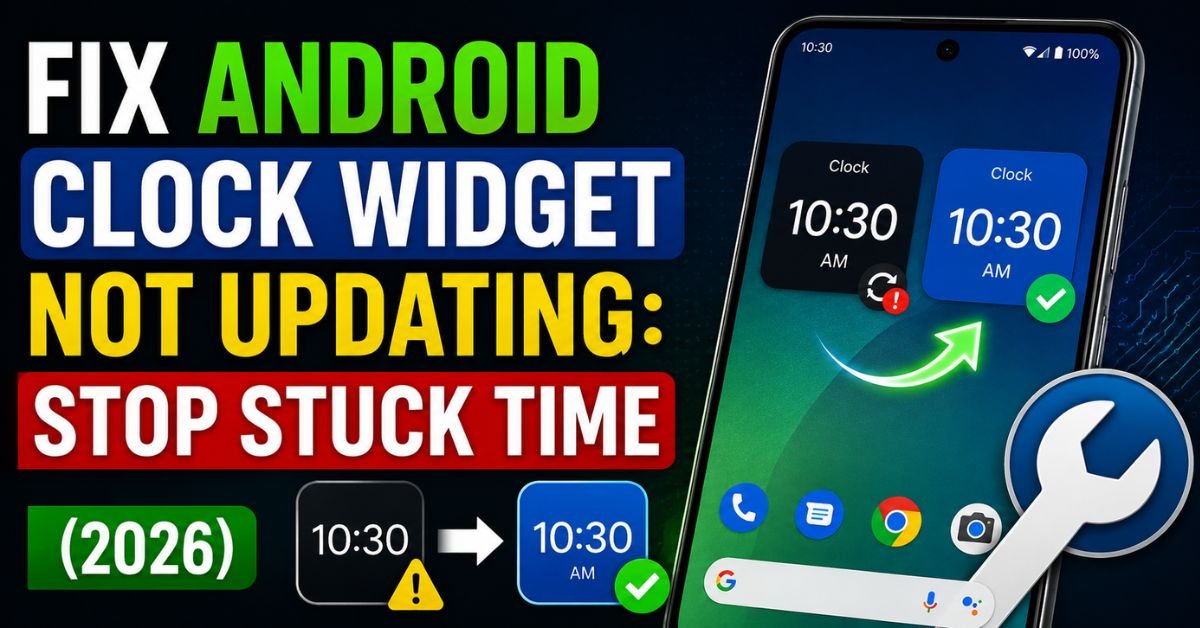
Fix Android Clock Widget Not Updating: Stop Stuck Time (2026).I’ll never forget the Tuesday morning I almost lost a freelance contract because my phone “lied” to me. I woke up, glanced at my Google Pixel, and saw 7:15 AM. Perfect—I had plenty of time for my 8:00 AM Zoom call. I took my time brewing coffee, only to realize the sun was much higher than it should be. I checked my microwave: 8:05 AM.
My home screen clock widget was frozen. It hadn’t updated since the night before.

If you’re reading this, you’ve probably felt that same spike of adrenaline. Whether you’re on a Samsung Galaxy running One UI or a Pixel running the latest Android Operating System, a stuck clock widget is one of those tiny bugs that can absolutely wreck your day. It’s not just a visual glitch; it’s a failure of the System UI to communicate with the core clock process.
Let’s dig into why this happens and how I’ve fixed it on dozens of devices ranging from Android 11 to 14.
Why Your Android Clock Widget Freezes
It feels like a simple task, right? Just show the time. But under the hood, the Android Operating System is constantly fighting a war between performance and battery life.
The primary culprit is usually Doze Mode. Introduced years ago to save juice, Doze puts apps into a “deep sleep” when your phone is stationary. If the clock app—or the Home Screen Launcher hosting the widget—gets caught in this net, the time stops ticking.
Then you have aggressive OEM skins. Samsung’s Power Management in One UI is notoriously “trigger-happy” when it comes to killing a Background Process to save 1% of battery. Sometimes, the widget simply loses its “heartbeat” connection to the system’s Automatic Time Sync.
Step 1: Disable Battery Optimization (The Primary Fix)
This is the “Silver Bullet.” In 90% of the cases I troubleshoot, the system is simply throttling the clock app to save power. Android treats the widget as a luxury, not a necessity. We need to tell the system that the clock is “Unrestricted.”
For Samsung (One UI) Users:
- Open Settings and tap on Apps.
- Find your Clock app (or whatever third-party widget app you use).
- Tap on Battery.
- You’ll likely see it set to “Optimized.” Switch this to Unrestricted.
- Pro Tip: Do the same for your launcher (e.g., Samsung Experience Service or One UI Home).
For Pixel (Pixel UI) and Motorola Users:
- Long-press the Clock app icon and tap the (i) Info button.
- Scroll down to App Battery Usage.
- Select Unrestricted.
By doing this, you’re exempting the app from the standard Battery Optimization rules. This ensures that even when your phone enters Doze Mode, the clock maintains its “tick” in the background.
Step 2: Refreshing System UI and App Cache
Sometimes the issue isn’t the app itself, but the System UI—the layer of Android that handles your status bar, notifications, and home screen. If the System UI is lagging, the widget won’t refresh.
Clearing the Application Cache
Don’t confuse “Clear Cache” with “Clear Data.” Clearing the cache is like wiping a chalkboard; clearing data is like throwing the chalkboard away.
- Go to Settings > Apps > Clock.
- Tap Storage.
- Hit Clear Cache.
- Repeat this for the Google app and Google Play Services. These two are the “glue” that keeps background tasks running smoothly.
The “Force Restart” Trick
If the clock is still stuck, you can force the System UI to reboot without restarting your entire phone.
- Go to Settings > Apps.
- Tap the “Show System Apps” filter (usually a small icon or in the three-dot menu).
- Find System UI.
- Tap Force Stop. Your screen might flicker for a second, and your navigation bar might disappear and reappear. This is normal. It forces the home screen to re-draw every element, including that stubborn clock.
Expert Insight: I’ve noticed that after a major OS update (like moving from Android 13 to 14), the Application Cache often gets corrupted. If your clock stops working right after an update, clearing the cache of your Home Screen Launcher is usually the quickest fix.
Real-World Scenarios: Third-Party App Interference
I love customization. I’ve spent hours tweaking Nova Launcher and Lawnchair. However, third-party launchers often struggle with widget “refresh intents.”
The “Task Killer” Problem
If you have an app like “Greenify” or any “Ram Booster” installed, delete it immediately. These apps are relics of the Android Gingerbread era. In modern versions of Android, they do more harm than good by killing the Background Process required for widgets to function.
Third-Party Widgets vs. Stock
If you’re using a fancy aesthetic clock widget from the Play Store, it relies on a “broadcast receiver” to know when the minute changes. If the developer hasn’t updated the app to comply with the latest Power Management APIs, the widget will eventually fall asleep. I always suggest testing with the stock Google Clock widget first. If the stock one works but your fancy one doesn’t, the problem is the app’s code, not your phone.
Hands-on Tips for Persistent Time Lag
What if you’ve done the battery fixes and it’s still lagging by a few minutes?
- Allow Background Data: Go to the app info for your clock and ensure Background Data Usage is toggled ON. Sometimes widgets need a tiny ping to verify the time against a server, especially if you’re traveling.
- Digital Wellbeing / Focus Mode: I once had a client whose clock froze every night at 10:00 PM. It turned out their Digital Wellbeing “Bedtime Mode” was pausing the app to help them “unplug.” Check your “Downtime” or “Focus Mode” settings to ensure your clock and launcher are on the “Allowed” list.
- The ‘Reset’ Method: This sounds simple, but it works. Long-press the widget, remove it from the home screen, restart your phone, and add it back. This forces the System UI to create a fresh instance of the widget ID.
Common Pitfalls to Avoid
I’ve seen people try some pretty drastic (and unnecessary) things to fix a clock. Here is what you shouldn’t do, or what you might be overlooking:
- Forgetting Automatic Time Sync: If your system time is wrong (not just the widget), check Settings > System > Date & Time. Ensure Set time automatically is toggled on. If your phone’s internal clock is out of sync with the network, the widget will never be right.
- Ignoring Google Play Services: We often ignore the “Update” notification for Google Play Services. Don’t. This service manages how apps interact with the Android Operating System‘s core functions. An outdated version can break widget syncing across the board.
- Extreme Battery Saver: If you are constantly in “Ultra Power Saving Mode,” your widgets will not update. Period. That’s the trade-off for 48-hour battery life.
My “Secret Sauce” Fix for Samsung Users
On Samsung devices, there is a feature called “Never Auto-Sleeping Apps.”
- Go to Settings > Battery > Background Usage Limits.
- Tap Never auto-sleeping apps.
- Add the Clock and your Launcher to this list. This is even more powerful than just “Unrestricted” battery settings because it prevents the OS from ever putting the app into a standby bucket.
Frequently Asked Questions
Q: Why does my clock widget only update when I click on it?
A: This is a classic symptom of Battery Optimization. The system has put the app to sleep to save power, and “wakes it up” only when you interact with it. Switching the app to Unrestricted in the battery settings will solve this.
Q: Can a low-quality wallpaper app cause the clock to freeze?
A: Surprisingly, yes. Some “Live Wallpaper” apps use a lot of resources or crash the System UI in the background. If the System UI crashes or hangs, the clock widget—which lives on that layer—will stop updating. Try switching to a static wallpaper to see if the issue persists.
Q: My widget is stuck, but the time in the top-left corner (status bar) is correct. Why?
A: The status bar time is part of the core Android Operating System and is almost never throttled. The widget, however, is treated as an external “add-on.” This proves the issue is with the widget’s refresh permission or the launcher, not the phone’s internal timekeeping.
Q: Does “Data Saver” mode affect the clock widget?
A: Generally, no, unless the widget requires an internet connection to display weather or world clock data. However, it’s a good practice to allow Unrestricted Data Usage for your primary clock and weather apps just in case.
Q: I’ve tried everything and it’s still stuck. What’s left?
A: Check for a launcher update in the Play Store. If you’re using a beta version of a launcher (like Nova Beta), bugs like this are common. Reverting to a stable version or the default system launcher usually resolves the “last resort” scenarios.
To Wrap Things Up
A frozen clock is more than an eyesore; it’s a reliability issue. In my experience, the transition of Android toward more aggressive Power Management has made this a common headache. By tweaking your Battery Optimization to “Unrestricted” and keeping your System UI and Application Cache clean, you can ensure your home screen stays accurate.
Don’t let a “lazy” background process make you late for your next big meeting. Go into those settings, find your clock app, and give it the freedom to run. Your schedule—and your sanity—will thank you.