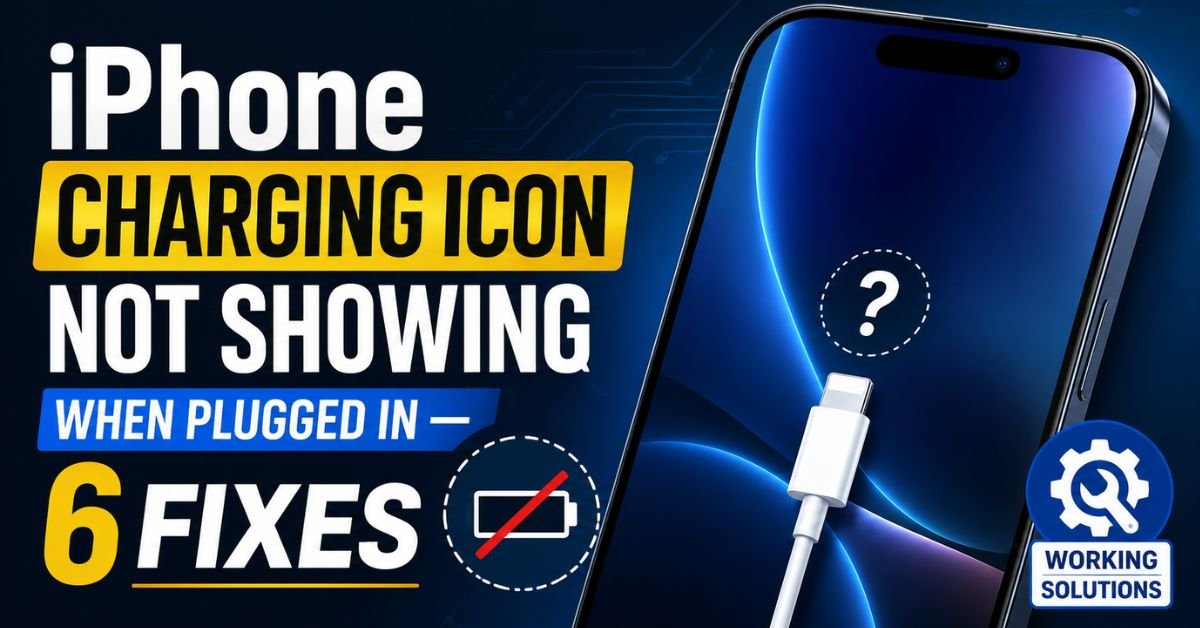
It happened to me last Tuesday. I was exhausted, ready to hit the sack, and I plugged my iPhone 15 Pro into its usual USB-C cable. I waited for that familiar ding and the little green bolt. Nothing. I unplugged it, flipped the cable (even though USB-C shouldn’t care), and tried again. Still, the screen remained as black as my coffee.
There is a specific kind of sinking feeling you get when your primary lifeline to the world refuses to acknowledge a power source. Is the port dead? Is the Lithium-ion Battery finally toast? Or did I just waste $30 on a “fast charger” that’s actually a paperweight?
Before you sprint to the nearest Apple Store and prepare to hand over half a month’s rent for a repair, take a breath. I’ve spent years tinkering with every model from the iPhone 8 to the latest titanium beasts, and I’ve learned that a missing charging icon is rarely a death sentence. It’s usually a communication breakdown between the iOS Operating System and the charging circuitry.
Here are the six fixes that have actually saved my skin (and my wallet) over the years.
Fix 1: The Deep Port Cleanse (A Hands-on Guide)
We carry our phones in our pockets. Pockets have lint. Over months, every time you plug in your Lightning Connector or USB-C cable, you aren’t just charging; you’re compacting that lint into a dense, felt-like brick at the bottom of the port.
I once had a reader tell me their port was “loose.” They thought the internal pins were bent because the cable kept falling out. In reality, the cable couldn’t seat deep enough to click.
The “Mushy” Test: When you plug your cable in, do you feel a crisp, tactile “click”? If the connection feels “mushy” or if the cable wiggles easily from side to side, you have debris.
How to clean it without breaking things: Forget the “compressed air” advice you see on generic tech blogs. Air just shoves the debris deeper into the corners. You need a surgical strike. I use a plain wooden toothpick. Avoid metal needles or paperclips—you do not want to short out the pins or scrape the delicate coating off the USB-C Port or Lightning pins.

- Turn off your iPhone.
- Use a flashlight to peer inside. You’ll likely see a greyish mass.
- Gently (and I mean gently) pick at the corners.
- You’ll be shocked at the size of the “lint monster” that comes out.
I once pulled a piece of denim thread out of an iPhone 12 that was so thick it looked like it belonged in a sweater. Once the lint was gone, the charging bolt appeared instantly.
Fix 2: Cable and Adapter Swapping Strategy
Not all cables are created equal. This is where the MFi Certification (Made for iPhone) becomes your best friend.
Apple’s iOS Operating System is incredibly picky about the Amperage and voltage it receives. If you’re using a gas-station cable, the phone might “handshake” with it for a week, but the moment you update your software, Apple’s security protocols might flag that cable as a fire hazard and stop the current entirely.
The Strategy:
- The “Wiggle” Factor: Plug the cable in and gently flex the neck near the connector. If the bolt flickers on and off, the internal copper wiring is frayed. It’s garbage.
- The Wall Adapter: People often blame the phone when it’s the Wall Adapter that died. Electronic components inside those little white cubes can fail due to heat or power surges.
- Power Delivery (PD): If you’re using an iPhone 12 or newer, ensure you’re using a 20W or higher PD-compatible brick. If you’re trying to charge a modern iPhone with an old 5W “sugar cube” from 2014, it might not even have enough “oomph” to wake the charging logic if the battery is at 0%.
Pro Tip: The “Ghost” Cable Check I’ve seen cheap cables that provide enough power to keep the phone alive but not enough to actually charge it. If your phone stays at 12% for three hours, the cable is likely failing to provide the required Amperage. Always keep one original Apple cable in a drawer strictly for “diagnostic testing.”
Fix 3: The Force Restart (The Software ‘Kickstart’)
Sometimes, the hardware is fine, but the software has “hiccuped.” The charging process is managed by a chip called the Tristar (or Hydra in newer models) and the iOS kernel. If the software that manages power stalls, the phone won’t recognize it’s plugged in.
A standard “slide to power off” won’t fix this because it doesn’t fully reset the charging controller. You need a Hard Reset.
For iPhone 8 through iPhone 15:
- Quickly press and release the Volume Up button.
- Quickly press and release the Volume Down button.
- Press and hold the Side Button (Power) and DO NOT LET GO when you see the “Slide to Power Off” slider. Keep holding until the Apple logo appears.
I’ve seen this revive “dead” phones more times than I can count. It forces the hardware to re-initialize the connection to the battery.
Fix 4: Checking Battery Health and Optimized Charging Settings
Is your phone plugged in, but stuck at 80%? This is a common “false alarm.”
Since iOS 13, Apple has included a feature called Optimized Battery Charging. It uses on-device machine learning to understand your daily charging routine. If you usually charge your phone overnight, iOS will wait at 80% and finish the last 20% right before you wake up to preserve the Lithium-ion Battery lifespan.
The “Heat” Factor: If your phone is hot to the touch—maybe you were playing a high-intensity game or left it on the dashboard—the iOS Operating System will physically cut off the power to protect the internal circuitry. You won’t see the charging icon because the phone is literally refusing to take a “sip” of electricity until it cools down.
What to check: Go to Settings > Battery > Battery Health & Charging. Check if “Clean Energy Charging” or “Optimized Battery Charging” is active. If you’re troubleshooting, toggle these off temporarily to see if the bolt reappears.
Fix 5: Wireless Charging and Software Updates
If your port is physically mangled, you aren’t necessarily out of luck. This is the ultimate “is it the port or the phone?” test.
Try placing the phone on a Qi-certified or MagSafe wireless charger. If the charging bolt appears wirelessly, you have effectively narrowed the problem down to the Lightning Connector or USB-C Port hardware.
The Mac/PC Connection: Try plugging your iPhone into a computer. Does the computer recognize it? If the computer says “USB Device Not Recognized,” but the phone doesn’t show a bolt, there’s a data-pin communication error. Sometimes, updating the iPhone via a Mac (Finder) or PC (iTunes/Apple Devices app) can clear a corrupted firmware bug that’s preventing the charging handshake.
Fix 6: Hardware Assessment and Professional Help
If you’ve cleaned the port, swapped the cable, hard reset the device, and wireless charging still won’t work, we’re looking at a deeper hardware issue.
The Flashlight Inspection: Look inside the port one last time. Do you see green or black discoloration? That’s corrosion, likely from moisture. Even a drop of rain can cause a tiny short-circuit.
The Third-Party Pitfall: I always tell my friends: be careful with “mall kiosks” for charging port replacements. Modern iPhones have very complex circuitry integrated with the microphone and speaker assemblies. A cheap, non-genuine port replacement can kill your cellular reception or make your haptic engine rattle.
If you’re still under warranty or have AppleCare+, Apple Support is your only move. They can run a remote diagnostic that checks the “cycle count” and “health status” of your battery and the integrity of the charging port pins.
Real-Time FAQs
Q: My iPhone only charges when turned off. Why?
A: This is almost always a sign of a “Tristar” chip failure or a software-handshake issue. When the phone is off, a basic, low-level hardware loop handles charging. When it’s on, the iOS Operating System takes over. If the OS detects a power fluctuation it doesn’t like (often from a non-MFi Certification cable), it rejects the charge. Try a different, high-quality cable first.
Q: Can I use a needle to clean the port if I’m very careful?
A: I wouldn’t. I once watched a friend spark his charging port because the needle touched two pins at once. Use a toothpick or a plastic dental pick. Wood and plastic don’t conduct electricity.
Q: Does a “Liquid Detected” alert mean my port is permanently broken?
A: Not at all. It just means the sensors detected moisture. Unplug the cable and let the phone sit in a dry area with some airflow (don’t use a hairdryer!) for at least 5 hours. Do not put it in rice—rice dust is worse for the port than the water was.
Q: My phone shows the “Red Battery” icon but no bolt when plugged in. What gives?
A: This usually means the battery is so depleted it doesn’t even have enough power to display the charging animation properly. Leave it on a high-wattage Wall Adapter for at least 30 minutes without touching it. Sometimes it takes a while for the Lithium-ion Battery to reach a stable voltage.
Q: My iPhone 15 Pro won’t charge with my MacBook cable. Is it broken?
A: Not necessarily. Some older USB-C cables don’t support the specific Power Delivery (PD) profile the iPhone requires. Try the cable that came in the iPhone box specifically to rule this out.
My Final Take: Ninety percent of the time, the fix is either a different cable or a tiny ball of pocket lint that’s been compacted for six months. Don’t panic. Start with the toothpick, move to the Hard Reset, and only then start looking at repair costs. Most of the time, your iPhone just needs a little “digital and physical” spring cleaning to get that bolt back on the screen.