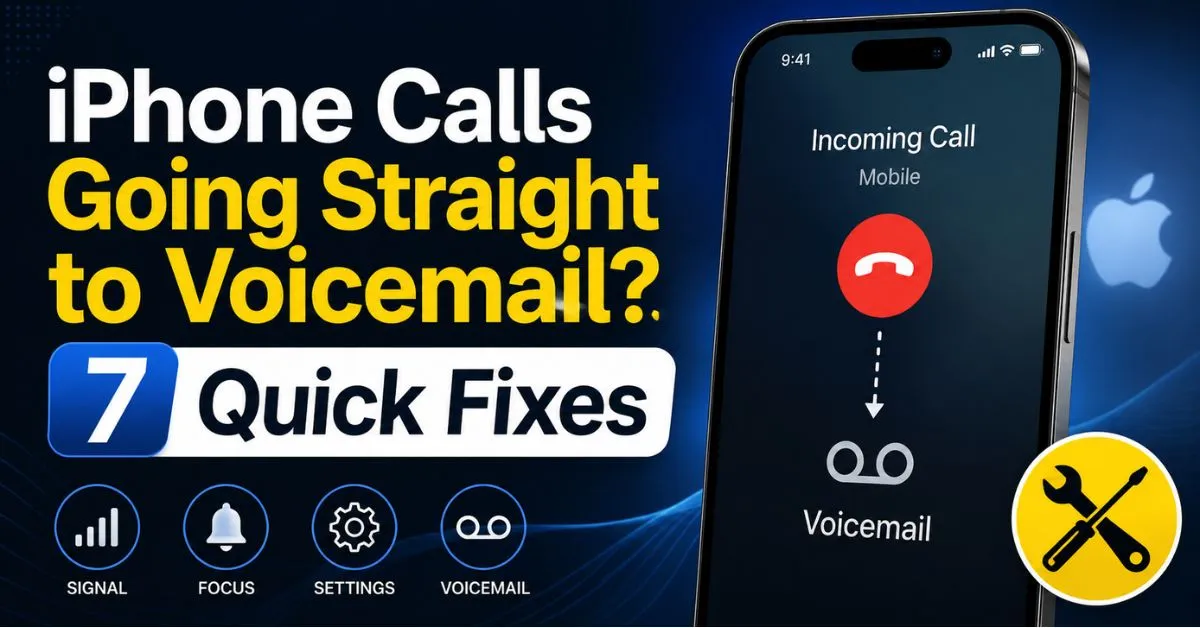
iPhone Calls Going Straight to Voicemail? 7 Quick Fixes. I still remember the afternoon I missed a crucial call from a specialist regarding my daughter’s health. I was sitting right next to my iPhone 15 Pro. The screen didn’t light up. There was no ringtone. No vibration. Two minutes later, a notification popped up: Voicemail (1).
My blood ran cold. I checked my signal—four bars of 5G. I checked the ringer switch—it wasn’t on silent. It felt like my phone had developed a mind of its own, deciding which calls were worthy of my attention and which should be banished to the voicemail server.
If you’re reading this, you’re likely in that same frustrating boat. Your iPhone is acting like a digital gatekeeper that’s a little too good at its job. Over the last decade of testing iOS builds—from the early days of iPhone OS to the latest iOS 17 and iOS 18 developer betas—I’ve realized this “Silent Voicemail” glitch is rarely one single thing. It’s usually a conflict between a deep-buried setting and how your carrier handles the “handshake” with your device.
Let’s get your ringer back.
Introduction: Why Your iPhone Isn’t Ringing
When an iPhone sends a call straight to voicemail without ringing, it’s usually because the phone told the network, “I’m busy,” or the network couldn’t find the phone in time. This isn’t just a “glitch.” It’s often the result of the sophisticated (and sometimes overbearing) “Focus” features Apple has integrated to help us disconnect.
In my experience, 80% of these cases are software-based settings. The other 20% involve “Carrier Settings” or physical SIM card degradation. Before you go sprinting to the Apple Store or calling Apple Support, we need to determine if your phone is intentionally ignoring people or if it’s accidentally losing its connection to the cellular tower.
The “Ghost” Focus Mode Scenario
One of the weirdest things I’ve encountered happened after an iOS update. My “Work” Focus mode was scheduled to turn off at 5:00 PM, but the icon in the Control Center stayed active. Even though the schedule said it was off, the system logic was stuck. The result? Every call was treated as a “Do Not Disturb” event. If your phone feels like it’s in a phantom state, a simple restart is the first step, but we’re going to look much deeper than that.
The Most Common Culprit: Focus Modes and Do Not Disturb
Focus Mode is the evolved version of “Do Not Disturb,” and it is the #1 reason calls go to voicemail. It’s powerful, but it’s also easy to mess up.
Checking the Control Center
Swipe down from the top-right corner of your screen to open the Control Center. Look at the oval button near the middle. Does it say “Do Not Disturb,” “Work,” “Sleep,” or have a “Person” icon? If it does, your phone is actively blocking notifications.
But here is the kicker: even if it looks off, your Allowed People list might be misconfigured. I’ve seen users who had “Do Not Disturb” off, but a specific “Focus Filter” was still silencing unknown numbers because of a “Smart Activation” setting they forgot they enabled.
Reviewing ‘Allowed People’ in iOS 17/18
- Go to Settings > Focus.
- Tap into each mode (especially Do Not Disturb).
- Check People. Ensure that “Allow Calls From” is set to “Everybody” if you’re expecting important calls from non-contacts.
- The “Share Across Devices” Trap: This is a big one. If you enable a Focus mode on your iPad to watch a movie, your iPhone will automatically silence itself too. I always recommend toggling Share Across Devices to OFF if you want your iPhone to remain your primary reachable device.
Scenario 2: The Silence Unknown Callers Filter
Apple introduced “Silence Unknown Callers” to combat the plague of robocalls. It’s a godsend for most, but a nightmare if you’re waiting for a call from a delivery driver, a new doctor, or a business colleague not in your address book.
When this is on, any number not in your Contacts, Mail, or Messages goes straight to voicemail. Your phone won’t even flicker.
How to fix it:
- Navigate to Settings > Phone.
- Scroll down to Silence Unknown Callers.
- Toggle it Off.
I’ve had several readers complain that their iPhone “randomly” turned this on. Usually, it happens after a “Reset All Settings” or a major iOS version jump where Apple prompts you to “Enhance your Privacy” during the setup flow. We often tap “Yes” without realizing we just blocked our plumber from calling us about that leak.
Carrier and Connectivity Troubleshooting
Sometimes the call never even reaches your iPhone’s software. If the cellular handshake fails, the carrier’s Voicemail Server assumes your phone is off or out of range and takes the call immediately.
Identifying the ‘Carrier Settings Update’
Carriers (Verizon, AT&T, T-Mobile, etc.) frequently push small files to your iPhone to tell it how to talk to their towers. If these are outdated, your “LTE/5G handshake” might be sluggish.
- Go to Settings > General > About.
- Stay on this screen for about 30 seconds. If an update is available, a pop-up will appear. If not, you’re current.
SIM Card Degradation
In a world of eSIM, we forget about the physical tray. If you still use a physical SIM card, it can get “tired.” Heat and humidity can cause micro-corrosion on the gold contacts. I’ve solved “Straight to Voicemail” issues simply by popping the tray, wiping the SIM with a microfiber cloth, and re-inserting it. If you have a very old SIM (4+ years), go to your carrier and ask for a fresh one—or better yet, migrate to an eSIM.
The Reset Network Settings Solution
This is the “Nuclear Option,” but it works. It flushes your cellular cache, Wi-Fi passwords, and Bluetooth pairings.
- Settings > General > Transfer or Reset iPhone > Reset > Reset Network Settings.
- Pros: Clears out stuck cellular logs.
- Cons: You’ll have to re-enter your home Wi-Fi password.
Hands-on Diagnostic Steps: Step-by-Step
To save you a trip to the Genius Bar, run through this diagnostic decision tree I developed while helping a client who missed ten calls in a single morning.
The “Tested by a Tech Specialist” Decision Tree
- Is it ALL calls or just SOME?
- Just some: It’s likely “Silence Unknown Callers” or a specific “Focus” contact filter.
- All calls: It’s likely “Do Not Disturb,” “Airplane Mode,” or a Carrier issue.
- Check Call Forwarding:
- Go to Settings > Phone > Call Forwarding. Make sure this is OFF. I once found a prank app that had enabled this to send all my calls to a weather hotline.
- The Bluetooth Hijack:
- This is a unique insight many miss: Are your AirPods in their case but the lid is slightly open? Or are they in another room? Sometimes the iPhone thinks it’s still connected to a Bluetooth headset and sends the “Ring” audio there. If you don’t hear it, you think it didn’t ring. Toggle Bluetooth OFF in the Control Center to test.
- Test with a Different SIM:
- If you have a friend’s phone nearby, swap SIM cards. If the problem follows the SIM, it’s a carrier/account issue. If the problem stays with the iPhone, it’s a hardware or deep software glitch.
Expert Insight: Check your “Announce Calls” setting under Settings > Phone. Occasionally, if this is set to “Headphones Only” and the phone thinks headphones are plugged in (due to debris in the lightning/USB-C port), the ringer might behave erratically.
Common Pitfalls and Mistakes to Avoid
We often look for the most complex solution while ignoring the obvious.
- The Physical Mute Switch: On older iPhones, that little toggle on the left side shows a sliver of orange when muted. On iPhone 15 Pro and later, the Action Button might be mapped to “Silent Mode.” I’ve seen people accidentally trigger this in their pockets.
- The “Scheduled” DND: Check your “Sleep” schedule in the Health app. Even if you aren’t in bed, if the Health app thinks you should be sleeping, it will trigger the Sleep Focus and silence your world.
- Neglecting iOS Updates: Apple frequently releases “point” updates (like iOS 17.4.1) specifically to fix “Cellular Connectivity” bugs reported by carriers. If you’re three versions behind, you’re essentially running buggy code that Apple has already patched.
Frequently Asked Questions
1. Why do my calls go to voicemail even when Do Not Disturb is off?
This is usually caused by the “Silence Unknown Callers” feature or a “Call Blocking” app like Hiya or RoboKiller. These apps act as a firewall between your carrier and your phone. If the app’s database incorrectly flags a number as spam, it will kill the call before your phone rings.
2. Can a weak 5G signal cause calls to go straight to voicemail?
Absolutely. This is called a “Dropped Handshake.” If your phone is in the middle of switching from 5G to LTE (a process called ‘handover’) exactly when a call comes in, the network may fail to locate your device and default to voicemail. Try switching your Voice & Data settings to “LTE” only for a day to see if the problem persists.
3. Does Airplane Mode affect voicemail?
If Airplane Mode is on, your cellular radio is off. Your carrier sees your device as “Disconnected” and will immediately route all incoming traffic to the voicemail server. Always ensure the “Airplane” icon isn’t glowing orange in your Control Center.
4. What if my phone only rings when it’s unlocked?
This is a classic “Focus Mode” behavior. Many Focus settings allow notifications when the phone is active but silence them when the screen is locked. Re-check your Focus settings and ensure “Silence Notifications” is set to “Always” or “While Locked” depending on your preference.
5. My iPhone shows the call, but it only rings once before stopping. What is that?
Check your “Attention Aware Features” under Settings > Face ID & Attention. If your iPhone sees you looking at it, it will automatically lower the volume of the ringer because it knows it has your attention. If it’s going to voicemail after one ring, check with your carrier about your “Ring Time” settings—sometimes this is set to 5 or 10 seconds on their end, which isn’t enough time for you to answer.
By systematically walking through these steps, you’re doing exactly what a technician would do. Start with the software (Focus/Settings), move to the hardware (SIM/Mute Switch), and end with the network (Carrier/Reset). Usually, the culprit is hiding in plain sight, tucked away in a sub-menu designed to “help” you stay focused. Turn those gatekeepers off, and let the calls through!