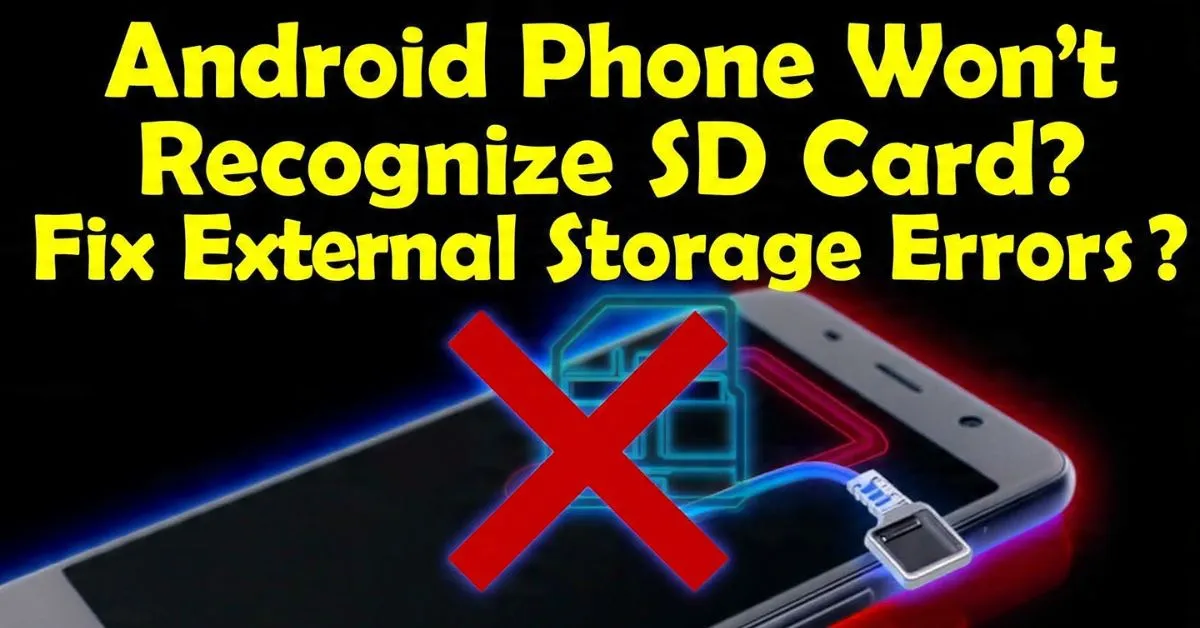
I remember the sinking feeling in my gut last summer. I was out in the mountains, about to snap a panoramic shot of the sunset on my Samsung Galaxy, when a notification popped up: “SD card unexpectedly removed.” My 256GB microSDXC, loaded with three years of travel photos, had vanished into thin air. No matter how many times I rebooted, the phone acted like the slot was empty.
If you’re staring at your screen right now, frustrated because your Android phone won’t recognize SD card entries or keeps throwing “unsupported error” messages, I’ve been in your shoes. I’ve spent the last decade tearing down phones and troubleshooting everything from the Android 15 update bugs to physically mangled SIM trays.

The good news? Most of the time, your data isn’t gone. It’s just stuck behind a software glitch or a bit of physical grime. Let’s walk through how to fix external storage errors using the same steps I use on my own devices.
Also Reade : Complete Android Fix Guide: Every Android Problem Solved (2026)
Real-World Scenarios: When Your SD Card Goes Missing
It’s rarely a clean break. Usually, you’ll see one of these three frustrating patterns:
- The “Card Removed” Loop: You’re using the phone normally, and suddenly it tells you the card was removed. Then it remounts. Then it drops again. This is often a sign of Android SD card keeps disconnecting due to a loose tray or a dying controller.
- The Ghost Files: The card is “detected” in settings, but your Gallery is empty. This usually points to a corrupted cache or a Media Storage system app failure.
- The “Blank SD Card” Warning: This is the scary one. Android sees the card but says it’s unsupported or has an incompatible file system.
Before we panic and hit “Format,” we need to figure out if the card is physically “fried” or if Android is just having a mid-life crisis. A quick way to tell? If the card gets scorching hot to the touch after being in the phone for five minutes, the internal flash controller is likely shorted. If it stays cool, we have a fighting chance.
Hands-On Hardware Diagnostics
I can’t tell you how many people I’ve “saved” just by using a $0.50 office supply. Before messing with settings, we need to ensure the physical connection is solid.
The “Eraser Trick” for Cleaning Contacts
MicroSD cards use tiny gold-plated pads for data transfer. Over time, these can develop a microscopic layer of oxidation—especially if you live in a humid climate or have dealt with Android SD card issue after water damage.

Take a standard pencil eraser (the pink kind works best) and gently rub the gold contacts on the back of the card. You’re looking to buff them until they’re shiny. Don’t use water or harsh chemicals; they can seep into the casing. I’ve seen this fix Android SD card not detected issues more often than any software “hack.”
Inspecting the Tray and Slot
Check your SIM/SD tray. Is it bent? Even a half-millimeter warp can prevent the pins from meeting the microSDHC or microSDXC pads. If you’ve recently dropped your phone, the Android SD card reader not working might be due to a dislodged spring inside the motherboard slot.

Software Fixes Within the Android OS
If the hardware is clean, the problem is likely how the OS is Mounting (computing) the drive.
Forced Mounting and Cache Clearing
Sometimes the system UI bug just needs a nudge.
- Go to Settings > Storage.
- Look for “SD Card.” If it says “Disconnected,” tap it and try to select Mount.
- If that fails, we need to clear the Media Storage cache. This is a hidden system app that indexes your files.
- Go to Settings > Apps.
- Tap the “Filter and Sort” icon and toggle on Show system apps.
- Find Media Storage and External Storage.
- Clear Cache and Clear Data for both, then reboot.
The Android 14 & 15 Update Bug
I’ve noticed a spike in Android SD card issue after Android 15 update reports. Google has been tightening storage permissions, and sometimes the update breaks the link to the card. If you’re on a Samsung Galaxy or Pixel phone, try resetting your app preferences (Settings > System > Reset Options > Reset app preferences). It won’t delete your data, but it will force the OS to ask for storage permissions again.
Expert Insight: If your phone is overheating while charging, Android might temporarily unmount the SD card to protect the Storage Class Memory from thermal damage. This is a safety feature, not a bug!

Advanced Recovery: Using a PC to Fix the Card
When the phone says “SD card corrupted,” it usually means the File Allocation Table (FAT) or exFAT header is scrambled. Your PC is much better at repairing these than your phone is.
Using CHKDSK to Repair Bad Sectors
Don’t format yet! If you have a PC and a card reader, try this:
- Plug the card into your PC. Note the drive letter (e.g., E:).
- Open Command Prompt as Administrator.
- Type
chkdsk E: /f(replace E with your letter). This tool looks for Bad Sectors and I/O Errors. It can often fix the file system without touching your photos.
Choosing the Right Format: FAT32 vs. exFAT
If you must format, the file system matters.
- FAT32: Great for older phones and cards under 32GB. It’s stable but has a 4GB file size limit (annoying for long 4K videos).
- exFAT: The standard for microSDXC (64GB+). Most modern Xiaomi devices, OnePlus phones, and Motorola units prefer this.
Pro Tip: Always perform a “Full Format” rather than a “Quick Format” if the card has been acting up. A full format checks every single sector for health, whereas a quick format just wipes the index.

Common Pitfalls and How to Prevent Future Failure
The “Fake SD Card” Epidemic
I’ve seen dozens of clients bring in “1TB” cards they bought for $15 online. These are counterfeit cards. They are actually 8GB or 16GB cards with hacked firmware that tells the phone they are larger. Once you exceed the real capacity, they start overwriting your old data, causing a total SD card inaccessible fix nightmare. Use a tool like H2testw on your PC to verify the real capacity of any new card.
Adoptable Storage: The Double-Edged Sword
Android has a feature called “Adoptable Storage” where it treats the SD card as internal memory. Do not do this unless you have a high-speed (V30 or U3) card. If you use a cheap, slow card, it will cause your whole phone to lag, and if that card dies, your phone might not even boot properly. I always recommend keeping the SD card as “Portable Storage.”
Safe Removal and Power Management
Never pull the card out while the phone is on without “Unmounting” it in settings first. This is the #1 cause of interrupted formatting and damaged partitions. Also, check your power saving mode; some aggressive battery savers on Oppo or Vivo phones cut power to the SD slot when the screen is off, causing random unmounting.
Troubleshooting Guide: Brand-Specific Quirks
- Samsung Galaxy: Often struggles with Read/Write Protection. Use the “My Files” app to check if the card is set to “Read Only.”
- Xiaomi/Realme: These phones are notorious for Android SD card issue because of third party apps like cleaner tools. Uninstall any “Booster” apps that might be interfering with storage mounting.
- Pixel Phones: Since Pixels don’t have SD slots, you’re likely using an OTG adapter. Ensure the adapter supports the Android SD card issue with OTG adapters power requirements.
Fixing an Android SD card issue is usually a process of elimination. Start with the eraser, move to the system cache, and use the PC as a last resort. If you’ve tried everything—including Android Debug Bridge (ADB) commands to force a reformat—and the card still won’t show up on any device, it’s time to admit defeat. Flash memory has a limited lifespan, and sometimes, the hardware just gives up the ghost.
My final piece of advice? Cloud backup is your best friend. Even the best microSDXC card in the world is just a tiny piece of plastic that can fail. Keep your photos synced to Google Photos or Dropbox, so the next time your phone says “SD Card Missing,” it’s just a technical annoyance, not a digital tragedy.