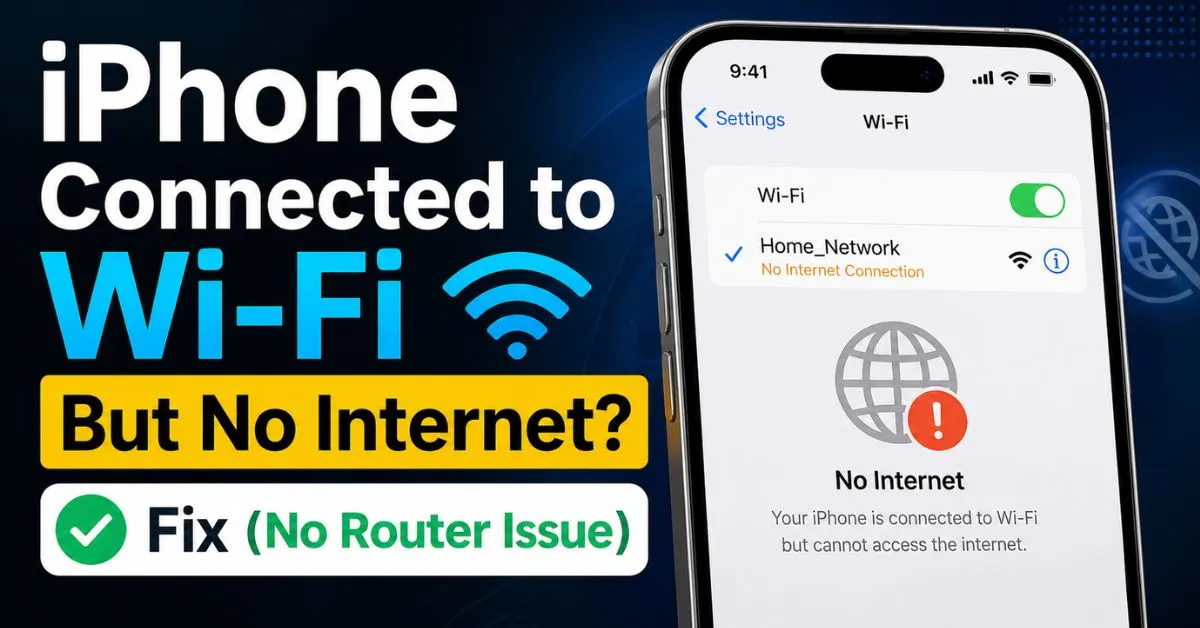
iPhone Connected to Wi-Fi But No Internet? Fix (No Router Issue).There is a specific kind of digital purgatory reserved for the moment you see that blue checkmark next to your Wi-Fi name, followed immediately by the soul-crushing subtext: “No Internet Connection.”
I’ve spent over a decade as a mobile technician, and I’ve seen this exact scenario play out hundreds of times. You’ve already done the “router dance”—unplugged it, waited thirty seconds, plugged it back in. You’ve checked your iPad, your roommate’s Android, and even your smart fridge, and they’re all streaming 4K video without a hitch.
This isn’t a router problem. This is the “Only My iPhone” syndrome.
When your iPhone establishes a handshake with a wireless access point but refuses to route data, the issue usually lies deep within the iOS network stack, a conflict in the DHCP assignment, or a security feature that is a little too overzealous for its own good. Let’s stop blaming the ISP and fix the actual culprit: your phone.
Step 1: Addressing the ‘Private Wi-Fi Address’ Conflict
Back when iOS 14 dropped, Apple introduced a feature called “Private Wi-Fi Address.” It was a win for privacy advocates but a nightmare for network stability. Essentially, your iPhone stops using its hardware MAC Address and starts generating a random one for every network it joins.
I remember a client who came into my shop because his iPhone would work for exactly ten minutes on his office Wi-Fi and then drop the connection. It turned out the office router had a security protocol that flagged “new” devices. Every time his iPhone randomized its ID, the router thought an unauthorized device was trying to spoof the network and cut the data flow.
How to disable it (for testing):
- Open Settings and tap Wi-Fi.
- Tap the “i” (info) icon next to your connected network.
- Toggle off Private Wi-Fi Address.
- Disconnect and reconnect.
By turning this off, you’re providing the router with your device’s static hardware identity. If your internet suddenly springs back to life, you’ve found your culprit.
Insider Note: MAC randomization is great for public hotspots at Starbucks, but it can confuse older 802.11 routers or enterprise-grade systems that rely on consistent device identification for IP Address allocation.
Step 2: DNS and IP Address Troubleshooting
If the MAC address isn’t the issue, we need to look at the “negotiation” between your iPhone and the Router Gateway. Sometimes, the DHCP (Dynamic Host Configuration Protocol) server fails to hand your iPhone a valid IP Address or Subnet Mask.
If you see an IP address starting with 169.254.x.x, your iPhone has “self-assigned” an address because it couldn’t hear back from the router. You’re essentially in a room alone, talking to yourself.
The ‘Renew Lease’ Trick
Before you go changing settings, try the “Renew Lease” button. It’s located at the bottom of your Wi-Fi network’s info page. This forces the iPhone to ask the router for a fresh set of credentials. It’s the digital equivalent of saying, “Let’s start this conversation over.”
Manual DNS: Bypassing ISP Hang-ups
Often, the connection is fine, but the DNS (Domain Name System) is broken. Think of DNS as the phonebook of the internet. If your phone can’t look up “google.com,” it can’t load the page.
I’ve found that switching to a third-party DNS provider fixes “No Internet” issues about 40% of the time.
- In your Wi-Fi settings, tap Configure DNS.
- Switch from Automatic to Manual.
- Delete the existing servers and add Google’s DNS:
8.8.8.8and8.8.4.4. - Alternatively, use Cloudflare:
1.1.1.1.
Step 3: The VPN and Proxy Content Trap
This is the “Ghost VPN” scenario. I once spent two hours diagnosing a friend’s iPhone only to find out they had an old Ad-Blocker VPN profile that was trying to route traffic through a server that had been shut down three years ago.
Even if your VPN app says “Disconnected,” there might be a background process or a Proxy Server configuration lingering in your iOS settings.
Checking for Interference:
- VPN Profiles: Go to Settings > General > VPN & Device Management. If you see anything there that you don’t recognize or haven’t used in months, delete the profile.
- Limit IP Address Tracking: This is a newer iOS feature found under Settings > Wi-Fi > [Your Network]. It’s designed to hide your IP from known trackers in Mail and Safari, but it can occasionally cause a conflict with certain router firewalls. Try toggling it off.
Hands-on Scenarios: Public Wi-Fi and Captive Portals
We’ve all been there: you join the airport or hotel Wi-Fi, the checkmark appears, but nothing loads. This is usually because a Captive Portal (the login page) failed to trigger.
Your iPhone is waiting for you to “Sign In,” but because the browser won’t pop up, you’re stuck in a stalemate.
The ‘Forced’ Login Hack
If the login page doesn’t appear automatically, open Safari and type captive.apple.com into the address bar. This is a non-secure (HTTP) site that Apple uses specifically to trigger these portal redirects. Since it isn’t encrypted, the router can easily hijack the request and redirect you to the “I agree to the terms” page.
The Low Data Mode Pitfall
Check if Low Data Mode is enabled in your Wi-Fi settings. While it shouldn’t completely kill your internet, it can stop background syncs, Mail downloads, and specific app functions to the point where it feels like the internet is dead.
Pro Tip: If you’re on a public network and things are slow, check if Wi-Fi Assist is on (Settings > Cellular). If your Wi-Fi is weak, iOS might be trying to flip to cellular, but if your cellular signal is also bad, you’ll end up with no data at all.
Step 4: The Nuclear Option — Reset Network Settings
I call this the nuclear option because it’s a bit of a pain, but it is incredibly effective. When you Reset Network Settings, you are wiping out all saved Wi-Fi passwords, Bluetooth pairings, and VPN configurations. You’re effectively resetting the entire network driver stack to factory defaults.
What stays safe: Your photos, messages, and apps are untouched. What gets deleted: Your Wi-Fi passwords. Make sure you know your home password before you do this!
How to do it:
- Go to Settings > General.
- Scroll to the bottom and tap Transfer or Reset iPhone.
- Tap Reset and select Reset Network Settings.
After the reboot, your iPhone will act like it’s the first time it’s ever seen a Wi-Fi signal. In my experience, this fixes 95% of software-based “No Internet” bugs.
Common Pitfalls to Avoid During Troubleshooting
- Date & Time Desync: This sounds stupid, but if your iPhone’s date is manually set to 2014, almost every website will fail to load because of SSL certificate errors. Your phone will think the certificates aren’t valid yet (or have expired). Ensure Set Automatically is toggled on in Date & Time settings.
- Parental Controls: I’ve had parents bring in phones because “the internet doesn’t work,” only to find out they set a “Screen Time” limit that cut off Safari after 8 PM. Check Settings > Screen Time > Content & Privacy Restrictions.
- Airplane Mode “Sticky” State: Occasionally, the radio firmware gets stuck. Toggle Airplane Mode on, wait 10 seconds, and toggle it off. It’s a cliché for a reason—it works.
Expert Insight: Why iOS Updates Matter
Occasionally, a specific iOS version has a known bug with certain Wi-Fi chipsets. For example, during the early days of iOS 15, there were documented issues with Wi-Fi drops on the iPhone 12 series. Always check Settings > General > Software Update. If there’s a patch waiting, it likely contains the firmware fix for the very problem you’re experiencing.
Frequently Asked Questions
Q: Why does my iPhone say “No Internet Connection” but my laptop works fine? A: This is usually due to device-specific settings like Private Wi-Fi Address or a corrupted DHCP lease. Your laptop has a different MAC address and a different “handshake” with the router. If the router is working for other devices, the issue is how your iPhone is identifying itself to the network.
Q: Will resetting my network settings delete my eSIM or cellular plan? A: No. Reset Network Settings focuses on Wi-Fi, Bluetooth, and VPN profiles. Your cellular plan and eSIM data will remain intact, though you may briefly lose signal while the radio stack reboots.
Q: I changed my DNS to 8.8.8.8, but it still doesn’t work. What now? A: If DNS doesn’t fix it, the problem is likely at the IP Address layer. Check if you have a valid IP (not starting with 169). If you do have a valid IP, the issue might be a VPN profile or an App-specific restriction. Try disabling any security apps like Norton or McAfee for mobile.
Q: What is a Captive Portal, and why is it breaking my connection? A: A captive portal is a “gate” used by hotels or coffee shops. Your iPhone connects to the Wi-Fi, but the router blocks all internet traffic until you verify your room number or email. If your iPhone doesn’t “see” the gate, it stays blocked. Using captive.apple.com in Safari forces that gate to open.
Q: Can a hardware failure cause “Connected, No Internet”? A: It’s rare. Usually, hardware failure results in the Wi-Fi toggle being greyed out or the phone being unable to see any networks at all. If you can see the network and connect to it, the hardware is likely fine, and the issue is purely configuration or software-based.