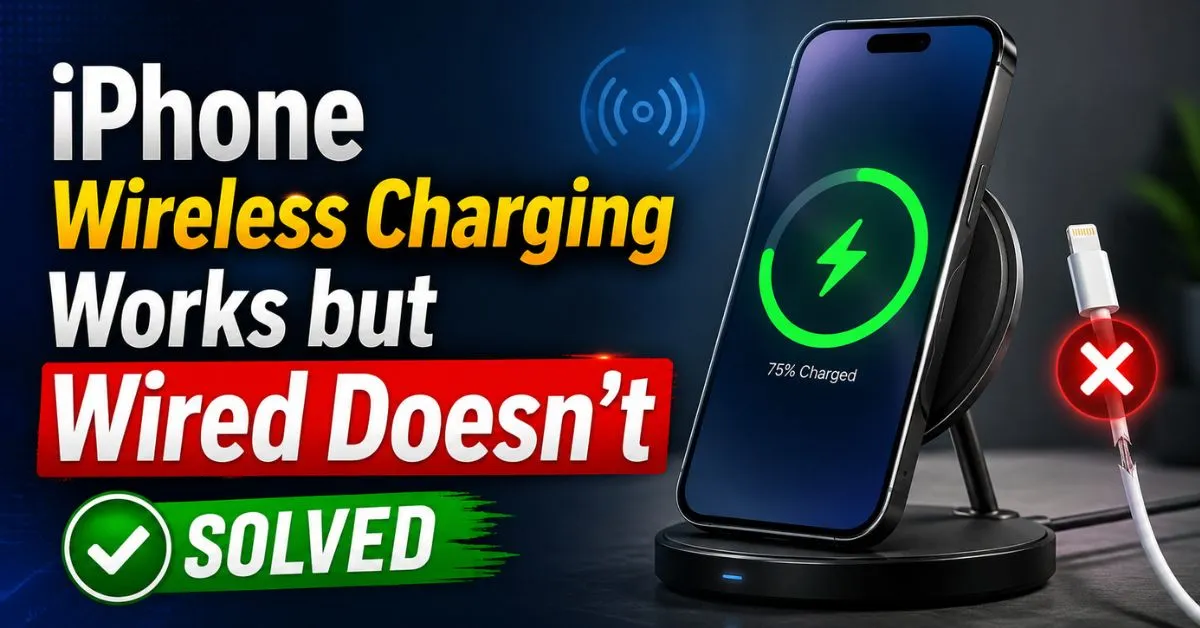
iPhone Wireless Charging Works but Wired Doesn’t — Solved. I remember the exact moment my iPhone 13 Pro decided to give me the silent treatment. I was at a rest stop halfway through a six-hour drive, my battery was sitting at a terrifying 4%, and when I plugged in my reliable braided cable, nothing happened. No “ding,” no lightning bolt icon—just a cold, dead piece of glass. Panic set in. However, when I set it down on the car’s built-in wireless pad, it hummed to life immediately.
This is the “Charging Paradox.” Your iPhone isn’t technically dead, but its primary lifeline—the physical port—is out of commission. It’s a frustrating, confusing middle ground. Why does inductive charging work perfectly while the physical connection fails? After years of tinkering with hardware and helping dozens of people with this exact issue, I’ve realized it usually comes down to three things: dirt, degraded hardware, or a very specific chip failure on the logic board.
Introduction: The Charging Paradox
When your iPhone accepts power wirelessly but rejects a cable, it tells us something very important: the Lithium-ion battery itself is healthy enough to hold a charge, and the power management system is still operational. We’ve successfully isolated the problem to the “wired” path.
Wired and wireless charging are essentially two different highways leading to the same city. Wireless charging uses a copper coil on the back of the phone to catch an electromagnetic field (inductive charging). Wired charging relies on a physical hand-shake between the Lightning connector (or USB-C on newer models) and the phone’s internal circuitry.
If your phone is behaving this way, you might notice “ghost touching” when you do manage to get a cable to work, or perhaps the cable only charges when held at a precise, awkward angle. These are the battle cries of a failing port.
The #1 Reason: Physical Obstructions in the Port
You might think your pockets are clean. You’re wrong. Over months of use, the bottom of our pockets becomes a collection point for lint, hair, and microscopic debris. Every time you plug your phone in, you aren’t just connecting a cable; you are physically compacting that lint into the back of the port.
I once helped a friend who swore her port was broken. I took a macro lens to it and what I saw looked like a bird’s nest. We pulled out a piece of blue denim lint the size of a grain of rice. That tiny cushion was preventing the cable pins from making a “click” connection.
Tools You Need (And Tools to Avoid)
To clean this out, you need something thin and non-conductive.

- The Best Tool: A wooden or plastic toothpick, or a plastic dental pick.
- The Professional Tool: A specialized anti-static brush.
- The “Never Use” List: Sewing needles, safety pins, or paperclips. Metal tools can easily short-circuit the gold-plated pins or cause galvanic corrosion if there’s any residual moisture in there.
Step-by-Step Port Excavation
- Power down the iPhone. This is a safety precaution for the logic board.
- Use a bright light. You need to see the very bottom of the port.
- Gently scrape. Insert the toothpick and move it in a “C” shape along the back wall. Don’t jab; think of it like sweeping a floor.
- The “Compressed Air” Finish: Once you’ve loosened the big chunks, a quick blast of compressed air can blow out the finer dust.
Expert Insight: If you don’t feel a distinct, tactile “click” when you plug your cable in, there is almost certainly debris in the port. A flush fit is mandatory for the handshake to occur.
Testing the Hardware: Cables and Bricks
Sometimes the phone is fine, but the accessories are lying to you. I’ve seen cables that look brand new on the outside but have suffered internal fractures from being bent at the bedside.
The MFi Program Mystery
Apple’s MFi Program (Made for iPhone/iPad) isn’t just a marketing ploy to make things more expensive. MFi cables contain a small authentication chip. If that chip fails or if you’re using a cheap $2 gas station cable, the iOS firmware might allow the cable to provide a tiny bit of power but refuse to actually “charge” the battery to protect the hardware.
The Wiggle Test
Try this: Plug your cable in and gently—very gently—wiggle the connector up and down. If the charging bolt flickers on and off, the internal pins of the port have likely become desoldered from the flex cable, or the springs inside the port have lost their tension. This is a hardware failure that cleaning won’t fix.
Software Glitches and Charging Logic
It sounds weird, but sometimes the software is the gatekeeper. The iPhone has a complex “charging logic” managed by the operating system.
The “Liquid Detected” Alert
If your phone even thinks it feels moisture in the port, it will disable wired charging to prevent a short circuit. Sometimes, this alert gets stuck in a “false positive” loop. Even if the port looks dry, a tiny bit of humidity can trigger it.
I’ve found that performing a Force Restart (Volume Up, Volume Down, then hold the Side Button until the Apple logo appears) often resets the charging controller’s state and clears these phantom alerts.
iOS Firmware Updates
Occasionally, a bug in a specific iOS version affects power management. Check for updates while on wireless charging. Apple often pushes “under the hood” stability fixes for the U2 IC chip communication protocols in their point-updates (like 17.4 to 17.4.1).
Internal Damage: When It’s Not Just Lint
If you’ve cleaned the port and tried three different MFi-certified cables and it still won’t charge via wire, we have to look at the “brain” of the charging system.
The U2 Power IC Chip
This is the “traffic cop” of your iPhone’s logic board. The U2 IC chip (also known as the Tristar or Hydra chip in various models) is responsible for identifying what is plugged into the port.
If you’ve used a high-voltage, non-certified car charger, you might have fried this chip. A classic symptom of U2 failure is a phone that charges fine wirelessly but won’t recognize a cable, or a phone that “fake charges” (shows the lightning bolt but the percentage stays the same or goes down). This is a professional repair job involving microsoldering.
Galvanic Corrosion
If you’ve ever dropped your phone in water, even if you dried it out, a process called galvanic corrosion can begin. Look into the port with a flashlight. Do the pins look green or black? That’s corrosion. It eats away the gold plating and creates a high-resistance barrier that power can’t cross. While 90% isopropyl alcohol on a fine brush can sometimes save it, usually, the entire dock connector assembly needs replacement.
Preventive Maintenance for iPhone Longevity
Once you get your wired charging back (or if you’re forced to rely on wireless for a while), you need to change your habits to prevent a total hardware blackout.
- Use Port Plugs: You can buy tiny silicone plugs for a few cents. They keep the lint out, meaning you never have to “scrape” the port again.
- Avoid “Cheating” the Cable: We all do it—resting the phone on our chest while lying down, which bends the cable at a 90-degree angle. This ruins the port’s internal pins over time.
- Optimized Battery Charging: Keep this setting ON in your battery settings. It reduces the wear on the Lithium-ion battery by waiting to finish charging past 80% until you need it, which also keeps the charging port from staying “hot” for extended periods.
Frequently Asked Questions
Q: Can I use WD-40 or contact cleaner to fix a non-working port?
A: Absolutely not. WD-40 is an oil and will attract even more gunk, potentially ruining the screen’s adhesive. While specialized “Electronic Contact Cleaner” is okay in tiny amounts, it’s usually overkill and can damage the microphone or speaker membranes located right next to the port. Stick to a dry toothpick.
Q: Why does my phone charge wirelessly but get extremely hot?
A: Inductive charging is less efficient than wired charging. Much of the energy is lost as heat. If the phone gets too hot, the software will pause charging at 80%. This is normal, but it’s why wired charging is still the superior method for long-term battery health.
Q: How much does it cost to replace a charging port if cleaning doesn’t work?
A: If you have AppleCare+, it’s usually a very small fee (or free if determined to be a defect). Out of warranty, a local repair shop typically charges between $70 and $120 depending on the model. It’s a labor-intensive repair because the entire phone usually has to be gutted to reach the dock flex cable.
Q: Is it safe to only use wireless charging and never fix the port?
A: Technically, yes. You can live a “portless” life. However, you won’t be able to easily transfer data to a computer, use wired CarPlay, or perform a manual “DFU restore” if your software ever crashes. It’s a risky way to live.
Q: I see “Liquid Detected” but my phone is dry. What now?
A: This is often caused by debris that has absorbed humidity from the air. Clean the port as described above. If the error persists, try leaving the phone in a dry area with a fan blowing directly into the port for 24 hours. Avoid the “rice” trick—rice grains can get stuck in the port and the starch actually causes more damage.