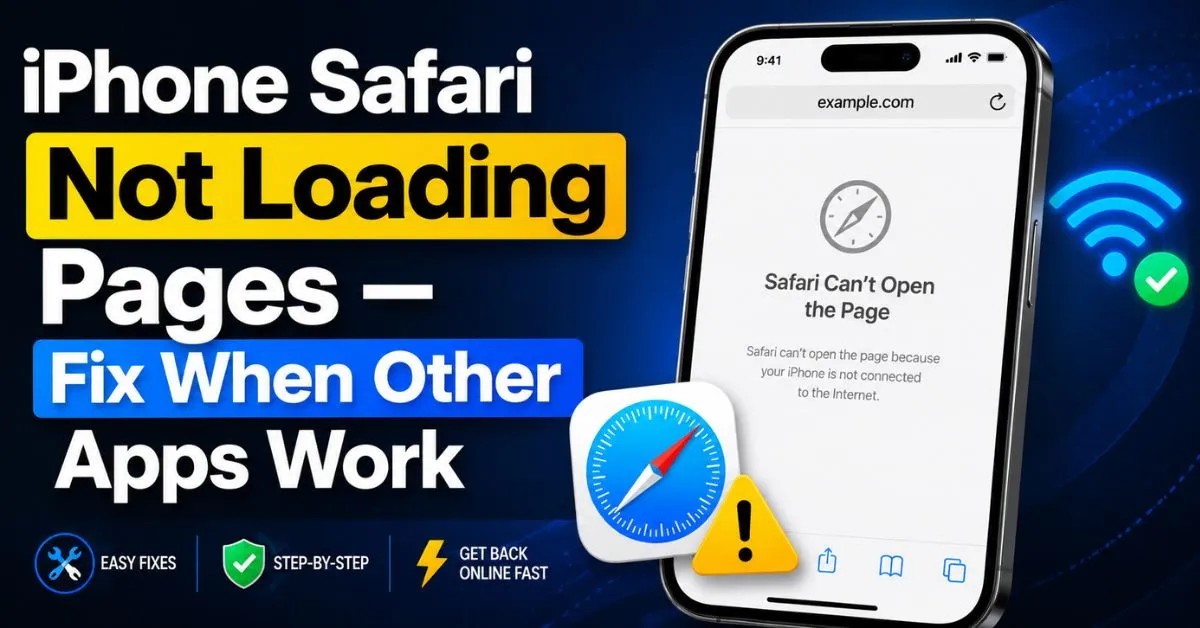
I was sitting in a crowded terminal at JFK last month, trying to pull up my digital boarding pass in Safari. My iPhone 15 Pro showed full 5G bars. Instagram was refreshing perfectly. Slack notifications were buzzing. But Safari? It was stuck on a blank white page, the progress bar mocking me at about 10% completion.
It’s one of the most maddening glitches in the iOS ecosystem. Your internet is clearly working—you’re literally watching a YouTube video in another app—yet Safari refuses to fetch a single byte of data. It feels like the browser has just decided to go on strike.
Over the years of testing beta profiles and troubleshooting my own devices, I’ve realized this isn’t usually a “bad signal” problem. It’s almost always a breakdown in the complex handshake between Apple’s WebKit engine, your DNS settings, and privacy features like iCloud Private Relay. Let’s walk through how to actually fix this without losing your mind.
Identifying the Specific Safari Connectivity Issue
Before we start toggling switches, we need to confirm this is a “Safari-only” problem. If your Mail app isn’t syncing and Spotify won’t stream, you have a general network issue. But if it’s just the browser, you’re dealing with a software or configuration bottleneck.
Usually, you’ll see one of two things. Either the “Safari cannot open the page because the server cannot be found” error pops up instantly, or the page just hangs indefinitely. I’ve found that the “server cannot be found” error is often a DNS or IP tracking issue, while the infinite hanging usually points toward a corrupted cache or a stalled WebKit process.
Try opening a site you never visit. If google.com won’t load but wikipedia.org does, you might just be looking at a site-specific outage. But if the entire web is dark while your other apps are bright and sunny, it’s time to dig into the settings.
Quick Fixes to Try First
I know it sounds like “Tech Support 101,” but there’s a technical reason why force-closing the app and toggling Airplane Mode are my first steps.
When you force-close Safari (swipe up from the bottom and flick the app card away), you aren’t just hiding the window. You are killing the active WebKit instance. Sometimes, the rendering engine gets stuck in a loop trying to process a malformed script from a previous tab. Killing the app forces a fresh start.

Next, toggle Airplane Mode for about 10 seconds. This does more than just disconnect you; it forces the iPhone’s radio stack to re-register with the nearest cell tower or Wi-Fi node. It essentially flushes the temporary local IP assignment and forces a new handshake. If your Safari was stuck because of a “stale” connection transition between Wi-Fi and LTE, this usually snaps it back to life.
If those don’t work, do a hard restart. For the iPhone 15 Pro (and most recent models), it’s a quick press of Volume Up, Volume Down, and then holding the Side Button until the Apple logo appears. This clears out the system-level background processes that might be hogging the network’s attention.
Deep Cleaning Safari Cache and Data
If the “quick fixes” didn’t cut it, we need to look at Cache Corruption. Every time you visit a site, Safari stores bits of data to make it load faster next time. If one of those files gets corrupted, the browser might try to load that broken file instead of fetching a fresh version from the web.
Navigate to Settings > Safari. Scroll down and you’ll see Clear History and Website Data.
Now, here is a nuance I learned the hard way: Apple now gives you a timeframe. You can clear the “Last Hour,” “Today,” or “All History.” If Safari has been acting up all day, go for “All History.”
Warning: This will sign you out of most websites. It’s a pain to re-enter passwords, but it’s the only way to ensure a poisoned cache isn’t the culprit.
I once spent three days trying to fix a Safari glitch on my iPad, only to realize a single corrupted cookie from a news site was crashing the entire browser’s ability to resolve new URLs. Cleaning the slate solved it instantly.
Troubleshooting iCloud Private Relay and Privacy Settings
This is the most common “modern” reason for Safari failing while other apps work. iCloud Private Relay is a brilliant privacy feature, but it essentially acts as a dual-hop proxy. Your traffic is encrypted and sent through two different relays (one managed by Apple, one by a third-party partner like Cloudflare or Akamai).
If the second relay in that chain is having a hiccup, Safari will simply stop loading pages. Since most other apps bypass Private Relay and connect directly to the internet, they remain unaffected.
- Go to Settings > [Your Name] > iCloud > Private Relay.
- Toggle it Off.
- Choose “Turn Off Until Tomorrow” or “Turn Off.”
Wait a few seconds and try Safari again. If it works, you’ve found the culprit.
Related to this is the “Limit IP Address Tracking” setting. This is found under Settings > Wi-Fi, then tap the “i” next to your network. If this is on, your iPhone tries to mask your IP from known trackers using a system similar to Private Relay. Sometimes, local network configurations (like those in hotels or offices) hate this and will block the connection entirely. Try disabling it for your specific Wi-Fi network to see if the pages start flowing again.
Advanced Network and DNS Tweaks
If you’re still staring at a white screen, we need to look at the DNS (Domain Name System). Think of DNS as the phonebook of the internet. It turns “google.com” into an IP address. By default, your iPhone uses the DNS provided by your ISP or Wi-Fi router. These are notoriously slow and prone to crashing.
I personally use Cloudflare’s DNS (1.1.1.1) or Google’s (8.8.8.8) on all my devices. It’s faster and much more reliable.
How to change DNS on iPhone:
- Go to Settings > Wi-Fi.
- Tap the blue (i) icon next to your connected network.
- Scroll down to Configure DNS and set it to Manual.
- Remove the existing servers and add
1.1.1.1and1.0.0.1. - Hit Save.
Another thing to check is your VPN. Even if a VPN app says it’s “Disconnected,” sometimes the configuration profile it installed is still trying to force traffic through a virtual tunnel that no longer exists. If you have a VPN installed, go to Settings > General > VPN & Device Management and ensure no “ghost” VPN is trying to connect.
Pro Tip: The Content Blocker Trap If you use ad-blockers like AdGuard or 1Blocker, they operate as extensions within Safari. A buggy update to an ad-blocking list can tell Safari to “block” almost everything on a page, leaving you with a blank screen. Go to Settings > Safari > Extensions and toggle everything off. If Safari starts working, re-enable them one by one to find the offender.
The Nuclear Option: Network Resets and Updates
When all else fails, and you’ve confirmed it’s not a DNS issue or a Private Relay glitch, it’s time to reset the TCP/IP Stack.
On an iPhone, this is called Reset Network Settings. It’s located under Settings > General > Transfer or Reset iPhone > Reset > Reset Network Settings.
This is the “nuclear option” because it deletes every Wi-Fi password you’ve ever saved. It also clears your Bluetooth pairings and VPN settings. However, it completely flushes the low-level network configurations of the OS. If there is a deep-seated bug in how iOS is handling its network handshake, this is the only way to kill it. I’ve seen this fix Safari issues that survived even a full iOS update.
Finally, check for an iOS Update. Apple frequently releases “point” updates (like 17.4.1) specifically to patch bugs in the WebKit engine. Since Safari is tied directly to the OS, you can’t update the browser through the App Store—it only gets better when the whole phone gets an update.
Real-Time FAQs
Q: Why does Chrome work on my iPhone but Safari doesn’t?
A: This is a bit of an illusion. On iOS, all browsers (Chrome, Firefox, Edge) are forced to use Apple’s WebKit engine. However, Chrome might be bypassing certain Safari-specific extensions or iCloud Private Relay settings that are currently broken. If Chrome works and Safari doesn’t, it’s almost certainly a “Safari Extension” or “Clear History” issue, rather than a system-wide network problem.
Q: Can a “Full Storage” warning stop Safari from loading pages?
A: Absolutely. Safari needs “scratch space” on your disk to cache files as it downloads them. If your iPhone has 0 bytes of available space, Safari often fails to render pages because it has nowhere to store the temporary data it needs to build the site. Try deleting a few large videos and see if Safari breathes again.
Q: Will “Reset Network Settings” delete my photos or messages?
A: No. It only affects connectivity data—Wi-Fi passwords, VPN configs, and Bluetooth pairings. Your personal data, photos, and apps remain completely untouched.
Q: I turned off Private Relay, but Safari is still slow. What else?
A: Check if you have “Low Data Mode” turned on in your Cellular settings. Go to Settings > Cellular > Cellular Data Options and ensure Low Data Mode is off. This mode restricts background tasks and can sometimes cause Safari to “give up” on heavy websites to save data.
Q: What if Safari only works on Wi-Fi but not on Cellular (or vice versa)?
A: This usually means “Cellular Data” is toggled off for Safari specifically. Go to Settings > Cellular and scroll down to the long list of apps. Make sure the toggle next to Safari is green. If it’s already on, your carrier might be having a DNS issue, and switching to a manual DNS (as described above) might help.
Fixing a stubborn Safari isn’t about one single “magic button.” It’s about systematically stripping away the layers of privacy and caching until you find the one link in the chain that snapped. Start simple, end with the network reset, and nine times out of ten, you’ll be back to browsing before you finish your coffee.