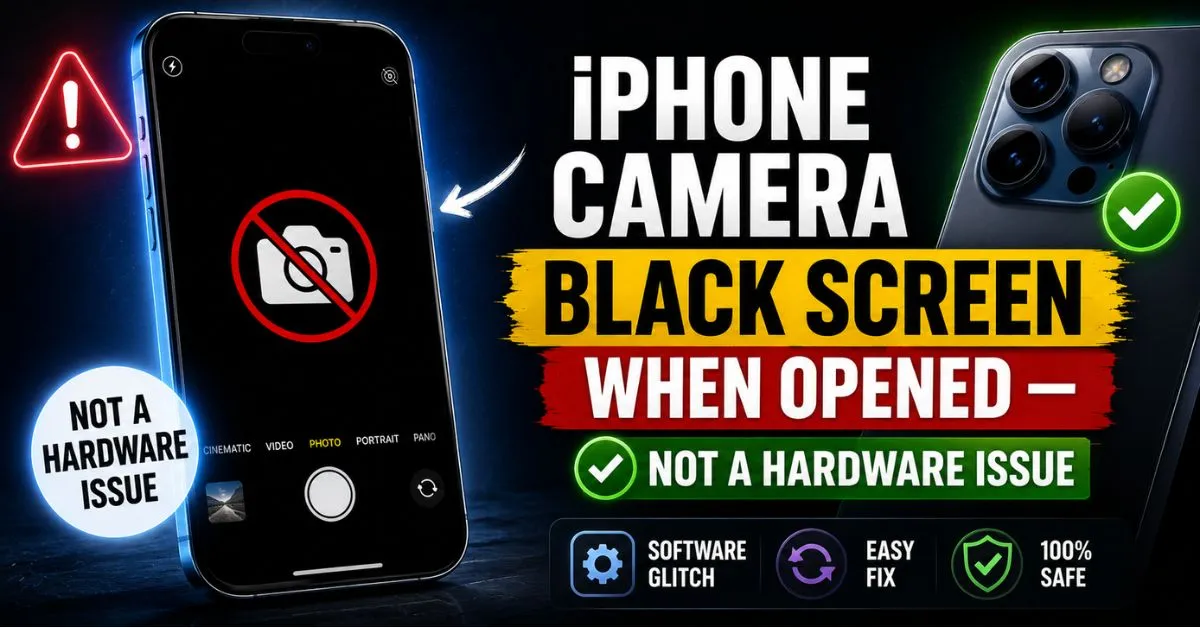
I was standing at the edge of the Grand Canyon last summer, the golden hour light hitting the red rocks in a way that felt almost spiritual. I pulled out my iPhone, swiped right to open the camera, and… nothing. A void. A black screen of death that stared back at me while the perfect shot evaporated into the twilight.
If you’ve experienced this, your first instinct is probably a cold sweat. You start calculating the cost of a lens replacement or wondering if that tiny drop onto the carpet three weeks ago finally caught up with you. But here’s something I’ve learned after years of tinkering with iPhones and writing about mobile tech: nine times out of ten, that black screen isn’t a hardware failure. It’s a software hiccup—a digital brain freeze where the iOS Operating System fails to handshake with the Image Signal Processor (ISP).
Before you make an appointment at the Apple Genius Bar and prepare to part with your device for three days, let’s walk through the exact troubleshooting protocol I use. We’re going to dive deep into the guts of your phone’s software to wake that shutter up.
The 60-Second Diagnosis: Is It Really a Software Issue?
Before we start digging into settings, we need to prove the hardware is actually alive. It’s a waste of time to fix software if the ribbon cable is actually snapped.
The Flashlight Test
This is my favorite “quick and dirty” trick. Swipe down for your Control Center and try to turn on your flashlight. Is the icon greyed out? If the iPhone thinks the Camera App is currently in use (even if the screen is black), it will often disable the flashlight to prevent overheating or resource conflicts. If it’s greyed out, your phone is stuck in a software loop. If the flashlight works perfectly, the camera hardware is likely receiving power, which is a great sign.
The Third-Party App Test
Open Instagram, WhatsApp, or TikTok. Try to use the camera within those apps. Why does this matter? These apps use their own APIs to access the camera hardware, often bypassing some of the heavy post-processing layers of the native Apple app. If the camera works in Instagram but shows a black screen in the native app, you are 100% looking at a software glitch.
Switching Lenses
Sometimes, only one “eye” is closed. Switch to the selfie camera. If the front-facing camera works, the Firmware is functional, and the issue might be isolated to the rear-facing lens’s initialization sequence.
Level 1: The Quick Fixes That Resolve 80% of Glitches
Most of the time, the Camera App just needs a kick in the pants. iOS is aggressive with RAM (Random Access Memory) management, and occasionally, it kills a camera process mid-load, leaving the interface “open” but the feed “closed.”

Force Quitting the Right Way
Don’t just swipe to the home screen. Bring up the App Switcher (swipe up from the bottom and hold) and flick the Camera app away with authority. I usually recommend flicking away any other media-heavy apps like YouTube or Netflix at the same time to clear the RAM.
The “Quick Switch” Trick
I discovered this by accident. If the screen is black, try toggling between “Photo,” “Video,” “Pano,” and “Portrait.” Forcing the ISP to switch shooting modes changes the resolution and frame rate requests sent to the sensor. This often “jolts” the sensor into sending a signal again.
The Force Restart (The “Hard” Way)
A standard slide-to-power-off often saves the current state of your “glitchy” RAM to the disk so it can reload it when you turn it back on. We don’t want that. We want a clean slate.
- For iPhone 8 and later: Press and quickly release Volume Up. Press and quickly release Volume Down. Press and hold the Side Button until the Apple logo appears. This clears the cache and forces the iOS Operating System to re-index all hardware connections.
Expert Insight: The “Cold Boot” Theory When you force restart, you aren’t just turning the phone off; you’re cutting power to the logic board for a split second. This forces the Image Signal Processor to re-initialize its handshake with the Sony-made sensors Apple uses. I’ve seen this fix cameras that “died” after a particularly buggy iOS update.
Level 2: Deep System Settings You Haven’t Checked
If the quick fixes failed, we need to look at the weird stuff. These are the settings that even the “tech gurus” on YouTube often overlook.
The “VoiceOver” Bug
This is the “Information Gain” tip you won’t find in the basic Apple support docs. There is a documented, yet rare, conflict between VoiceOver Accessibility and the Camera’s UI. Sometimes, VoiceOver tries to describe the “visuals” of the camera preview before the preview has even rendered, causing a race-condition crash. Go to Settings > Accessibility > VoiceOver and make sure it’s off. If it was already off, try toggling it on and back off. It sounds crazy, but it resets the UI overlay layer that sits on top of the camera feed.
Storage Throttle and Cache
iPhones need “breathing room” to process images. If your storage is 99% full, iOS will stop the camera from opening because it has nowhere to write the temporary buffer files. Check your System Settings > General > iPhone Storage. If you’re in the red, delete a few large 4K videos. Also, check if you have “Optimize iPhone Storage” turned on in Photos. If your phone is struggling to offload high-res photos to iCloud while you’re trying to take a new one, the camera app might just hang.
Background App Refresh Conflicts
I once had a third-party “smart mirror” app that was constantly pinging the camera in the background. Because iOS only allows one primary “owner” of the camera hardware at a time, the native app couldn’t take control. Go to Settings > General > Background App Refresh and try turning it off entirely for a few minutes. If the camera starts working, you’ve found your culprit—a rogue app is hogging the sensor.
The Nuclear Options: When Basic Fixes Fail
If you’re still staring at a black rectangle, it’s time to bring out the heavy machinery. We are moving from “fixing settings” to “reinstalling the brain.”
Reset All Settings
Note: This is not a factory reset. It won’t delete your photos or apps. Go to Settings > General > Transfer or Reset iPhone > Reset > Reset All Settings. This will wipe your Wi-Fi passwords, wallpaper, and Bluetooth pairings, but more importantly, it resets every hardware permission and internal mapping. I’ve found this is the “magic bullet” for cameras that stopped working after a major iOS version jump (like moving from iOS 16 to 17).
DFU Mode: The Final Boss
If even a “Reset All Settings” doesn’t work, you might have corrupted Firmware. This is deeper than the OS. To fix this, you need DFU Mode (Device Firmware Update). You’ll need a computer (Mac or PC with iTunes). This process wipes the phone and reloads the firmware from scratch. It’s the most thorough software repair possible. If the camera is still black after a DFU restore and being set up as a “New iPhone” (don’t restore from backup yet!), then—and only then—can you say for certain that it’s a hardware issue.
Final Verdict and Maintenance Tips
It’s easy to panic and think the lens is toasted. But modern iPhones are surprisingly resilient. The black screen is almost always a symptom of the software getting “confused” by conflicting instructions.
My Real-World Advice:
- Stop using “Optimize Storage” if you have the space. Let the phone keep its cache local so it isn’t constantly fighting for bandwidth when you open the camera.
- Avoid Beta Software if your camera is your life. Developer betas often have unoptimized drivers for the ISP.
- Keep it cool. I’ve noticed the black screen happens more often when the phone is hot (like after a long gaming session or sitting on a car dashboard). High heat causes the OS to throttle hardware to protect the battery.
If you’ve gone through the DFU restore and the screen is still black, then yes, it’s time to see the pros. But by doing these steps, you’ve saved yourself the embarrassment of a technician simply restarting your phone in front of you.
Frequently Asked Questions
1. Why does my camera work for selfies but stays black for the back lens?
This usually indicates a specific failure in the rear-facing camera’s driver initialization. Since the front and rear cameras use different hardware paths, one can work while the other is “crashed” at the software level. Try the “Force Restart” method specifically for this, as it resets the hardware bus.
2. Can a magnetic phone case cause a black camera screen?
Actually, yes. Some high-end iPhones use magnets for Optical Image Stabilization (OIS) and Closed-loop autofocus. If your case has extremely strong magnets, it can interfere with the sensor’s ability to “park” itself correctly, which might lead the software to fail the launch sequence and show a black screen. Try removing the case.
3. I updated my iOS and now the camera is black. Is it a bug?
It’s very common. During an update, the Firmware for the camera module is sometimes updated separately. If that process is interrupted or if there’s a conflict with old settings, the camera won’t “wake up.” A “Reset All Settings” usually fixes this post-update glitch.
4. What if the camera is black only when I use the 0.5x (Ultra Wide) lens?
This points to a specific hardware-software handshake failure for that individual lens. Since the iPhone 13 and later use different sensors for different zoom levels, the iOS Operating System treats them almost like separate devices. If a restart doesn’t fix it, the Ultra Wide sensor itself may have a physical connection issue.
5. Does the “Find My” app affect the camera?
In rare security-lock scenarios, if an iPhone is flagged or has certain MDM (Mobile Device Management) profiles from a workplace, the camera can be disabled at the system level. If your phone is a company device, check with your IT department to see if they’ve restricted camera access via a profile.