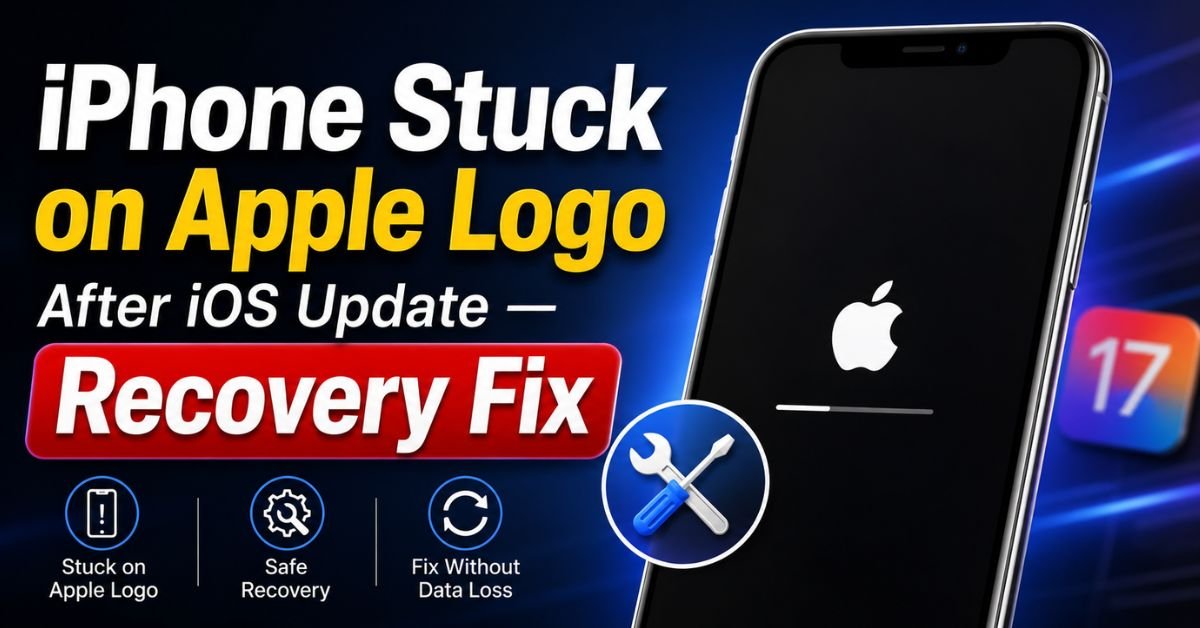
I’ve been there. You click “Install Now,” walk away to grab a coffee, and come back thirty minutes later to find your iPhone staring back at you with that static, white Apple logo. No progress bar. No movement. Just a glowing icon and a rising sense of dread in your chest.
It’s called the “Infinite Boot Loop,” and honestly, it’s a rite of passage for long-time iOS users. Whether it’s a corrupted iOS Firmware download or a Kernel Panic caused by a hardware handshake gone wrong, the result is the same: your $1,000 device is currently a very expensive paperweight.
But here’s the thing: after a decade of tinkering with developer betas and bricking my own devices more times than I’d like to admit, I’ve learned that 95% of these “stuck” phones aren’t actually broken. They’re just confused.
In this guide, I’m going to walk you through the exact hierarchy of fixes I use, from the “60-second miracle” to the deep-level DFU Mode restoration that even some Apple Store techs skip over.
Introduction: Why Your iPhone is Stuck on the Logo
Before we start mashing buttons, we need to distinguish between a “slow” update and a “failed” update. If you see a progress bar underneath that Apple logo and it’s moving—even at a snail’s pace—leave it alone. iOS updates (especially major version jumps) can take up to an hour depending on your storage speed and file indexing.
However, if the logo has been static for more than 20 minutes with no bar, or if the phone keeps flickering and restarting to the logo, you’ve hit a snag. This usually happens because the update process couldn’t verify the IPSW file (the firmware package) or the internal storage ran out of “breathing room” mid-install.
I’ve seen this happen most often when people try to update with 500MB of storage left. The system tries to swap files, runs out of space, and the whole OS architecture collapses. It’s messy, but fixable.
Phase 1: The Force Restart (The 60-Second Fix)
You’d be surprised how often a simple hardware-level interrupt solves the problem. A force restart cuts the power to the processor for a split second, clearing any temporary cache errors that might be holding the boot process hostage.

The “rhythm” matters here. Don’t rush it.
For iPhone 8, X, XS, XR, 11, 12, 13, 14, 15, and 16 Series:
- Press and quickly release the Volume Up button.
- Press and quickly release the Volume Down button.
- Press and hold the Side button (Power).
- Important: Keep holding even when the screen goes black. Only let go when the Apple logo reappears.
For iPhone 7 and 7 Plus:
Press and hold both the Side button and the Volume Down button simultaneously until you see the logo again.
For iPhone 6s and Older:
Hold the Home button and the Top (or Side) button at the same time.
Expert Insight: I once spent two hours trying to fix a friend’s iPhone 13 before realizing they weren’t holding the side button long enough. You have to be patient. Sometimes it takes 15–20 seconds of holding before the hardware trigger kicks in.
Phase 2: Using Recovery Mode without Data Loss
If the force restart didn’t work, your iPhone’s software is likely in a state where it doesn’t know how to “find” the startup disk. This is where we bring in the heavy hitters: a Mac or a PC.
The Setup
Plug your iPhone into your computer using a high-quality Lightning cable or USB-C cable. I cannot stress this enough: use an MFi-certified cable. I’ve seen cheap $5 gas station cables cause a restore to fail at 99%, which can actually cause permanent damage to the NAND flash storage.
- Open Finder (on macOS Catalina or later) or the Apple Devices app/iTunes (on Windows).
- Perform the Force Restart steps mentioned above, but do not let go when you see the Apple logo. Keep holding until you see a screen with a laptop and a cable icon. This is Recovery Mode.
- A window will pop up on your computer. It will give you two options: Update or Restore.
CHOOSE UPDATE.
When you select “Update,” your computer will attempt to reinstall the iOS Firmware without erasing your photos, messages, or apps. It basically “paints over” the corrupted system files with a fresh coat of code.
What if the download takes too long?
If the firmware download takes longer than 15 minutes, your iPhone will automatically exit Recovery Mode. Don’t panic. Just let the download finish on your computer, then put the phone back into Recovery Mode and try again.
Phase 3: The Deep Fix – DFU Mode Deep Dive
Sometimes, the “Update” method fails with an “Error 4013” or “Error 9.” This usually means the partition map is so garbled that the phone needs a total wipe. This is where DFU Mode (Device Firmware Update) comes in.
DFU is different from Recovery Mode. In Recovery Mode, the iBoot (bootloader) is active. In DFU mode, the phone is in a “brain-dead” state where the hardware can communicate with the computer without the OS even trying to load.
The Screen Must Stay Black. If you see a logo or an icon, you are in Recovery Mode, not DFU.
Entering DFU Mode (iPhone 8 and newer):
- Connect the phone to your computer.
- Quick-press Volume Up.
- Quick-press Volume Down.
- Hold the Side Button for 10 seconds until the screen goes black.
- While still holding the Side Button, press and hold the Volume Down button for 5 seconds.
- Let go of the Side Button but keep holding Volume Down for another 10 seconds.
If done correctly, your computer will say it has “detected an iPhone in recovery,” but the phone’s screen will be completely black. Now, you must click Restore. This will wipe the device and install a clean version of iOS. This is your last resort for software issues.
Common Pitfalls and Real-World Scenarios
I’ve diagnosed hundreds of these, and it’s rarely a mystery. Usually, it’s one of three things:
- The “Storage Full” Trap: If your phone was at 127.9GB of 128GB before you updated, the update had no room to move files. The system essentially suffocated. In this case, a “Restore” (data loss) is often the only way out unless you have a recent iCloud backup.
- Unstable Wi-Fi: If you did an Over-The-Air (OTA) update and your Wi-Fi flickered, the downloaded packet might be corrupt. Always try to do major updates (like moving from iOS 17 to iOS 18) via a wired connection to a Mac/PC if possible.
- The Cable Issue: I once saw a “Kernel Panic” boot loop caused by a knock-off charging cable that was shorting out the data pins in the Lightning port. If your phone is acting weird, change the cable first.
Pro Tip: If you’re on a Mac and Finder is being finicky, try using Apple Configurator (available in the Mac App Store). It’s a professional-grade tool Apple uses for bulk deployments, but it has a “Revive Device” feature that is sometimes more robust than the standard Finder restore process.
Advanced Troubleshooting: Hardware vs. Software
If you’ve tried DFU mode and the restore fails with a specific error every single time, you might be looking at a hardware failure.
- Failing Battery: If the battery can’t provide a consistent voltage during the high-intensity update process, the CPU will throttle and crash, leading to a logo hang.
- Logic Board Issues: Specifically, the “NAND” (storage chip) or the “Audio IC” can fail on older models like the iPhone 7, causing a permanent boot loop.
- Third-Party Tools: You’ll see ads for software like Reiboot or iMyFone Fixppo. Are they worth it? Sometimes. They essentially provide a user-friendly interface for the DFU and IPSW injection process. If you find the manual button-mashing too difficult, these tools can automate the entry into Recovery Mode, but they can’t fix a broken motherboard.
If you’ve tried everything and the Apple logo still haunts you, it’s time to book a Genius Bar appointment. Mention that you’ve already attempted a DFU restore—it will save you 20 minutes of them trying to do it in front of you.
Frequently Asked Questions
1. Will I lose my photos if my iPhone is stuck on the Apple logo?
If you can successfully perform an “Update” in Recovery Mode, your data should remain intact. However, if the “Update” fails and you are forced to use “Restore” or DFU Mode, all data on the device will be erased. This is why keeping an active iCloud backup is non-negotiable in the modern era.
2. How long should I wait before deciding it’s actually “stuck”?
Wait at least 30 minutes. I have seen “stuck” iPhones suddenly jump from 0% to 80% on the progress bar after 25 minutes of looking dead. If there is no progress bar and the phone hasn’t changed for half an hour, it’s safe to assume it’s stuck.
3. My computer isn’t recognizing my iPhone at all. What do I do?
First, try a different USB port (directly on the computer, not a hub). Second, swap the cable for a known-good MFi-certified one. Third, make sure you are in Recovery Mode; a computer often won’t “see” a phone that is stuck in a boot loop until it’s forced into that specific diagnostic state.
4. What is the difference between an IPSW file and a regular update?
An IPSW file is the complete standalone firmware image for your specific iPhone model. When you update through Settings, your phone only downloads the “delta”—the bits that changed. When you restore via a computer, it downloads the entire 6GB+ IPSW file to ensure the foundation of the OS is perfect.
5. Can a hardware button being stuck cause the Apple logo loop?
Yes! If your Volume Up button is jammed or has liquid damage, the phone might think you’re trying to enter a diagnostic mode every time it boots, leading to a loop. Clean your buttons with a tiny bit of isopropyl alcohol and a soft brush if they feel “mushy.”