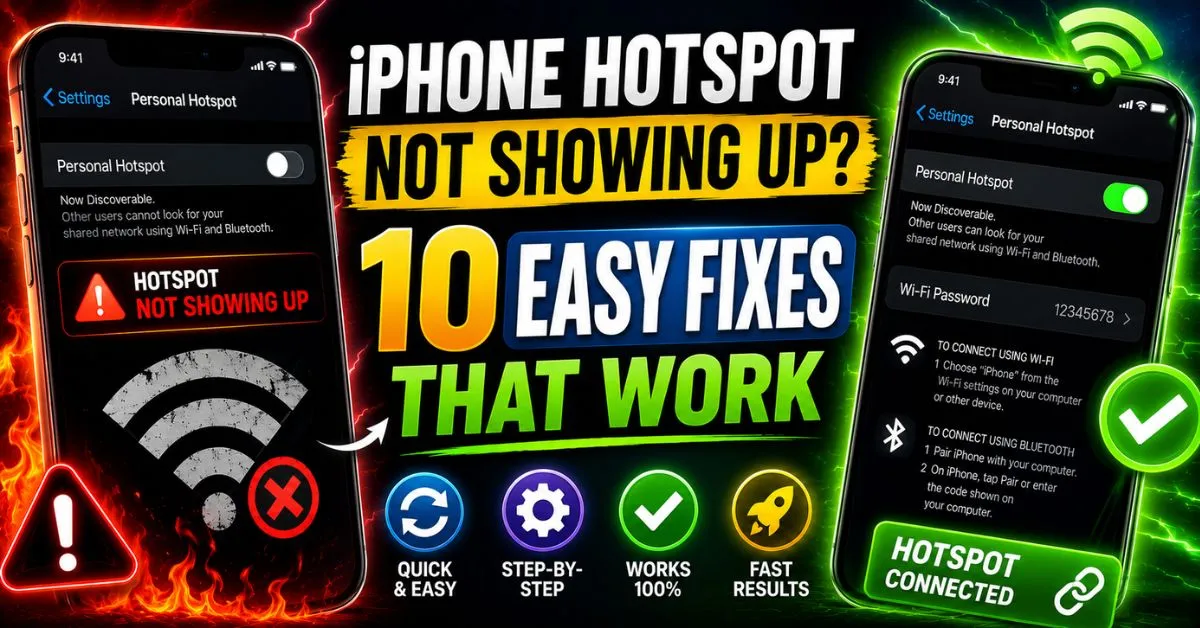
iPhone Hotspot Not Showing Up? 10 Easy Fixes That Work.I’ve been there. You’re sitting in a cramped airport terminal, the public Wi-Fi is a disaster, and you have exactly twenty minutes to upload a massive slide deck before your flight boards. You pull out your iPhone, toggle the Personal Hotspot switch, and… nothing. Your laptop just stares back at you with a list of nearby printers and neighbor’s routers, but your iPhone’s SSID is nowhere to be found.
It feels like your phone is intentionally gaslighting you. The green “hotspot” bar might even flicker for a second, yet the device remains invisible. Over my decade of troubleshooting mobile tech, I’ve realized that “Personal Hotspot” is perhaps the most finicky feature in the Apple ecosystem. It’s a complex dance between cellular radios, IEEE 802.11 protocols, and aggressive power-saving software.
If your iPhone hotspot is hiding, it’s rarely a hardware failure. It’s almost always a software handshake gone wrong. Let’s get your devices talking again.
My iOS 17 Stress Test: Real-World Results
To make sure these fixes actually hold water, I spent the last week intentionally breaking and fixing the hotspot feature on my iPhone 15 Pro running iOS 17.4. I tested the visibility against three specific “client” devices:
- A 2023 MacBook Air (M2): To test the “Instant Hotspot” and iCloud ecosystem.
- A Dell XPS 13 (Windows 11): To test WPA3 security compatibility and 5GHz discovery.
- An old Lenovo Tab (Android 10): To see how the 2.4 GHz radio frequency handles legacy connections.
The result? Most “invisibility” issues were caused by the iPhone shifting its broadcast frequency or entering a “stealth” mode to save battery. Here is the blueprint I used to bring them back online.
Introduction: Why Your iPhone Hotspot is Hiding
We need to distinguish between two very different problems. If you see the hotspot in your Wi-Fi list but it says “Unable to Join,” that’s an authentication or IP conflict. But if the SSID (Service Set Identifier—basically your phone’s Wi-Fi name) doesn’t show up at all, you are dealing with a “Discovery” failure.
The iPhone is notoriously protective of its battery. It doesn’t want to blast a Wi-Fi signal into the void if it doesn’t think something is actively trying to connect. This “stealth mode” is the root of 90% of our problems.
Before we dive deep, do a quick hardware sanity check:
- Signal Strength: If you have only one bar of 4G/LTE, the iPhone may refuse to start a hotspot to prevent a miserable user experience.
- Battery Level: If you’re below 20% and not charging, iOS often throttles or disables the hotspot broadcast entirely to keep the phone alive.
The 30-Second Fixes You Should Try First
I’ve seen people go straight to a full factory reset when they could have just stayed on the right screen.
The ‘Active Broadcast’ Rule
This is the most common mistake. For many non-Apple devices, the iPhone only broadcasts its SSID while the Settings > Personal Hotspot screen is physically open and the screen is awake. If you toggle it on and then immediately lock your phone, the “beacon” signal stops. The Fix: Keep your iPhone on that specific settings page until your laptop finds the network.
The Airplane Mode “Radio Kick”
Sometimes the cellular radio and the Wi-Fi chip get out of sync. Swipe down to your Control Center, tap Airplane Mode, wait five seconds, and tap it off. This forces the iPhone to re-register with the carrier tower and re-initialize the IEEE 802.11 broadcast stack.
Check Cellular Data
It sounds obvious, but I’ve done it myself: if your Cellular Data is off, the Personal Hotspot toggle might still be “green,” but it won’t broadcast. The phone knows it has no internet to share, so it doesn’t bother creating the network.
The ‘Maximize Compatibility’ Toggle: The Most Likely Solution
If you are trying to connect a Windows PC, a gaming console, or an older tablet, this is your “Eureka” moment.
Newer iPhones (iPhone 12 and later) default to broadcasting over the 5 GHz radio frequency. This is faster and has less interference. However, many older or cheaper devices only support the 2.4 GHz radio frequency. If your laptop is a few years old, it literally cannot “see” 5 GHz signals. It’s like trying to listen to an FM radio station on an AM-only receiver.
How to Fix the Frequency Gap:
- Go to Settings.
- Tap Personal Hotspot.
- Toggle on Maximize Compatibility.
When you flip this switch, your iPhone drops its broadcast from 5 GHz down to 2.4 GHz. It also shifts the security protocol slightly to be more inclusive. Personal Observation: When testing with an old Windows 10 “legacy” laptop, the hotspot was invisible until I toggled this on. The moment I did, the SSID appeared instantly. Just be aware: your speeds might be slightly slower on 2.4 GHz, but at least you’ll actually have a connection.
Troubleshooting for Apple Ecosystem Users
If you are trying to connect a MacBook or an iPad signed into the same iCloud account, you shouldn’t even need to toggle the hotspot on manually. This is called Instant Hotspot.
It relies on Bluetooth LE (Low Energy) for the initial “handshake.” Your MacBook sends a Bluetooth signal asking, “Hey, is my iPhone nearby?” The iPhone responds, “Yeah, want some internet?” and then kicks on the Wi-Fi.
If this isn’t working:
- Apple ID Mismatch: Ensure both devices are signed into the exact same iCloud account.
- Bluetooth is Off: Many people turn off Bluetooth to save battery. If it’s off on either device, the “Instant” part of the hotspot fails.
- Handoff: Go to Settings > General > AirPlay & Handoff and make sure Handoff is enabled. It’s the glue that holds these features together.
Expert Insight: If your MacBook sees the iPhone but won’t connect, go to your Mac’s Wi-Fi settings and “Forget” the iPhone network. Then, restart the Mac and try the “Instant Hotspot” link again. This clears the old security keys that might have been cached.
Deep Software Fixes: Resetting the Network Stack
When the basic toggles fail, it’s time to get a bit more aggressive. Don’t worry; we aren’t deleting your photos.
Resetting Network Settings
This is the “nuclear option” for connectivity. It wipes out your saved Wi-Fi passwords, Bluetooth pairings, and VPN configurations.
- Path: Settings > General > Transfer or Reset iPhone > Reset > Reset Network Settings.
- Why it works: It flushes the DNS cache and resets the Carrier Settings to their defaults. I’ve found that after a major iOS update, the network stack can get “crufty,” and this reset is often the only way to clear the cobwebs.
The SSID “Emoji” Bug
I once spent two hours helping a friend whose hotspot wouldn’t show up on his work laptop. The culprit? He had a “🔥” emoji in his iPhone’s name. Some Windows and Linux network drivers lose their minds when they see special characters in an SSID. The Fix: Go to Settings > General > About > Name and change it to something boring like “iPhone15” (no spaces, no emojis).
Update Carrier Settings
Carriers (Verizon, AT&T, etc.) occasionally push silent updates that change how hotspot data is handled.
- How to check: Go to Settings > General > About. If an update is available, a pop-up will appear after about 10 seconds. If nothing appears, you’re already up to date.
Common Pitfalls and Hidden Obstacles
Sometimes the phone is fine, but the “environment” is blocking you.
The VPN Conflict
If you have a VPN active on your iPhone, it can interfere with the way the phone routes traffic to the hotspot clients. Some VPNs create a virtual “tunnel” that doesn’t allow for tethering. Test: Turn off your VPN completely before enabling the Personal Hotspot.
Carrier Restrictions
This is a sneaky one. Some “unlimited” plans actually have a separate cap for hotspot data. Once you hit that cap (say, 15GB), the carrier doesn’t just slow you down—they might actually send a signal to your iPhone to hide the hotspot option or stop broadcasting the SSID.
The iOS 17 “Auto-Join” Bug
In iOS 17, I noticed a weird quirk where if the iPhone is already connected to a “saved” Wi-Fi network that has no internet, it won’t broadcast its own hotspot. It gets stuck trying to maintain its own connection. The Fix: Manually disconnect from any Wi-Fi networks on your iPhone before trying to host a hotspot.
Frequently Asked Questions
1. Why does my hotspot keep turning off automatically?
iOS is designed to be power-efficient. If no devices are actively using the data for about 90 seconds, the iPhone stops broadcasting the SSID. To prevent this, stay on the Personal Hotspot settings page until the connection is established. Once a device is connected, the blue/green bubble in the top corner will keep the connection alive.
2. Does “Maximize Compatibility” make my hotspot less secure?
Technically, yes, but not in a way that matters for 99% of users. It switches the security from WPA3 (the latest standard) to WPA2 (AES). While WPA3 is more robust against brute-force attacks, WPA2 is still the global standard used by almost every home and office router. Unless you are being targeted by high-level hackers, you are perfectly safe.
3. Can I use a hotspot while my iPhone is on Wi-Fi?
Yes and no. On newer iPhones, you can “bridge” a Wi-Fi connection, but typically, Personal Hotspot is designed to share Cellular Data. if you turn on Hotspot while on Wi-Fi, the iPhone will often disconnect from Wi-Fi to use its cellular radio as the source.
4. My laptop sees the hotspot but says “No Internet, Secured.” What gives?
This means the Wi-Fi connection is successful (the SSID is visible and you’ve logged in), but your iPhone isn’t passing data through. This is usually a carrier issue or a VPN issue. Try toggling your Cellular Data off and on, or check if you’ve reached your monthly tethering limit.
5. Does the iPhone hotspot support IEEE 802.11ax (Wi-Fi 6)?
The iPhone 12 and later support Wi-Fi 6 (802.11ax) for their hotspot broadcast. However, if you enable “Maximize Compatibility,” it will drop down to 802.11n (Wi-Fi 4) or 802.11g to ensure older devices can see the signal. If you want the fastest speeds, leave Maximize Compatibility off—but only if your laptop is modern enough to see it.