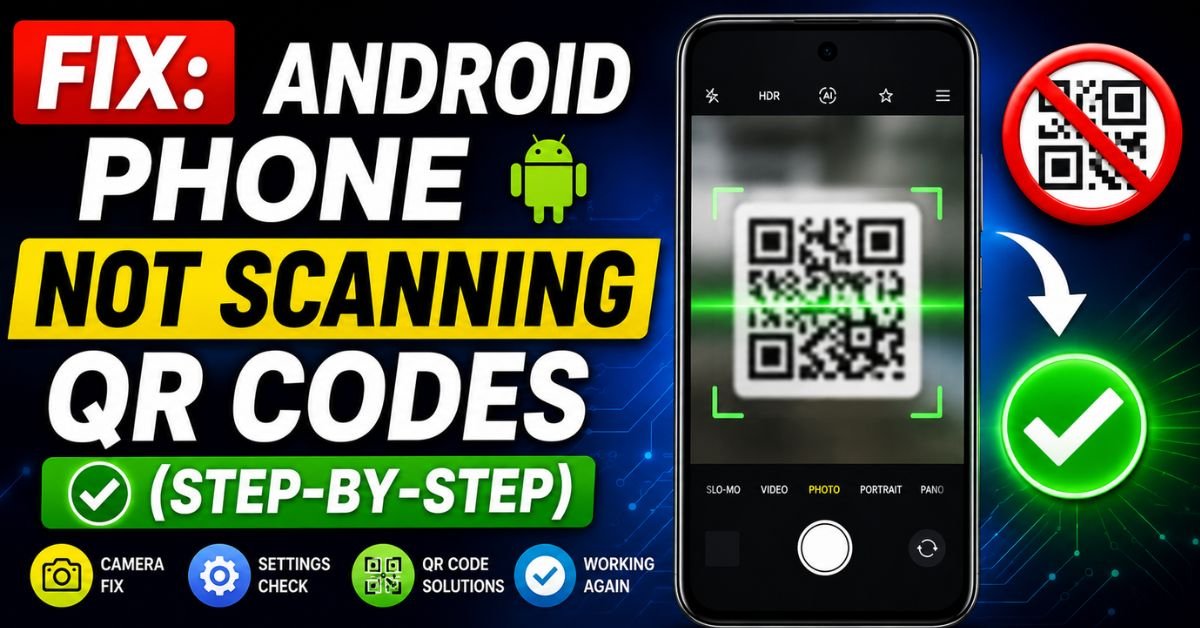
Fix: Android Phone Not Scanning QR Codes (Step-by-Step).You’re standing at a crowded outdoor concert, trying to scan the QR code for a digital beer ticket. Or maybe you’re sitting at a trendy bistro where the menu only exists in the cloud. You open your camera, point it at the little black-and-white square, and… nothing. No yellow link pops up. No vibration. Your Android phone just stares back at the code like it’s a piece of abstract art it doesn’t quite understand.
I’ve been there. As a mobile technician who has spent a decade behind a repair desk, I’ve seen hundreds of frantic users walk in thinking their Optical Lens was shattered or their sensor was fried, only to find out it was a simple software hiccup or a smudge of thumb grease.
Scanning a QR code seems like magic, but it’s actually a complex dance between your Android OS, the Camera API, and real-time Image Recognition algorithms. When that dance stops, it’s rarely because the phone is “broken.” It’s usually just confused. Let’s get your scanner back online.
Step 1: The Physical Reality Check
Before we dive into the guts of the System Settings, let’s talk about the stuff you can actually touch. You’d be surprised how often the solution is physical, not digital.
1. The “Thumbprint” Problem
Your phone lives in your pocket or purse. It hangs out with loose change, lint, and maybe the remnants of a granola bar. I once had a client whose Pixel 8 Pro refused to scan anything. I took one look at the lens and saw a thick smear of what I’m 90% sure was pizza grease.
Optical Lens quality is paramount for Image Recognition. A tiny smudge scatters light and destroys the contrast the sensor needs to read the QR Metadata.
- The Fix: Use a microfiber cloth. Avoid using your t-shirt—the fibers are abrasive and can actually strip the oleophobic coating off the lens over time.
2. Lighting and Glare (The Glossy Surface Trap)
QR codes printed on glossy plastic or displayed on high-brightness screens are a nightmare for cameras. If there’s a bright overhead light reflecting off the code, your sensor sees a white blob, not a pattern.
- The Fix: Tilt the phone. Don’t try to scan head-on if there’s a glare. Change the angle so the reflection moves away from the code’s center.
3. Finding the “Sweet Spot” for Focal Length
Every phone has a minimum focus distance. If you’re too close, the Autofocus motor can’t move the lens far enough to sharpen the image. If you’re too far, the resolution isn’t high enough to distinguish the tiny squares.

- Expert Insight: I always tell people to start 12 inches away and slowly move closer. If your phone has a dedicated Macro mode, it might actually interfere with the standard QR reader. Try zooming in slightly from a distance instead of getting physically closer.
Step 2: Software Settings and Hidden Toggles
If the lens is clean and the lighting is perfect, but the phone still won’t “see” the code, the Android OS might have simply forgotten it’s supposed to be looking for one.
4. Enable the “Scan QR Codes” Toggle
On many Samsung and Google Pixel devices, this is a specific setting that can occasionally get toggled off after a major system update. I’ve seen this happen specifically during the transition from Android 13 to Android 14.
- For Samsung Galaxy Users: Open the Camera app > Tap the Settings (Gear Icon) > Ensure Scan QR codes is toggled ON.
- For Pixel Users: Open the Camera app > Tap the Settings icon (often a small cog or arrow) > Tap More Settings > Ensure Google Lens Suggestions is ON.
5. Reset Camera App Preferences
Sometimes the Camera API gets “stuck” in a specific state. Maybe another app (like Instagram or Snapchat) was using the camera and didn’t release the handle properly.
- Go to Settings > Apps > See all apps > Camera.
- Tap Force Stop.
- Tap Storage & cache > Clear Cache.
- Note: Clearing the cache won’t delete your photos, but it will clear out the temporary junk files that might be lagging the Barcode Scanner engine.
6. The “Battery Saver” Sabotage
This is a huge one that most people miss. When your phone is in “Power Saving Mode,” it often throttles the CPU and reduces the frame rate of the camera preview to save juice. Image Recognition requires a lot of processing power. If the frame rate is too low, the algorithm can’t “catch” the QR code’s pattern before you move your hand.
- The Fix: Disable Battery Saver and try the scan again.
Step 3: Advanced Troubleshooting & The Google Lens Fail-Safe
If the native camera app is acting like a stubborn toddler, it’s time to bring in the big guns.
7. Use Google Lens Directly
If your built-in camera app is failing, Google Lens is your best friend. It’s a dedicated Image Recognition powerhouse that bypasses many of the standard camera app’s UI limitations.
- Pull down your Quick Settings shade (swipe down twice from the top).
- Look for the Scan QR code tile.
- If it’s not there, tap the “Edit” (pencil) icon and drag the QR tile into your active grid. This uses a direct system-level scanner that is often more robust than the camera app.
8. The System WebView Update
Android uses a component called “Android System WebView” to display web content inside apps. If you’re trying to scan a QR code from within an app (like a banking app), and it’s failing, an outdated WebView is often the culprit.
- Go to the Google Play Store.
- Search for “Android System WebView.”
- If there’s an “Update” button, hit it.
9. Wiping the Cache Partition
This is a “techie” move, but it’s incredibly effective for fixing general system jank. The Cache Partition stores temporary system data. If this data gets corrupted, it can cause the Android OS to lag when calling up the camera hardware.
- Turn off your phone.
- Hold Volume Up + Power until the recovery screen appears.
- Use volume buttons to navigate to Wipe Cache Partition.
- Select it with the Power button.
- Warning: Be very careful not to select “Wipe Data/Factory Reset” unless you want to lose everything.
Pro Tip: The “Digital Zoom” Trick If you’re trying to scan a tiny QR code (like on the back of a router), don’t move the phone closer. Hold the phone back about 10 inches and use the 2x or 3x digital zoom. This forces the camera to use a different focal point and often makes the QR code’s Metadata much clearer for the processor to decode.
Common Pitfalls: What to Avoid
10. The “Ad-Heavy” App Trap
Whatever you do, do not download a third-party “QR Scanner” app from the Play Store unless you have a very specific reason. Most of these apps are “fleeceware”—they are packed with intrusive ads, track your location, and sometimes even require a “subscription” for a feature your phone does natively.
If your native camera isn’t working, downloading a third-party app usually won’t help because they use the same Camera API that’s already failing.
Is it Hardware Failure?
How do you know if your Autofocus motor is actually dead?
- Open your camera and try to take a photo of something very close, then something far away.
- If the camera stays blurry regardless of where you tap on the screen, your motor might be stuck.
- The “Technician’s Tap”: I’ve fixed hundreds of “stuck” focus motors by gently tapping the phone against the palm of my hand. Sometimes the tiny magnets inside the Optical Lens assembly get jammed. A little physical vibration can pop them back into place.
Real-Time FAQs
Q: Why does my camera scan some QR codes but not others?
A: Not all QR codes are created equal. Some have a lower “Error Correction Level.” If a code is poorly designed or has low contrast (like light gray on a white background), your phone’s Image Recognition engine might struggle to distinguish the data from the background noise. It’s likely the code’s fault, not your phone’s.
Q: Can a cracked screen prevent my phone from scanning?
A: If the crack is over the front-facing camera and you’re using that, yes. But if it’s just the display, it shouldn’t affect the rear camera’s ability to “see” the code. However, if the rear glass covering the Optical Lens is cracked, the light will refract wildly, making a successful scan nearly impossible.
Q: Does my phone need internet to scan a QR code?
A: To identify the code? No. The decoding happens locally on your device via the Camera API. However, to open the link contained within the code, you obviously need a data or Wi-Fi connection.
Q: My phone vibrates like it scanned the code, but nothing happens. Why?
A: This usually means your default browser is acting up or a “pop-up blocker” is preventing the link from opening. Try clearing the cache of your Chrome or Samsung Internet app. It could also be that the QR code contains Metadata that isn’t a URL (like a plain text note or a Wi-Fi password), and your phone doesn’t know which app to use to display it.
Q: Will a software update fix my camera scanning problems?
A: Frequently, yes. Manufacturers like Samsung and Google regularly push patches for the Camera API to improve low-light performance and object recognition. If you’re more than two months behind on security patches, that should be your first step.
Scanning problems are a massive headache, especially when we rely on those little squares for everything from parking to payments. Usually, a quick lens wipe or a toggle in the System Settings is all it takes to bridge the gap between your phone and the digital world. Keep that lens clean, stay away from sketchy third-party apps, and you’ll be scanning like a pro in no time.