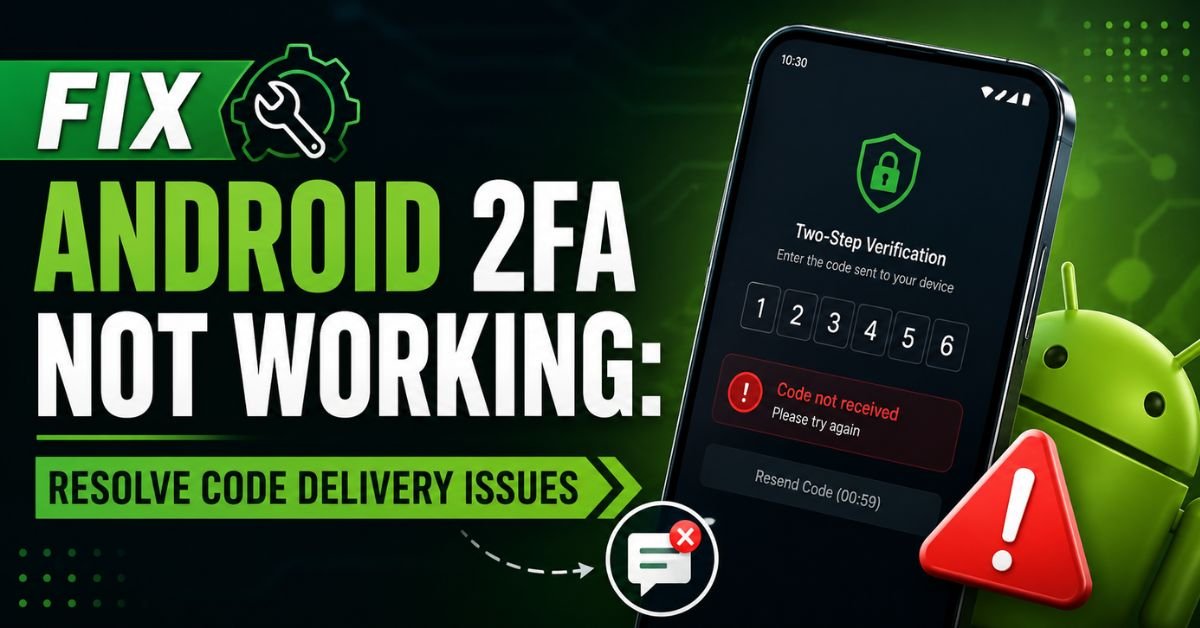
Fix Android 2FA Not Working: Resolve Code Delivery Issues.I’ve been there. It’s 11:45 PM, you’re trying to log into your brokerage account or a critical work email on your Pixel 7, and the screen just stares back at you. “Enter the 6-digit code sent to your phone.” You wait. You tap “Resend.” You toggle Airplane Mode. Nothing. The silence from your SMS inbox is deafening.
As someone who has spent over five years in technical support and mobile security, I can tell you that “2FA failure” is the leading cause of digital high blood pressure. Last year, I nearly locked myself out of my own primary Google account after a factory reset because I hadn’t properly migrated my Google Authenticator seeds. It took me three hours and a very dusty folder of printed backup codes to get back in.
If your Android device is refusing to cooperate with Multi-Factor Authentication (MFA), don’t panic. Whether it’s a missing SMS, a “wrong” code from Authy, or a Google Prompt that never pops up, we’re going to fix it. We’re going deep—beyond the “is your phone on?” level of advice—to look at RCS messaging conflicts, Network Latency, and the dark corners of Google Play Services.
Why Your 2FA Is Failing
The login loop is a special kind of hell. You have the password (the “something you know”), but the “something you have”—your Android phone—isn’t playing ball. On Android, we generally deal with three flavors of Two-Factor Authentication:
- Short Message Service (SMS): The old-school text message code.
- App-based (TOTP): Time-based One-Time Passwords from apps like Google Authenticator or Authy.
- Google Prompts/Push Notifications: That “Is it you?” tap-to-verify screen.
When these fail, it’s rarely a “broken” phone. It’s usually a synchronization error, a hidden setting, or a conflict with how your carrier handles Short Message Service traffic.
Real-World Scenario: The SMS That Never Arrives
SMS is the most common 2FA method, and ironically, the most fragile. I once spent forty minutes troubleshooting a user’s Samsung S23 only to realize their RCS (Rich Communication Services) was intercepting the verification text and failing to decrypt it because of a temporary handshake error with the Identity Provider.
Carrier Filtering and Short Codes
Most 2FA codes come from “short codes” (5 or 6-digit numbers). Carriers sometimes flag these as spam. If you aren’t getting codes, your carrier’s Carrier Filtering might be too aggressive.
The Fix: Call your carrier and ask if there’s a “Premium SMS” block on your line. I’ve seen this happen after a plan change where the system defaults to “High Security,” effectively ghosting every bank and social media site trying to reach you.
The RCS Conflict
Google’s “Chat Features” (RCS) is great, but it can be a nightmare for automated verification.
- Try this: Open Messages > Settings > RCS Chats. Turn it OFF temporarily.
- Try to trigger the 2FA code again. If it arrives as a standard SMS, you’ve found your culprit. Sometimes the bridge between the Short Message Service gateway and the RCS server gets “stuck.”
Network Latency and Dead Zones
If you’re in a “dead zone” or a building with heavy shielding, the Network Latency might be so high that by the time the SMS reaches you, the Encryption Key for that specific session has expired. Always check your bars. If you have “Emergency Calls Only,” your 2FA isn’t coming through.
Hands-On Fixes for App-Based Authentication
If you use Google Authenticator or Authy and the app is giving you a code, but the website says it’s “invalid,” you’re likely dealing with a “Clock Drift.”
Syncing the Internal Clock
TOTP (Time-based One-Time Password) relies entirely on your phone’s internal clock being perfectly synced with the server’s clock. Even a 30-second discrepancy will result in an invalid code.
On Google Authenticator:
- Tap the three-dot menu.
- Go to Settings > Time correction for codes.
- Tap Sync now.
I cannot tell you how many “broken” accounts I’ve fixed with those three taps. It’s the most common failure point for app-based 2FA.
Clearing Google Play Services Cache
Google Play Services is the invisible backbone of Android security. If its cache gets corrupted, it can stop syncing security tokens.
- Go to Settings > Apps > Google Play Services.
- Tap Storage & Cache > Clear Cache.
- Pro Tip: Do NOT “Clear All Data” unless you want to re-setup your Google Pay and some other system features. Just clear the cache first.
Background Data and Battery Optimization
Android is aggressive about killing apps to save battery. If Authy or your bank’s app is “optimized,” it might not be allowed to refresh its internal Encryption Key in the background.
- Go to Settings > Apps > [Your Auth App] > Battery.
- Set it to Unrestricted.
Troubleshooting Google Prompts and Push Notifications
Google Prompts (the “Is this you?” screen) are more secure than SMS, but they rely on a persistent connection to Google’s servers.
The ‘Do Not Disturb’ Trap
This is a classic. You’re trying to log in at night, your phone is in Do Not Disturb mode, and the 2FA prompt is being suppressed.
- Check your DND settings.
- Ensure that “Alarms” or “Priority Notifications” are allowed, or simply toggle DND off while you log in.
Re-logging to Refresh the Token
Sometimes the “token” that identifies your phone to Google gets stale.
- Go to Settings > Google > Manage your Google Account.
- Tap the Security tab.
- Look at “Your devices.” If your current phone shows up twice or looks “old,” sign out of the account on that device and sign back in. This forces a fresh handshake with the Identity Provider.
Expert Insight: If you’re using a VPN, turn it off. Many security systems see an IP address from a different country/state and immediately flag the 2FA request as suspicious, often delaying or outright blocking the notification to your phone to protect the account.
Pro-Tips and Common Pitfalls to Avoid
I’ve seen people lose access to 10 years of photos because of one simple mistake: The Factory Reset.
The Migration Mistake
Never, ever factory reset your phone or trade it in before you have migrated your 2FA seeds to a new device. Most apps like Google Authenticator don’t automatically cloud-sync (for security reasons). You have to manually export the accounts.
The ‘VPN Trap’
As mentioned, Identity Providers hate IP hopping. If you’re using a VPN with “Kill Switch” enabled, your phone might lose its connection to the FIDO2 or MFA servers the moment the VPN stutters. Turn off the VPN before attempting a sensitive login.
Avoid VOIP Numbers
Using a Google Voice or Skype number for 2FA is a recipe for disaster. Most financial institutions and major platforms (like Amazon or Meta) now block VOIP numbers for 2FA because they are too easy to spoof. Always use a “Real” SIM-based mobile number.
Building a Fail-Safe: Future-Proofing Your Security
Don’t wait for the next failure to prepare. Here is how I set up my personal security to ensure I am never locked out again.
- Physical Security Keys (FIDO2): I use a YubiKey. It’s a USB-C/NFC key that you tap against your phone. No codes, no SMS, no latency. It works even if you have zero cell service.
- Offline Backup Codes: Every time you set up 2FA, the site gives you a list of 10 “One-time use” codes. Print them. Don’t just save them on your phone (if you lose your phone, you lose the codes). Put them in a safe or a physical wallet.
- Secondary Trusted Device: If you have an old Android tablet or a secondary phone, add it as a “Trusted Device” in your Google account. It acts as a backup receiver for Google Prompts.
Frequently Asked Questions
1. Why am I getting 2FA codes from hours ago all at once?
This is usually caused by Network Latency or “SMS Queueing” at the carrier level. When the carrier’s gateway is overloaded or your phone has a poor connection to the tower, the messages stack up. Once the connection stabilizes, they all “burst” through. Unfortunately, these codes are likely expired by the time they arrive. Switching to an app-based TOTP (like Google Authenticator) solves this.
2. Can I get 2FA codes if I don’t have a signal but have Wi-Fi?
If you are using App-based TOTP (Google Authenticator, Authy), YES. These apps do not need any internet or cellular connection to generate codes; they only need your phone’s internal clock to be correct. However, SMS codes will only work if you have Wi-Fi Calling enabled and your carrier supports it.
3. I lost my phone and don’t have backup codes. Am I locked out forever?
Not necessarily, but it will be difficult. You will have to go through the “Account Recovery” process for each specific service. This usually involves proving your identity with a photo ID or answering security questions. This process can take 3 to 7 days. This is why keeping offline backup codes is so vital.
4. Does “Clear Data” on the Authenticator app delete my accounts?
YES. Be extremely careful. If you go into Android settings and “Clear Data” for Google Authenticator or Authy, you are deleting the secret Encryption Keys (seeds) for all your linked accounts. Only “Clear Cache” unless you are looking to start from scratch and have your backup codes ready.
5. Why does my phone say “Invalid Code” even when I type it perfectly?
This is almost always a time synchronization issue. Your phone think it’s 10:00:30, but the server thinks it’s 10:01:00. Because TOTP codes change every 30 seconds, you are essentially providing the “future” or “past” code. Use the “Sync now” feature in your app’s settings to fix this instantly.