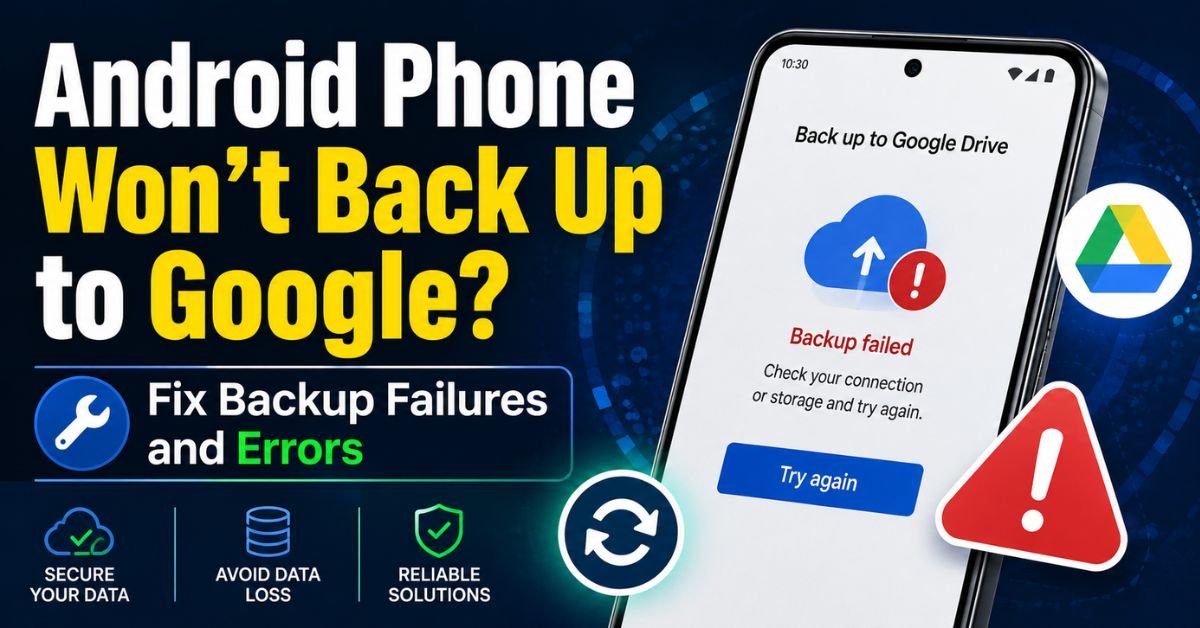
Android Phone Won’t Back Up to Google? Fix Failures Now.Last Tuesday, I was ready to trade in my old Pixel for the new Fold. I had the box ready, the shipping label printed, and the excitement was real. But then I saw it: the dreaded “Waiting to back up…” message in my settings, greyed out like a ghost. No matter how many times I tapped “Back up now,” nothing happened. My last successful backup? Two months ago.
If you’ve ever been in this spot, you know the cold sweat that kicks in. You start thinking about all the buried text messages, Wi-Fi passwords, and app data that might just vanish. Over a decade of tinkering with the Android Operating System has taught me that Google’s backup system is brilliant—until it’s not. It’s a complex dance between Google Play Services, your Cloud Storage limits, and local system permissions.
When it breaks, it doesn’t usually give you a helpful error code. It just… stops. Let’s get your data moving again.
Real-World Scenarios: When Android Backups Fail
I’ve seen this play out in three main ways across dozens of devices. First is the “Infinite Loop.” You go to Settings > Google > Backup, and the button is literally disabled. You can’t even click it.
The second is the “Partial Success.” Google Photos is backing up just fine (because that’s a separate API), but your “Application Data” and “SMS” are sitting at 0 bytes. This is particularly dangerous because you might think you’re backed up because your photos are in the cloud, only to realize your contacts and call logs are gone after a factory reset.
The third is the “Storage Wall.” You’re paying for a Google One plan, but for some reason, the phone thinks you’re out of space. These aren’t just glitches; they are often caused by “System Sync” conflicts or a handshake failure between your device’s API Level and Google’s servers.
The Pre-Flight Checklist: Basic Fixes
Before we start messing with the “scary” settings, let’s rule out the low-hanging fruit. I can’t tell you how many times I’ve spent an hour debugging only to realize I had a “Metered” Wi-Fi connection setting turned on.
- Google One Storage Limits: Open the Google One app. Are you actually out of space? Remember, your 15GB (or paid tier) is shared across Gmail, Google Drive, and Photos. If your inbox is bloated with 4K video attachments, your phone backup will be the first thing Google “pauses.”
- The Wi-Fi “Metered” Trap: Android is smart—sometimes too smart. If your phone thinks your home Wi-Fi is a mobile hotspot (Metered), it will block backups to save data. Go to Settings > Network & internet > Internet, tap the gear icon next to your Wi-Fi, and ensure “Network usage” is set to “Treat as unmetered.”
- Account Authentication: Sometimes the Two-Factor Authentication (2FA) token for your Google Account expires in the background. It won’t always ask you to sign in again, but it will quietly stop syncing. Go to Settings > Passwords & accounts, tap your Google email, and hit “Account Sync.” If you see any red exclamation marks, you’ve found your culprit.
Hands-On Tips: Forcing a Stuck Backup
If the basics didn’t work, we’re moving into the “Hands-on” phase. This is where my experience with Samsung’s OneUI vs. Pixel’s Stock Android comes in handy.
The Google Play Services Cache Clear
Google Play Services is the “brain” that manages the connection between your hardware and Google’s cloud. If its cache gets corrupted (common after a major Android version update), the backup engine stalls.
- Go to Settings > Apps > See all apps.
- Find Google Play Services.
- Tap Storage & cache.
- Tap Clear cache. Do not tap “Clear all data” unless you want to re-setup your Google Pay cards and some system preferences.
The “Screen Lock” Trick (The Non-Obvious Fix)
This is a weird one, but it works surprisingly often. Android uses your Screen Lock (PIN, Pattern, or Password) to encrypt your backup data. Occasionally, the link between the encryption key and the backup manager breaks.
- Temporarily change your Screen Lock to “None” or “Swipe.”
- Try to trigger the backup again.
- Warning: This will remove your fingerprints and face unlock data, so you’ll have to re-register those after, but it often “pokes” the backup service into waking up.
Manually Triggering via ADB (Advanced)
If you’re comfortable with a computer, the Android Debug Bridge (ADB) is the ultimate “force” button. I’ve used this on stubborn OnePlus and Samsung devices that refused to sync for weeks.
- Enable Developer Options and USB Debugging on your phone.
- Connect to your PC and open a terminal.
- Type:
adb shell bmgr backupnow --allThis command bypasses the UI and tells the internal Backup Manager (bmgr) to start the process immediately. Watch the terminal output; if it says “Success,” you’re golden.
Expert Insight: The “Waiting to Back Up” Grey Button If your “Back up now” button is greyed out, it’s almost always a conflict with a work profile or a lingering “Device Policy Controller” from an old enterprise account. Even if you deleted the work email, the “Security Policy” might still be active. Check Settings > Security > Device admin apps to see if anything weird is holding your backup hostage.
Common Pitfalls: Settings That Block Google
We often kill our own backups without realizing it. Modern Android is aggressive about saving battery life, and backups are “expensive” in terms of power.
- Battery Saver Mode: If your phone is constantly in “Low Power Mode” or “Battery Saver,” Google will indefinitely postpone backups. Backups usually require the phone to be charging, on Wi-Fi, and idle.
- Data Saver: Similar to battery saver, “Data Saver” (found in Connection settings) kills background data. If you have this on, you must manually whitelist “Google Play Services” and “Google One” under “Unrestricted data access.”
- The Cache Partition: On Samsung devices, sometimes a “Wipe Cache Partition” from the recovery menu is necessary after a system update. This doesn’t delete your photos or apps, but it clears out the “junk” system files that can interfere with background tasks like System Sync.
Maintaining a Healthy Backup Strategy
Don’t let Google be your only safety net. I learned this the hard way when I lost a week’s worth of client notes because I trusted a “System Sync” that hadn’t actually run.
Check your timestamps. Don’t just look for the “On” toggle. Check the “Last Backup” time for each category (SMS, Call History, Device Settings). If it’s more than 24 hours old, manually trigger it while your phone is on the charger at night.
Google Photos vs. System Backup. Remember that Google Photos is a separate entity. It might be backing up your pictures perfectly while your “Application Data” is failing. Always check both.
The Local Alternative. For absolute peace of mind, use a tool like “Neo Backup” (if you’re rooted) or just a simple manual transfer to a PC via USB once a month. Cloud storage is convenient, but having a physical copy of your DCIM folder on a hard drive is the only way to be 100% safe.
Frequently Asked Questions
Q: Why is my Google backup stuck on “Waiting to back up” even on Wi-Fi?
A: This usually happens because the device doesn’t meet the “Idle” criteria. Google prefers to back up when the phone is plugged in, screen off, and hasn’t been touched for about 30-60 minutes. Try leaving it on a charger overnight with Wi-Fi on and “Battery Saver” turned off. If that fails, use the “Clear Cache” method for Google Play Services mentioned above.
Q: Does backing up to Google One include my WhatsApp chats?
A: No, not directly through the system backup. WhatsApp has its own internal backup system that uses your Google Drive storage. You need to go into WhatsApp > Settings > Chats > Chat Backup to manage that. If your system backup is working but WhatsApp isn’t, check your Google Drive permissions specifically for the WhatsApp app.
Q: If I delete a file on my phone, is it deleted from the Google backup?
A: It depends. For “System Backup” (settings, SMS), the backup is a snapshot that gets updated. If you delete a text and a new backup runs, that text is gone from the cloud too. For Google Photos, if you have “Sync” on, deleting a photo on your phone usually deletes it from the cloud unless you use the “Free up space” option, which removes the local copy but keeps the cloud version.
Q: I have plenty of space in Google Drive, but it says “Storage Full.” Why?
A: This is often a “Sync lag” issue. Check your “Bin” or “Trash” in Google Drive and Google Photos. Files in the trash still count against your quota for 30 days. Empty the trash manually, then restart your phone to force the storage quota to refresh.
Q: Will Google back up my side-loaded APK data?
A: Generally, no. Google’s “Application Data” backup primarily supports apps installed via the Play Store that use the official Backup API. If you’ve side-loaded apps (like from APKMirror or F-Droid), their internal data and settings might not be included in the standard Google One backup. For those, you’ll need a local backup solution.