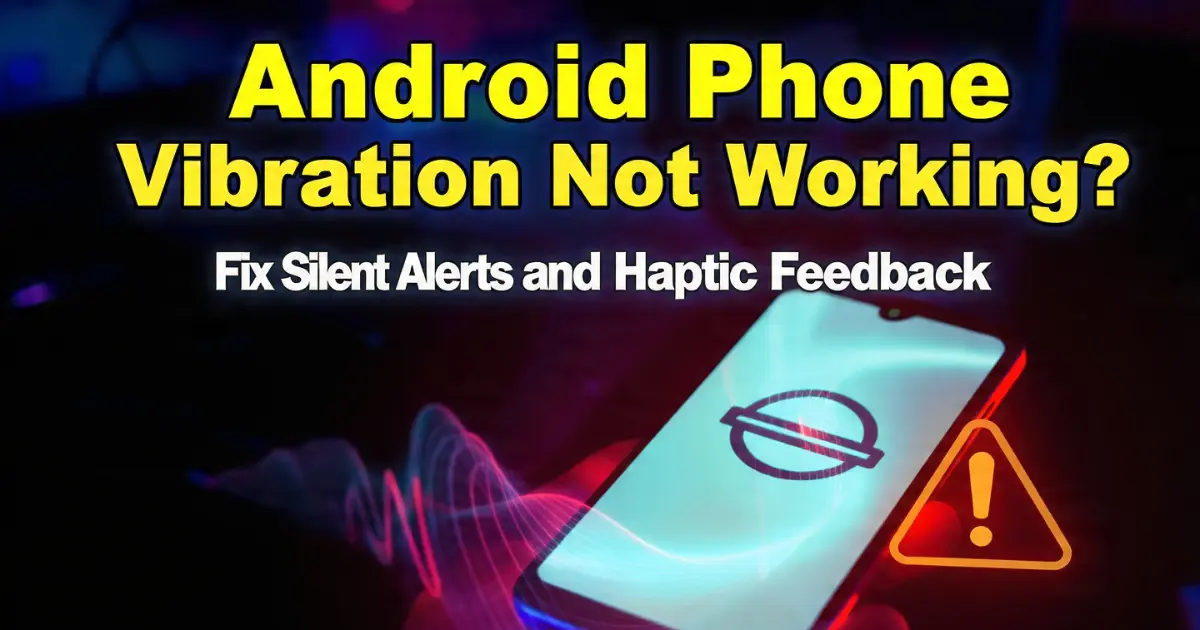
If you’re reading this, you’re likely in the same boat. Maybe your Android phone vibration stopped working after a software update, or perhaps your Android haptic feedback is missing on navigation gestures. It’s incredibly frustrating when you realize how much we rely on tactile feedback to navigate our digital lives. From knowing you’ve successfully hit the “Q” on your keyboard to feeling that ghost-thrum in your pocket for a text message, vibration is essential.
Last Tuesday, I missed three urgent calls from my editor while my phone was sitting right next to me on my desk. No ringtone? That was intentional—I keep my phone on vibrate to stay focused. But there was no “buzz-buzz” either. My phone had gone completely silent, and not in the way I wanted.
Also Reade : Complete Android Fix Guide: Every Android Problem Solved (2026)
I’ve spent the last decade tearing down Android phones and digging through system logs. Let’s get your device shaking again.
Introduction: Why Your Android Stopped Buzzing
Before we dive into the guts of the settings, we need to distinguish between two different things. First, there’s alert vibration—that’s the heavy motor movement used for incoming calls and text messages. Then, there’s haptic feedback (or touch feedback), which uses haptic technology to provide a subtle tap when you type on Gboard or use the back gesture.
Often, an Android vibration motor issue isn’t a hardware failure at all. It’s usually a software conflict. Did you just update to Android 15? Or maybe you toggled a power-saving mode that you forgot about?
Before you panic about Android vibration motor hardware problems, do the “dumb check.” Swipe down your notification shade. Is Do Not Disturb Mode on? Is your phone set to “Mute” instead of “Vibrate”? It sounds obvious, but you’d be surprised how often a stray tap in the pocket disables everything.

Software Audit: Deep Dive into Sound & Haptic Settings
Android isn’t a monolith. A Samsung Galaxy feels different from a Google Pixel, and a Xiaomi device has a completely different UI than a OnePlus or Motorola.
The Master Switches
The first place I always look is the Accessibility Settings. This is a common “gotcha.” On many versions of Android, there is a master toggle that can override individual app settings.
- Open Settings.
- Navigate to Accessibility > Vibration and haptics.
- Ensure the “Use vibration and haptics” toggle is ON.
If this is off, it doesn’t matter what your ringtone settings say—the motor is effectively dead.
Samsung One UI vs. Google Pixel UI
On a Samsung Galaxy, go to Settings > Sounds and vibration > Vibration intensity. I’ve seen cases where, after a firmware update, these sliders randomly reset to zero. Make sure “Incoming call,” “Notifications,” and “System” are all turned up.
On Pixel phones, the path is Settings > Sound & vibration > Vibration & haptics. Google gives you granular control over “Ring vibration,” “Notification vibration,” and “Touch feedback.” If your Android touch vibration is not working, this is usually where the culprit hides.
The Gboard Trap: Fixing Haptics for Typing
Is your Android keyboard vibration not working? If you use Gboard (the default for many), the app has its own internal haptic settings that can override the system.
- Open any app where you can type.
- Tap the Settings (gear icon) on the keyboard.
- Go to Preferences.
- Scroll down to Haptic feedback on keypress.
- If it’s on but weak, tap Vibration strength on keypress and set it to “System Default” or manual “Max.”
If you’re a SwiftKey user, the process is similar: Settings > Sound & Vibration within the SwiftKey app itself.
Power Management: Battery Saver and Background Restrictions
This is a classic “Experience” lesson I learned the hard way. I once spent two hours troubleshooting a OnePlus vibration issue only to realize the phone was at 15% battery.
Most Android phones automatically disable the Linear Resonant Actuator (the fancy name for your vibration motor) when Battery Saver is active. Why? Because physically spinning a motor or moving a magnetic weight consumes a lot of juice.
Adaptive Battery and Throttling
Check if your Android vibration keeps turning off only when the battery is low.
- Go to Settings > Battery > Battery Saver.
- Check the “Extreme Battery Saver” or “Schedule” settings.
- In some cases, Adaptive Battery might decide that the vibration motor is a “non-essential” background process if it thinks you’re trying to stretch the last 10% of your charge.
Pro Tip: The “Gaming Mode” Conflict If you find your Android phone no vibration in games, check your phone’s built-in “Game Mode” or “Game Dashboard.” Many of these modes have a “Do Not Disturb” feature that kills haptics to prevent “distractions” during gameplay. I’ve seen this happen frequently on Xiaomi and Realme devices.
Hardware Testing: Is the Motor Dead?
If you’ve checked every setting and your Android phone is still silent without vibration, we need to see if the hardware actually works. We can do this without opening the phone.
Hidden Diagnostic Menus
Most manufacturers include a secret “Service Mode.”
- For Samsung: Open the Phone app and dial
*#0*#. This opens a white diagnostic screen. Tap the Vibration tile. The screen should go black, and the phone should vibrate continuously. If it doesn’t, your motor is likely physically disconnected or burned out. - For Pixel/Motorola/Other: You might need a third-party app like “Device Info HW” or “Sensor Test.” These apps can manually trigger the vibration motor to see if it responds.
The “Gentle Tap” Trick (The Technician’s Secret)
Sometimes, the Android vibration motor—especially the older eccentric rotating mass (ERM) types—gets stuck. This happens often after dropping the phone or if the phone suffers water damage.
I’ve fixed dozens of phones by simply giving the back of the device a firm (but not violent) tap against the palm of my hand. This can sometimes “unstick” the internal weight of the motor. It sounds like “voodoo tech,” but it’s a legitimate mechanical fix for a mechanical part.

Advanced Software Fixes: Cache and System Updates
If the motor works in the diagnostic menu but not during calls, you have a system UI issue.
Wiping the Cache Partition
A corrupted system cache can cause the Android vibration no response issue, especially after a major OS update like moving to Android 14 or 15. This process won’t delete your photos or apps.
- Turn off your phone.
- Hold Volume Up + Power (this varies by model; some require a USB cable connected to a PC) to enter Recovery Mode.
- Use the volume buttons to select Wipe Cache Partition.
- Confirm with the Power button.
- Reboot your system.
Safe Mode Testing
If your Android vibration issue is due to a third-party app, Safe Mode is your best friend. Hold the Power button, then long-press the “Power Off” icon on the screen to see the Safe Mode prompt. In Safe Mode, only system apps run. If the vibration starts working again for messages or alarms, you have a rogue app (likely a third-party launcher or a custom notification app) that is hijacking your haptics.
Common Pitfalls and User Errors
We all make mistakes. Here are the ones I see most often in the comments of my blog:
- Individual App Settings: Is Android vibration not working on WhatsApp or Messenger? Check the app’s internal settings. Go to WhatsApp Settings > Notifications > Vibrate and ensure it’s not set to “Off.”
- The “Silent” Profile Sync: If you have a smartwatch connected, your phone might be set to “Mute phone while wearing watch.” Check your Wear OS or Galaxy Wearable app settings. This is a huge reason for Android vibration issues during Bluetooth connection.
- Bedtime Mode: I once thought my Android alarm vibration issue was a hardware failure. Turns out, I had Bedtime Mode scheduled to turn off all haptics and sounds from 11 PM to 7 AM.
- Case Interference: I’ve encountered bulky, rugged cases that are so tight they actually dampen the vibration motor’s movement to the point where you can’t feel it. Take the case off and test it bare.
When All Else Fails: The Factory Reset
If you’ve tried the dialer codes, wiped the cache, and verified every accessibility setting, but your Android vibration stopped working after a security patch, you might be facing a deep-seated software bug.
The “nuclear option” is a factory reset. Back up everything to Google Drive first. If a fresh, wiped phone still won’t vibrate during the initial setup vibration test, you are 100% looking at a hardware failure. At that point, it’s time to look up an Android vibration repair guide for your specific model or visit a certified technician to replace the vibration motor.
Android phone vibration not working is a minor problem that feels major because it breaks the “connection” between you and your device. Hopefully, these steps—from the “gentle tap” to the accessibility master switches—get your haptics humming again.
Did one of these fixes work for you? Or did you find a weird setting I missed? Drop a comment below—I’m always looking to update this guide with real-world user experiences!