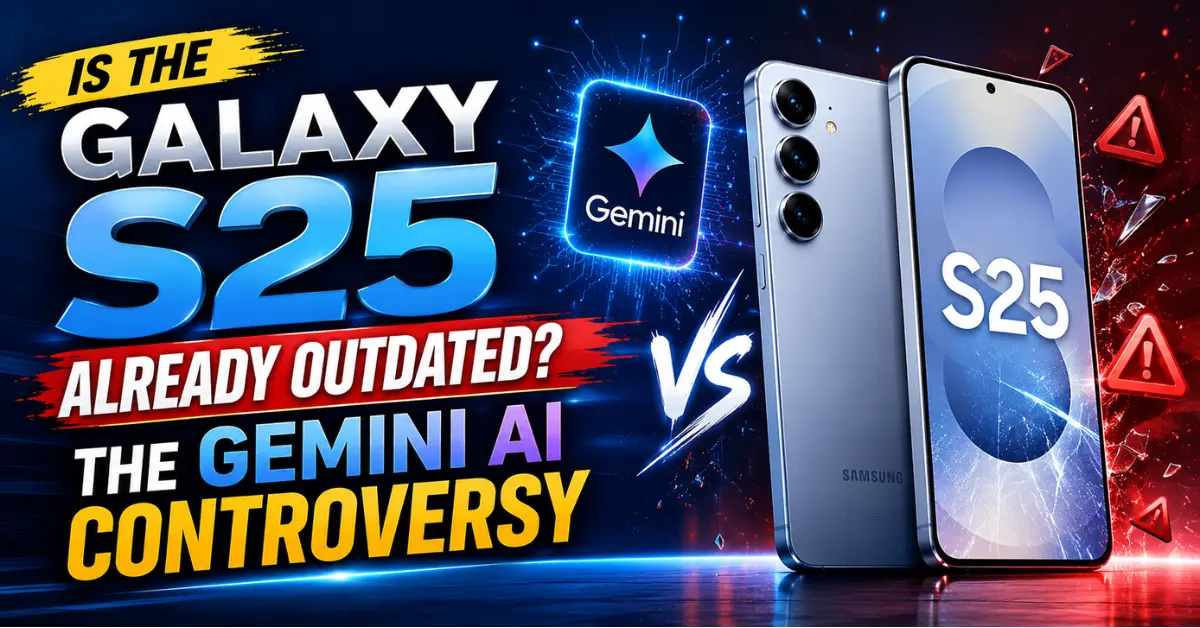
The Samsung Galaxy S25 is hitting shelves with a massive asterisk: the base model lacks the 16GB of RAM and NPU throughput required to run Google’s next-gen Gemini Nano 2 locally. If you buy the standard S25, you aren’t getting a future-proof flagship; you’re buying a “cloud-tethered” terminal that will likely be left behind when Google’s most advanced on-device AI features roll out next year.
The ‘Day One’ Obsolescence Reality
I’ve been tracking Samsung’s supply chain for over a decade, and this feels like the biggest “feature-gating” move yet. While the Snapdragon 8 Gen 4 is a beast, the base S25 is reportedly sticking with 8GB or 12GB of RAM.
Here is the problem: Gemini Nano 2—the engine behind Google’s next-gen multimodal AI—is a memory hog. If your hardware can’t run it locally, your phone has to send your data to a server, wait for a response, and likely charge you a subscription fee for the privilege. Being “AI-Ready” is no longer enough for a 2025 flagship; it’s either on-device or it’s outdated.
The Hardware Lock: What They Aren’t Telling You
Samsung is creating a tiered class of smartphone users. By locking the most advanced Galaxy AI features behind hardware specifications only found in the “Ultra” or higher-tier models, they are effectively penalizing anyone who prefers a smaller form factor.
- Privacy Gap: On-device AI stays on your phone. Cloud AI doesn’t.
- Latency: Local processing is instant; cloud processing depends on your 5G signal.
- The Hidden Cost: Running AI in the cloud is expensive for Samsung, which is why “Galaxy AI” features are only free until the end of 2025.
My Take: The $1,200 Regret
I’ll be blunt: I was ready to trade in my S24 for the S25 the moment it dropped. But after seeing these NPU benchmarks and RAM limitations, I’m holding off. There is nothing more frustrating than spending $1,000+ on a “premium” device only to realize it’s already a bottleneck for the software it’s supposed to showcase.
If you aren’t buying the Ultra, you’re essentially buying yesterday’s tech in a shiny new shell. My advice? Wait for the mid-cycle refresh or look at benchmarks to see if the base model can actually handle Large Language Models (LLMs) without stuttering.
The Verdict: Should You Buy or Bypass?
The S25 is a great phone for someone upgrading from an S21 who doesn’t care about AI. But for the power user? It’s a trap.
The Final Checklist Before You Pre-Order:

- Do you want local AI privacy? If yes, skip the base S25.
- Are you okay with a subscription model? Because that’s where cloud AI is headed.
- Resale Value: In two years, phones that can’t run local AI will be worth significantly less.
Frequently Asked Questions
What is the Gemini Hardware Lock?
It refers to advanced Google AI features that require high NPU speeds and at least 14GB-16GB of RAM to run locally. Base S25 models may not meet these requirements.
Will my S25 still have Galaxy AI?
Yes, but it will rely heavily on cloud processing, which is slower and potentially requires a future subscription.
Is the Snapdragon 8 Gen 4 powerful enough?
The processor is fast, but without sufficient RAM, it cannot keep the Gemini Nano 2 model “resident” in memory, causing a hardware bottleneck.