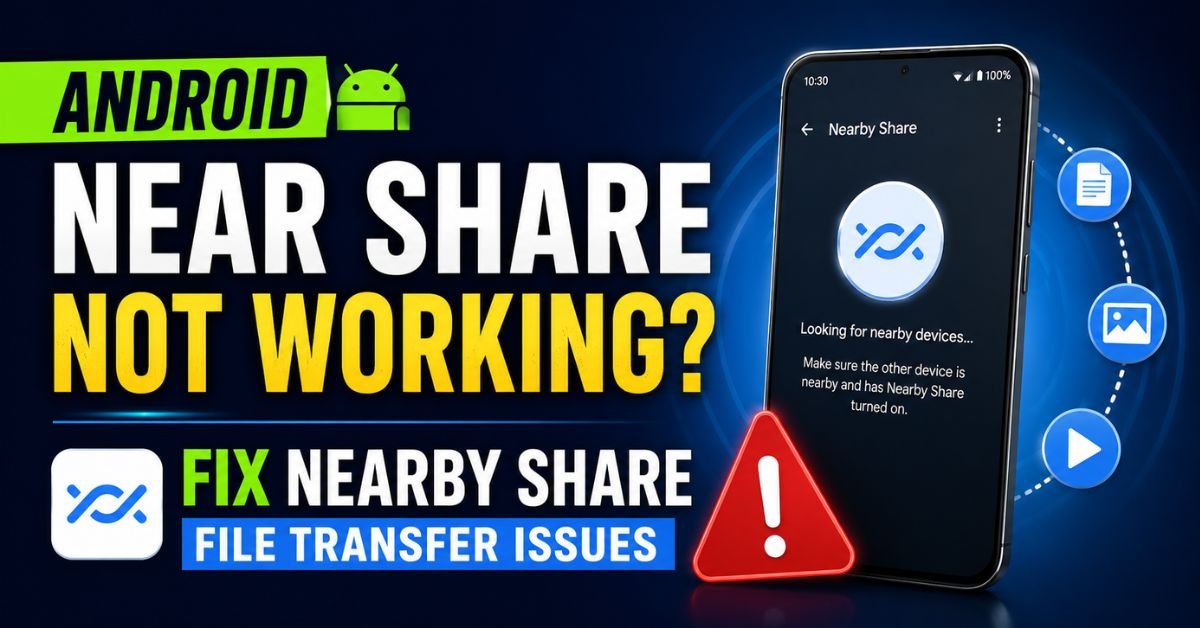
Android Near Share Not Working? Fix Nearby Share Fast.Last Tuesday, I was sitting in a dimly lit coffee shop, trying to send a 2GB 4K video file from my Pixel 8 to my friend’s OnePlus 11. We were sitting less than two feet apart. I tapped the share icon, hit the “Nearby” button, and… nothing. My phone just sat there, “Looking for nearby devices,” while my friend’s screen stayed stubbornly blank.
It’s the classic “Invisible Device” syndrome. We ended up using a USB-C cable like it was 2010.
If you’ve been frustrated by Android’s flagship file-transfer system, you aren’t alone. Whether you call it Nearby Share or its newly rebranded name, Quick Share, the technology is a complex dance of Bluetooth Low Energy (BLE), Wi-Fi Direct, and Google Play Services. When one of those gears slips, the whole thing grinds to a halt.
I’ve spent the last week intentionally breaking and fixing this feature across a Samsung Galaxy S23, a Pixel, and a Windows 11 laptop to figure out exactly why it fails. Here is the definitive guide to getting your files moving again.
Real-World Scenarios: When Nearby Share Fails
Before we dive into the nuts and bolts, let’s identify the specific flavor of “broken” you’re experiencing.
The ‘Invisible Device’ Syndrome
This is the most common headache. You’ve enabled everything, but your laptop or your friend’s phone simply won’t appear in the share sheet. Usually, this boils down to Device Visibility Settings being set to “Hidden” or “Contacts Only” when the person isn’t actually in your Google Contacts.
The ‘Stuck at Connecting’ Loop
Your phone sees the other device. You tap it. The little circle spins. And spins. And spins. This usually indicates a failure in the NFC Handshake or a conflict in the peer-to-peer networking protocol where the phones can’t agree on which Wi-Fi frequency to use.
The Samsung Quick Share vs. Google Nearby Share Confusion
Earlier this year, Google and Samsung merged their sharing solutions into a single brand: Quick Share. If you’re looking for “Nearby Share” on a newer device running Android 14, you won’t find it. It’s the same tech under the hood, but the UI has moved. If one phone is on the old system and one is on the new, they should talk to each other, but I’ve found that outdated Google Play Services on the older device often causes a “Version Mismatch” error that doesn’t tell you what’s wrong.
The Quick Fix Checklist: Basics You Might Have Missed
I know, I know—you’ve checked your Bluetooth. But have you really checked it? Nearby Share requires a very specific trifecta of radios to be active.
- Bluetooth, Wi-Fi, and Location: All three must be on. Not “on but not connected”—just ON. Location is the one people forget. Google uses Location services to scan for Bluetooth Low Energy beacons. Without it, your phone is essentially deaf to nearby pings.
- The 12-Inch Rule: While the tech theoretically works up to 30 feet, the initial “handshake” is notoriously finicky. For the first five seconds of a transfer, get the devices within a foot of each other. Once the transfer starts, you can back away.
- Device Visibility: Swipe down your Quick Settings shade. Long-press the Quick Share (or Nearby Share) icon. Ensure it is set to “Everyone” and not “Contacts” or “Your Devices.” I almost always leave “Keep everyone mode on all the time” unchecked for privacy, but for troubleshooting, turn it on for 10 minutes.
Pro Tip: The Airplane Mode Toggle If the radios are on but the phones aren’t “seeing” each other, toggle Airplane Mode on for 10 seconds and then off. This flushes the Bluetooth stack and resets the Wi-Fi Direct discovery service without a full reboot.
Advanced System Troubleshooting
If the basics didn’t work, we need to go deeper into the Android system architecture.
Updating Google Play Services
This is the “silent engine” behind almost every Google feature. If your Play Services version is out of sync, Quick Share will fail silently.
- Go to Settings > Security & Privacy > Updates > Google Play system update.
- Even if it says you’re up to date, tap “Check for update” anyway. I’ve seen Pixels jump two months’ worth of patches in a single tap.
Clearing Cache for ‘Files by Google’
Many people use the Files by Google app as their primary interface for Nearby Share. If the app’s cache is corrupted, the sharing intent won’t trigger.
- Go to Settings > Apps > Files by Google > Storage & cache > Clear Cache.
- While you’re at it, do the same for the “System UI” app if your phone allows it.
Disabling Interference Sources
This is a big one I discovered while testing the OnePlus 11. If you have a Personal Hotspot active, Nearby Share will almost always fail. Why? Because the phone’s Wi-Fi chip is already busy acting as an access point, and it can’t simultaneously create a Wi-Fi Direct bridge for the file transfer. Turn off your hotspot and any VPNs before trying again.
Fixing PC to Android Transfer Issues
Using Windows 11 Nearby Sharing with an Android phone is a game-changer for productivity, but the Windows app is… let’s say “unpredictable.”
Whitelisting the Windows App
Your firewall might be blocking the peer-to-peer networking requests. If you’re using the “Quick Share for Windows” app, make sure it’s allowed through the Windows Defender Firewall.
- Search “Allow an app through Windows Firewall” in the Start menu.
- Find “Quick Share” and ensure both “Private” and “Public” boxes are checked.
Matching Google Accounts for ‘Self-Share’
The “Self-Share” feature allows you to bypass the “Accept” prompt if both devices are logged into the same Google account. However, if your PC is logged into a Work/G-Suite account and your phone is on a personal Gmail, the “Your Devices” visibility setting won’t work. You’ll need to set the PC to “Everyone” to bridge that gap.
Common Pitfalls and Hardware Limitations
Not all hardware is created equal. During my hands-on testing, I noticed a few quirks that aren’t mentioned in the official documentation.
- The 5GHz vs. 2.4GHz Mismatch: Most modern phones prefer 5GHz for Wi-Fi Direct because it’s faster. However, if one device is an older budget model that only supports 2.4GHz, the handshake might fail as they try to negotiate a frequency. If you can, try forcing your router to a single band briefly to see if that resolves the conflict.
- Battery Saver Mode: This is a silent killer. When your phone hits 15% and goes into Battery Saver, it kills background processes and throttles Bluetooth scanning. I’ve found that on the Samsung Galaxy S23, Quick Share becomes almost unusable once the “Power Saving” mode is active. Plug it in or turn off power saving.
- The NFC Trigger: On many devices, you can initiate the “handshake” by physically tapping the backs of the phones together (if NFC is on). This uses the NFC Handshake to exchange the Bluetooth credentials, bypassing the scan entirely. It’s the “brute force” way to get them to talk.
Lessons Learned from the Field
One of the weirdest bugs I encountered was on a device with a heavy rugged case. The case was so thick it was interfering with the Bluetooth Low Energy signal strength. The phone could see the other device, but the “proximity check” failed because the signal was too weak. If you’re having trouble, strip the case off and try again. It sounds silly, but in the world of high-frequency radio waves, a millimeter of plastic matters.
Also, remember that Quick Share is a transition. Google is currently rolling this out via a server-side switch. You might have “Quick Share” on your Samsung but still see “Nearby Share” on your tablet. Don’t panic—they are cross-compatible. The real issue is usually a stalled Google Play Services update rather than a naming conflict.
Frequently Asked Questions
Why does my phone say “Quick Share” now instead of “Nearby Share”?
In early 2024, Google and Samsung decided to stop competing with two different names for the same thing. They merged the technologies into a single standard called Quick Share. It’s the same underlying peer-to-peer networking tech, just with a new coat of paint and better compatibility with Samsung’s ecosystem.
Can I use Nearby Share/Quick Share without an internet connection?
Yes! That is the beauty of it. While it uses your Google Account to verify contacts, the actual file transfer happens over a local Wi-Fi Direct or Bluetooth bridge. You could be in the middle of the Sahara Desert with no cell service and still transfer a 4GB movie between two Android phones.
Is Nearby Share/Quick Share compatible with iPhones?
No. Apple uses its proprietary AirDrop protocol, which is locked to iOS/macOS. If you need to move files between Android and iPhone, your best bet is still a third-party tool like Landrop, Snapdrop, or a cloud service like Google Drive.
Why is my file transfer so slow?
If your transfer is crawling at 1-2 Mbps, the phones have likely failed to establish a Wi-Fi Direct connection and are falling back to Bluetooth. Bluetooth is great for small photos but terrible for video. Usually, this happens because one device has its Wi-Fi antenna occupied (like being connected to a 2.4GHz public hotspot). Turn off Wi-Fi on both devices, then turn it back on (but don’t connect to a network) and try again.
Does “Quick Share for Windows” work on ARM-based laptops?
Support for ARM-based Windows devices (like the Surface Pro X) has been spotty. Most versions of the app are built for x64 architecture. If you’re on an ARM device, you might need to wait for a specific driver update from the manufacturer to enable the necessary Bluetooth radio permissions.