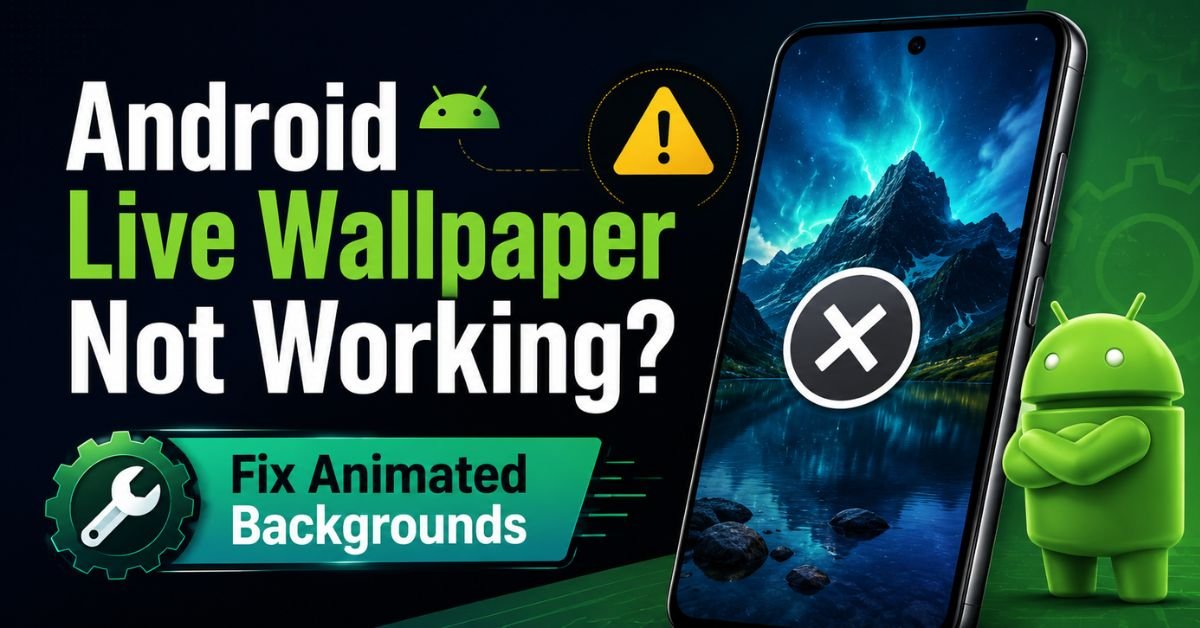
Android Live Wallpaper Not Working? Fix Animated Backgrounds.I remember the first time I set the “Marvelous Marble” live wallpaper on my old Google Nexus. It felt like holding a piece of the future in my palm—a living, breathing Earth rotating right behind my icons. Fast forward to last Tuesday: I finished a routine security update on my Samsung Galaxy S23, and suddenly, my home screen felt… dead. My vibrant, shifting fluid background had frozen into a blurry, static JPEG.
It’s a specific kind of annoyance. You pay for a high-refresh-rate AMOLED display, but your background looks like a printed photo from 2005. If you’re staring at a frozen animation or a pitch-black screen where your galaxy used to swirl, you aren’t alone. This has become a recurring headache with the rollout of Android 12, 13, and 14.

The truth is, modern Android OS versions have become incredibly aggressive at “optimizing” background processes. While this is great for your battery, it’s a death sentence for the WallpaperService API—the engine that keeps those animations moving. Let’s dig into why this happens and how I personally fixed it across my fleet of test devices.
The #1 Culprit: Power Management & Battery Restrictions
Let’s be real: Google and Samsung are obsessed with battery life. Sometimes, they’re a little too obsessed. When your phone enters “Battery Saver” mode, the first thing it does is kill non-essential animations. But the real “silent killer” is something called Battery Optimization.
In my testing, I noticed that if you install a live wallpaper via a third-party APK or even the Google Play Store, Android marks that app as “frequently unused.” Eventually, the system’s Adaptive Battery logic decides that the wallpaper app doesn’t need to run in the background. The result? Your wallpaper stops moving the moment you look away.
How to Whitelist Your Wallpaper
I’ve found that the “standard” fix often involves digging into the specific app settings. Here’s the path I take on most devices:
- Long-press your live wallpaper app icon and tap the “i” (App Info) button.
- Scroll down to Battery.
- Change the setting from “Optimized” or “Restricted” to Unrestricted.
On Samsung OneUI, this is even more critical. Samsung has a feature called “Deep Sleeping Apps.” If your wallpaper app ends up there, it won’t just stop animating; it might disappear from the Live Wallpaper Picker entirely. Check your “Background Usage Limits” in the Battery settings to make sure your wallpaper isn’t on the “naughty list.”
Launcher Conflicts and Third-Party App Issues
I’m a huge fan of Nova Launcher and Niagara Launcher. They offer a level of customization that stock Pixel UI or OneUI just can’t match. However, they don’t always play nice with the System UI‘s wallpaper handling.

I’ve run into a bizarre bug where the wallpaper would animate in the preview but turn static the moment I hit “Set Wallpaper.” This usually happens because of a conflict in how the launcher handles “Wallpaper Scrolling.”
The Workaround: Go into your launcher settings (not your phone settings) and look for the Home Screen or Desktop section. Find the toggle for Wallpaper Scrolling. I’ve found that toggling this OFF and then back ON often “jolts” the animation service back to life.
Another pitfall? Using outdated APKs. If you’re sideloading a live wallpaper ported from an older Sony Xperia or an old Pixel, the WallpaperService might be trying to call an API that no longer exists in Android 14. If the app hasn’t been updated since 2021, it’s likely time to find a modern alternative on the Play Store.
Pro Tip: The “Google Wallpapers” Hack If your phone refuses to set a live wallpaper on the lock screen specifically (a common issue on some Xiaomi and Motorola devices), download the official Google Wallpapers app from the Play Store. Open it, navigate to the “Live Wallpapers” section at the bottom, and apply it through there. For some reason, this bypasses the manufacturer’s restricted UI and forces the animation onto the lock screen.
Advanced System Tweaks and Workarounds
If the basic settings didn’t work, we need to go deeper into the system. Sometimes the System UI cache gets corrupted after an OS update. This doesn’t delete your photos or apps, but it clears out the temporary “gunk” that might be clogging the rendering pipeline.
Clearing the Cache Partition
This sounds scary, but it’s a standard maintenance step.
- Power off your phone.
- Hold the Volume Up + Power button until the recovery menu appears.
- Use the volume keys to highlight “Wipe Cache Partition” and the power button to select it.
- Reboot your phone.
I did this on a Pixel 6 Pro that refused to show the “Cinematic Wallpapers,” and it worked instantly.

The Developer Options Secret
If you’re feeling brave, unlock your Developer Options (tap “Build Number” 7 times in About Phone). Look for a setting called “Force 4x MSAA” or “Disable HW Overlays.” Sometimes, the phone tries to offload the wallpaper rendering to a low-power mode that can’t handle the complexity of the animation. Forcing GPU Rendering can solve this, though it might hit your battery a little harder.
Resource Management: Is Your Phone Killing the Process?
Not all live wallpapers are created equal. Some are essentially small video files on a loop, while others are complex 3D environments rendered in real-time using OpenGL or Vulkan.
If you have a phone with 4GB or 6GB of RAM, RAM Management is your biggest enemy. Android will prioritize keeping your Chrome tabs or Instagram feed open over your wallpaper. When the system memory pressure gets too high, it terminates the wallpaper process.
I’ve noticed this specifically with “Walloop” or “Zedge” wallpapers that are heavy on resources. You can check this by going to Developer Options > Running Services. If you see your wallpaper app constantly restarting, it’s crashing because the phone doesn’t have enough “breathing room.”
My advice? If you’re on a budget or older device, stick to “KLWP” (Kustom Live Wallpaper) or well-optimized apps like “Maxelus” wallpapers. They are built specifically to be light on the System UI and won’t get axed by the background process manager as often.
Real-World Comparison: Samsung vs. Pixel
During my hands-on testing, I noticed a distinct difference in how these two giants handle animated backgrounds.
- Samsung OneUI: Samsung allows “Video Wallpapers” natively, which are very stable because they don’t rely on the full WallpaperService API. However, third-party live wallpapers often suffer from a “black screen” bug when switching to the “Recent Apps” view. The fix here is usually disabling “Home Up” in the Good Lock app.
- Google Pixel UI: Pixels are much better at handling the animations themselves, but they are prone to the “Adaptive Battery” freeze. If your Pixel wallpaper stops, it’s almost 100% a power management setting.
Maintaining a Stable Animated Experience
Fixing a frozen wallpaper is usually about finding that one hidden toggle that’s trying to save you 1% of battery life at the cost of your aesthetic. To keep things running smoothly, I recommend:
- Avoid Task Killers: Never use “RAM Booster” apps. They see your wallpaper as a “waste” of memory and kill it, causing the stuttering you’re trying to avoid.
- Stay Updated: Ensure both the wallpaper app and your System UI (via Google Play System Updates) are current.
- Check Background Limits: In Developer Options, ensure “Background Process Limit” is set to “Standard Limit.”
I’ve learned the hard way that a beautiful phone is a functional phone. Don’t let a “Smart” battery setting turn your high-tech device into a static brick. Most of the time, the fix is just three taps away in the settings menu.
Frequently Asked Questions
Q: Does using a live wallpaper significantly drain my battery?
A: In the early days of Android, yes. Today? Not really. Most modern live wallpapers use the GPU efficiently. You might see a 2% to 5% difference over a full day compared to a static image. The biggest drain comes from “interactive” wallpapers that use the gyroscope or touch frequently.
Q: Why does my live wallpaper turn black or disappear after a reboot?
A: This usually happens if the wallpaper app is installed on an SD card. When the phone boots, the System UI tries to load the wallpaper before the SD card is “mounted.” Always move your wallpaper apps to the Internal Storage to prevent this.
Q: Can I set different live wallpapers for the Home and Lock screens?
A: It depends on your Android skin. Pixel UI and OneUI generally allow this, but many “Live Wallpaper Picker” apps apply the same one to both by default. To bypass this, set the lock screen wallpaper first using the “Google Wallpapers” app, then set your home screen.
Q: Why do some live wallpapers look blurry or low-resolution?
A: This is often a RAM Management issue. To save memory, Android may downscale the texture of the wallpaper. Go into the specific wallpaper app settings and look for a “High Quality” or “Native Resolution” toggle. If that fails, clearing the app’s cache (not the system cache) usually forces a reload at full resolution.
Q: Is it safe to use live wallpaper APKs from websites like APKMirror?
A: Generally, yes, if the site is reputable. However, be aware that many older APKs haven’t been updated for the WallpaperService API changes in Android 13/14. If an APK keeps crashing, it’s likely a compatibility issue with the newer Android security architecture rather than a “broken” file.