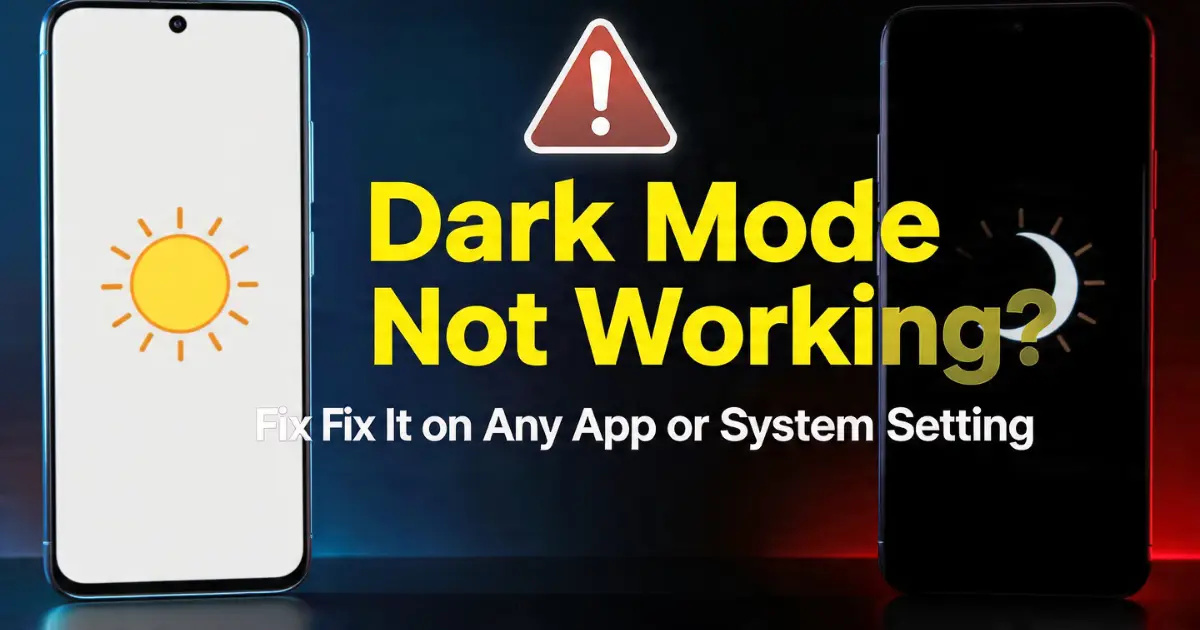
If you are reading this, you’ve likely dealt with the same frustration. Maybe your Android Dark Mode stopped working after a recent Firmware update, or perhaps Android apps are not switching to dark mode despite your best efforts. I’ve spent years tinkering with Android OS, from the early days of rooting to testing the latest Android 15 update on my Google Pixel 14 and Samsung Galaxy S24. I’ve seen every bug in the book.
It happened again last night. I was scrolling through my feed at 2 AM, eyes adjusted to the comforting dimness of my room, when I opened a specific app. BAM. A blinding white screen seared my retinas like a solar flare. Even though my System-wide settings were set to dark, this one app decided it didn’t care about my sleep hygiene or my OLED Display.

Also Reade : Complete Android Fix Guide: Every Android Problem Solved (2026)
The truth is, “Dark Mode” isn’t just one switch; it’s a complex dance between the User Interface (UI), app-level code, and the Android System Webview. When it breaks, it’s usually because one of those dancers tripped. Let’s get your screen back to the shadows.
Why Dark Mode Fails: Understanding the Basics
Before we dive into the deep fixes, we need to understand what we’re actually fighting. On a technical level, dark mode works differently depending on your hardware. If you have an AMOLED or OLED Display, dark mode literally turns off pixels to create “true black,” which is why it’s so great for battery saver enthusiasts. If you have an LCD, it’s just a color swap.
The problem usually falls into three categories:
- The system setting is bugged (System-wide).
- The app developer didn’t implement the “follow system” flag.
- A third-party setting (like a Blue Light Filter or Battery Saver) is overriding the theme.
I remember a specific Android Dark Mode issue on Samsung Galaxy devices where a custom theme from the Galaxy Store would “lock” the UI in light mode, ignoring the system toggle entirely. It took me three hours to realize the theme was the culprit, not the OS.

Step 1: Fixing System-Wide Dark Mode Glitches
If your Android system dark mode issue is universal (meaning even the settings menu is white), we start here.
Check the Schedule (The “Ghost” Toggle)
I can’t tell you how many times I’ve had someone complain that Android Dark Mode keeps turning off, only to find they had a schedule set.
- Go to Settings > Display > Dark Theme.
- Check if “Schedule” is enabled. If it’s set to “Sunset to Sunrise,” your phone will automatically switch to light mode during the day.
- Pro Tip: Sometimes the “Sunset” timing gets bugged if your Location Services are off. If your phone doesn’t know where you are, it doesn’t know when the sun goes down!
The Battery Saver Conflict
This is a weird one. On older versions of Android, Battery Saver would actually force Dark Mode to save juice. However, I’ve seen recent Android Dark Mode battery saver conflict issues where certain “Medium Power Saving” modes on Xiaomi or Samsung devices actually disable the theme to reduce the “processing load” of switching assets. (It sounds crazy, but I’ve seen it happen). Try turning off Battery Saver to see if the dark theme returns.
Update Android System Webview
This is the “silent killer” of app themes. Android System Webview is the engine that lets apps like Gmail or Twitter display web content. If this is outdated, you’ll find Android Dark Mode not working in Chrome or Android Dark Mode not working in Gmail.
- Head to the Google Play Store.
- Search for “Android System Webview.”
- If there’s an update, take it. This fixed an Android Dark Mode not working in Instagram bug I had last month instantly.
Step 2: When Specific Apps Refuse to Go Dark
What if the system is dark, but Android Dark Mode is not applying to apps like Facebook or WhatsApp?
Manual App Overrides
Some apps have their own independent theme engines.
- WhatsApp: Settings > Chats > Theme > Dark.
- Instagram: Settings and Privacy > Accessibility > Dark Mode. (Yes, they buried it under accessibility!)
- Facebook: Settings & Privacy > Settings > Dark Mode.
If Android Dark Mode is not working in Facebook, it’s often because the app’s internal “Cloud Settings” haven’t synced with your phone’s local settings. I usually fix this by logging out and logging back in.

Clearing the Application Cache
If Android Dark Mode stopped working for just one app, the Application Cache is likely corrupted. I once had a YouTube update that left me with a “Grey-Scale” bug where the background was white but the text was light grey—completely unreadable.
- Long-press the app icon.
- Tap App Info (i).
- Go to Storage & Cache.
- Tap Clear Cache.
- Do not tap “Clear Data” unless you want to log in again and lose your settings!
Step 3: The Power-User Fix (Developer Options)
If you have an older app that simply won’t update to support dark mode, or if you’re facing an Android force dark mode not working issue, we need to bring out the big guns: Developer Options.
How to Unlock Developer Options
- Go to Settings > About Phone.
- Find the Build Number.
- Tap it 7 times. You’ll see a little toast message saying, “You are now a developer!”
- Go back to Settings > System > Developer Options.
Enabling “Override Force-Dark”
Once inside, search for a toggle called “Override force-dark” (or “Force Dark Mode”). When you toggle this, the Android OS will manually invert the colors of all apps, even if they don’t officially support it.
The Pitfall: I have to warn you, this isn’t perfect. I used this on an old banking app, and it made the “Send Money” button invisible. Because it’s a forced override, sometimes white text stays white on a newly black background. If you notice Android Dark Mode readability problems, this toggle is likely why.
Common Pitfalls and Real-World Scenarios
The Accessibility Trap
I once spent an hour troubleshooting a Motorola phone where the user complained of an Android Dark Mode color inversion issue. It turned out they had accidentally enabled “Inverted Colors” in the Accessibility menu.
- Check Settings > Accessibility > Color and Motion.
- Ensure Color Inversion is OFF. If it’s on, Dark Mode will actually look like Light Mode, and everything will look like a photographic negative.
Android Dark Mode Bug after Android 15 Update
Major software updates are notorious for breaking System-wide settings. If you just updated and noticed Android Dark Mode is missing from settings or Android Dark Mode keeps switching to light mode, you might be dealing with a “Dirty Flash” bug. This happens when the new system code clashes with old cached data.
- The Fix: Wipe the System Cache Partition (if your phone allows it) or simply reset your “App Preferences” under Settings > System > Reset Options.
Hardware: LCD vs. AMOLED behavior
I’ve seen users complain about Android Dark Mode flickering issue on cheaper devices. Usually, this isn’t a software bug but a hardware limitation of budget LCD screens. At low brightness, the pulse-width modulation (PWM) used to dim the screen can cause visible flickering when displaying dark greys. If you see this, try turning off Adaptive Brightness.
Device-Specific Troubleshooting
Not all Androids are created equal. The way Xiaomi handles dark mode is vastly different from a Pixel.
- Samsung Galaxy: One UI has its own “Force Dark Mode” in the Labs section for some versions. Also, check “Eye Comfort Shield”—if it’s too aggressive, it can make the dark mode look muddy and brown.
- Xiaomi / Realme: These devices have a specific setting called “More Dark Mode options” where you can individually toggle which apps are allowed to be forced into dark mode. If an app isn’t working, check this list; it might be disabled there.
- OnePlus: If you are using “Canvas” wallpapers or highly customized “OxygenOS” themes, they can sometimes override the Android system dark mode to match the color palette of your wallpaper.
Advanced Troubleshooting: When All Else Fails
If you’ve tried the cache, the developer options, and the updates, and Android Dark Mode is still not working, we need to get serious.
Safe Mode Testing
Restart your phone in Safe Mode (usually by holding the Power Off button on the screen). If Dark Mode works perfectly in Safe Mode, then a third-party app—likely a launcher like Nova or a “theming” app—is causing the conflict.
Chrome Flags (For the Browser Junkies)
If your Android Dark Mode is not working in Chrome, try this:
- Open Chrome and type
chrome://flagsin the URL bar. - Search for “Auto Dark Mode for Web Contents”.
- Set it to Enabled. This will force every website you visit to be dark, regardless of whether the site supports it. It’s a game-changer for late-night reading.
Expert Insight: Many “Dark Mode” apps in the Play Store are just shortcuts to the system settings or, worse, contain aggressive adware. Android has had native dark mode since version 10; you don’t need a third-party app to “enable” it. Stick to system settings to protect your privacy.
Summary Checklist for Future Updates
To keep your Android Dark Mode optimization on point, keep this checklist handy after every Google Play Services or system update:
- Check Location Services: Ensure your phone knows the time so schedules work.
- Update Webview: Keep that rendering engine fresh.
- Check for “High Contrast Text”: In Accessibility settings, this can sometimes mess with how dark mode renders fonts.
- Restart: A simple reboot clears the System UI cache and often fixes Android Dark Mode not responding quickly.
Fixing dark mode issues is usually a game of elimination. Start with the obvious (the toggle), move to the hidden (Developer Options), and always check if an individual app is just being stubborn.
Hopefully, your screen is now a soothing sea of black and charcoal. If you’re still seeing a white screen after a factory reset, it might be time to contact your manufacturer’s support—but in 99% of cases, the steps above will save your eyes and your battery life.