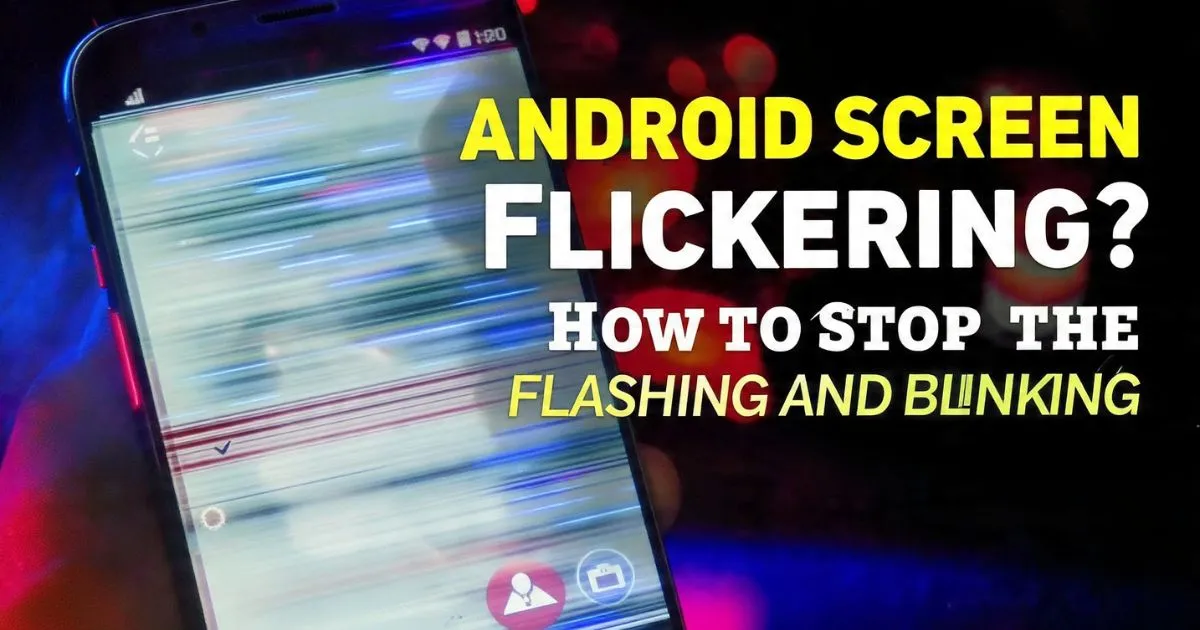
I still remember the night my old OnePlus 8 Pro decided to turn into a strobe light at 2 AM. I was just scrolling through some tech forums (ironically) when the display started this rhythmic, nauseating pulsing. My first thought? “Well, there goes $800.” I tried rebooting, I tried shaking it—neither worked. But before you go out and drop a month’s rent on a new Samsung S24 or Pixel 8, let me tell you: that android screen flickering isn’t always a death sentence for your hardware.
Sometimes, it’s just a confused GPU or a software bug that hitched a ride on the latest android 14 update. In this guide, I’m going to walk you through exactly how I’ve fixed dozens of these “blinking” phones over the years, from simple settings tweaks to the deep-dive Developer options stuff.

also reade : Android Screen Not Responding, Android Phone Overheating, Android Battery Draining Too Fast, Android Apps Keep Crashing
Understanding the Glitch: Why Android Screens Flicker
Before we start poking at settings, we need to know what we’re fighting. Is your screen doing a full-on strobe effect, or is it just a subtle dimming that’s driving you crazy?
The magic happens in the relationship between your GPU rendering engine and the display driver. When you see android screen flickering randomly, it’s often because these two aren’t talking to each other properly. On most modern phones, we’re dealing with an OLED display or an AMOLED screen. Unlike old-school LCD screen panels that have a constant backlight, OLEDs turn individual pixels on and off.
One big culprit is Pulse Width Modulation (PWM). This is how your phone handles brightness. Instead of actually dimming the light, it flashes the screen on and off really fast. To most eyes, it looks dim. To sensitive eyes (or when the software glitches), it looks like android screen flickering at low brightness.
Then there’s the hardware side. If you’ve got an android screen flickering after drop or android screen flickering after water damage, we might be looking at a loose flex cable or a failing LCD digitizer. But let’s not assume the worst yet.


Immediate Quick Fixes for Instant Relief
Sometimes the solution is so simple it’s almost insulting. If your android display flickering fix is just a toggle away, you’ll save yourself a lot of gray hair.
Also Reade : Complete Android Fix Guide: Every Android Problem Solved (2026)
1. The Adaptive Brightness Reset
Adaptive brightness uses the ambient light sensor to adjust your screen. If that sensor is dirty or the software is bugged, the phone will constantly jump between brightness levels, causing an android screen flickering constantly sensation.
- Go to Settings > Display.
- Toggle Adaptive brightness OFF.
- Manually set the slider to about 50% and see if the blinking stops.
2. Toggling the Refresh Rate
High refresh rates are great until they aren’t. I’ve seen many cases where an android 120hz screen flickering fix was as simple as dropping down to 60Hz.
- Check your display settings for “Motion Smoothness” or “Screen Refresh Rate.”
- If it’s on 120Hz or Adaptive refresh rate, switch it to Standard 60Hz.
- If the flickering stops, you might have a display driver issue specifically related to high-speed switching.
3. The “Hard Restart”
No, not just turning it off and on. I mean a forced reboot. For most phones, hold the Power + Volume Down buttons for 15 seconds until the logo appears. This clears the temporary system cache and forces the GPU to re-initialize the display.
Expert Insight: I’ve noticed that android screen flickering when charging is often caused by low-quality third-party cables or bricks. If your phone only blinks when it’s plugged in, it’s likely electrical interference. Try an official OEM charger before panicking.
Hands-on Technical Fixes: Using Developer Options
If the basics didn’t work, it’s time to go under the hood. Developer options is where the real “magic” (and some risks) happens.

To enable this, go to Settings > About Phone and tap the Build Number seven times. You’ll see a message saying “You are now a developer!”
Disable HW Overlays
This is the holy grail for fixing android screen flickering randomly. Usually, Android uses a “hardware overlay” for every app to decide whether the CPU or GPU should handle the rendering. Sometimes, the hand-off between them causes a flicker.
- Open Developer options.
- Scroll down to the Hardware-accelerated rendering section.
- Find Disable HW overlays (or “Always use GPU for screen compositing”) and toggle it ON. Warning: This will use a bit more battery, but it often stops the android amoled screen flickering fix instantly by forcing the GPU to handle everything.
Force GPU Rendering
While you’re in there, look for Force GPU rendering. This makes the phone use the GPU for 2D elements that might otherwise be handled by the CPU. If you’re seeing android screen flickering top half fix or android screen flickering bottom half fix, this can sometimes stabilize the image.
Surface Updates
Wait! If you see a toggle for Show surface updates, do NOT turn it on unless you want your screen to flash pink every time anything moves. If your screen is flashing pink and you were recently messing in these settings, this is likely why.
Isolating Software Conflicts: The Safe Mode Test
Sometimes it’s not the phone; it’s that sketchy wallpaper app you downloaded last week. To find out, we use Safe Mode.
How to enter Safe Mode:
- Press and hold the Power button.
- Long-press the “Power Off” icon on the screen.
- Tap “Safe Mode.”
In Safe Mode, your phone runs only the original factory apps. If the android screen blinking fix is successful here, you know a third-party app is the culprit. Look for apps that use “Screen Overlays” (like Facebook Messenger bubbles, blue light filters, or custom launchers).
Clearing the Cache Partition
This is a classic “pro” move. It doesn’t delete your photos, but it wipes the temporary system files that might be corrupted after an android 13 update or android 15 update.
- Turn off your phone.
- Hold Volume Up + Power (this varies by model, some require connecting to a PC).
- Use the volume keys to select Wipe Cache Partition.
- Reboot.

Common Pitfalls: What Not to Do
I’ve seen people make their situations worse by following bad advice.
- Don’t ignore updates: I know, sometimes updates cause the problem. But often, android screen flickering after android 14 update is a known bug that is fixed a week later in a minor patch. Check for firmware updates religiously.
- Beware of Screen Filter apps: Apps like “Twilight” or “Blue Light Filter” that sit on top of your system can conflict with the android oled screen flickering fix built into the OS. Disable them first.
- Case Pressure: I once had a client whose android screen flickering edges fix was just taking off a cheap, over-tightened plastic case that was squeezing the digitizer.
When to Call the Pros: Recognizing Hardware Failure
If you’ve tried a factory data reset and the screen is still doing a light show, we have to talk about hardware.
The Telltale Signs of Hardware Damage:
- Colored Lines: If you see android screen flickering horizontal lines fix or vertical lines, that’s almost always a cracked internal panel or a failing flex cable.
- Tints: A persistent android screen flickering green tint fix or pink tint often indicates the OLED material is oxidizing or failing.
- Dead Zones: If the screen flickers and then becomes unresponsive, your LCD digitizer is likely toast.
Repair vs. Replace
If you have a Samsung A series or a Realme Narzo, the android screen flickering repair cost might actually be more than the phone is worth. However, for a flagship like a Pixel 8 Pro or OnePlus 12, replacing the screen is worth it.
Before you pay a shop, check if your device is near a magnet. I’ve seen android screen flickering near magnet issues caused by magnetic phone mounts in cars or iPad covers nearby. It sounds crazy, but magnets mess with the internal sensors.
Summary Checklist for a Flicker-Free Life
- Toggle Adaptive Brightness and High Refresh Rate (switch to 60Hz).
- Enable Developer Options and “Disable HW Overlays.”
- Check for heat—android screen flickering when hot is a safety feature to prevent the OLED from burning. Let it cool down!
- Boot into Safe Mode to rule out rogue apps.
- Try DC Dimming—Some phones (Xiaomi, OnePlus) have a “DC Dimming” or “Anti-Flicker” mode in settings. This is the ultimate android screen flickering pwm fix for those with sensitive eyes.
Fixing a flickering screen is a process of elimination. Start with the software, move to the developer tweaks, and only then consider the hardware. My OnePlus 8 Pro? It turned out to be a weird conflict between a “Night Mode” app and the system’s own blue light filter. I deleted the app, toggled HW overlays, and it lived for another three years. Yours probably can too.