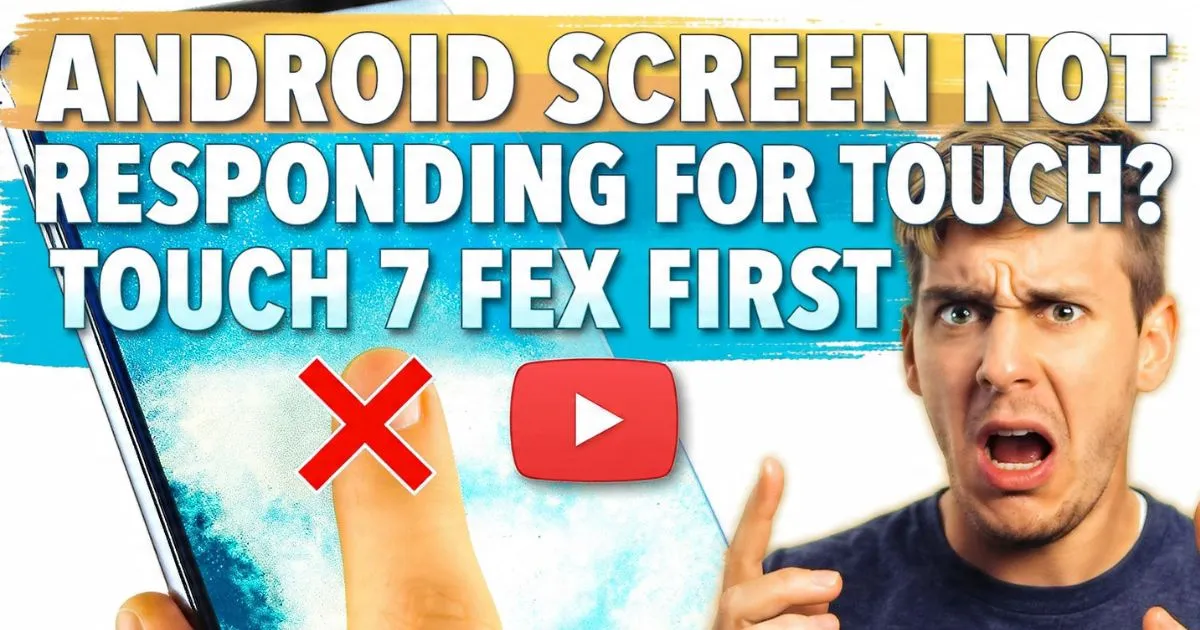
I’ve been there. We’ve all been there. Whether it’s a frozen screen, a weird android ghost touch problem, or a dead zone that refuses to acknowledge your existence, a non-responsive display feels like your digital life has just been padlocked. But before you start looking up the android screen replacement cost or considering a trade-in, let’s breathe. Most of the time, the digitizer (the layer of your screen that actually senses touch) is fine; it’s the software or a temporary physical glitch that’s acting up.
Also Reade : Complete Android Fix Guide: Every Android Problem Solved (2026)
I was sitting in a crowded coffee shop last Tuesday, trying to ignore the guy next to me who was aggressively tapping his phone like he was trying to punch a hole through it. He looked at me, exasperated, and said, “It’s just… frozen.” His android screen was not responding to touch, and I could see the panic in his eyes—mostly because his Uber was two minutes away and he couldn’t hit the ‘Confirm’ button.
Understanding Why Your Android Screen Stopped Responding
First, we need to figure out if we’re dealing with a “brain” problem or a “body” problem. In tech terms, is this a software hang or a physical digitizer failure?
A capacitive touchscreen works by detecting the electrical properties of your skin. If your android screen is not responding properly, it could be that the system is so bogged down it can’t process the input, or the hardware itself has been compromised. If you’re seeing android ghost touch (where the android screen is tapping by itself), that’s usually a sign of static, moisture, or a failing hardware component.
On the flip side, if the android screen is frozen on one image, it’s likely a firmware or Display Driver crash. I’ve seen android screen not responding after update scenarios happen frequently with the rollout of Android 14 and Android 15, where the new OS hasn’t quite played nice with the existing touch drivers.
1. Immediate First Steps: Quick Wins for Most Users
Before we get into the “scary” stuff, let’s try the tech equivalent of a cold shower.
The Hard Reboot (The 15-Second Trick) If your android screen is unresponsive, you obviously can’t use the on-screen “Power Off” slider. You need to force a restart. On most devices—whether it’s a Samsung S series, Pixel, or OnePlus—holding the Power button and Volume Down button simultaneously for about 10–15 seconds will force the hardware to cut power and reboot. This clears the temporary Cache Partition and resets the System UI.
Clean the Screen (Seriously) It sounds patronizing, but I’ve fixed “broken” phones just by using a microfiber cloth. Android screen not responding with wet hands or with gloves is common, but even built-up oils can create EMI interference. If you’ve been using your phone in hot weather or cold weather, condensation can build up under the screen protector, leading to android ghost touch fix needs.
Strip the Accessories Remove your case and that tempered glass ghost touch fix-candidate protector. Sometimes, a thick case or a poorly applied screen protector puts pressure on the Gorilla Glass, causing the android screen corners not responding or android screen edges not responding issues.
also read : Android Phone Stuck on Boot Screen , Android Microphone Not Working , Android Phone So Slow, Android Apps Keep Crashing ,Android Camera Not Working ,Android Bluetooth Not Working
2. Advanced Software Troubleshooting: Is an App the Culprit?
If the screen works for a few seconds after a reboot and then dies, you have an “App War” going on.
The Magic of Safe Mode Safe Mode is your best friend. It boots the phone with only the original factory apps running.
- Power off (or force restart).
- As soon as the logo appears, hold the Volume Down button until the phone finishes booting.
- You’ll see “Safe Mode” at the bottom.
If the android touchscreen is not working in normal mode but works perfectly in Safe Mode, a third-party app is the villain. Usually, it’s something with “Screen Overlay” permissions (like blue light filters or gesture navigators). I once had a Realme Narzo user whose screen “died” because a shady battery-saver app was constantly refreshing a transparent layer over the entire UI.
Check for System Updates Sometimes, Google or your manufacturer (like Xiaomi or Oppo) releases a buggy firmware that causes input lag. Go to Settings > System Update (if you can manage to tap it). Often, an android screen not responding after update is fixed by a secondary “hotfix” patch released a few days later.
3. Testing the Hardware: Diagnosing a Dead Digitizer
Is the whole screen gone, or is it just the android screen top half not responding?
Hidden Diagnostic Menus Most manufacturers have a secret handshake. On a Samsung (like the Samsung A series), open the phone dialer and type *#0*#. This opens a hardware test menu. Tap “Touch.” You’ll see a grid. Trace your finger across it. If there are white squares that won’t turn green, you’ve found a touch screen dead zone.
For other brands like Motorola, Nokia, or Redmi, you can use a touch screen hardware test app from the Play Store (if the screen is working enough to download one) or look for “Diagnostics” in the “About Phone” settings.
The “Show Taps” Trick If you can get into Developer Options (tap “Build Number” 7 times in settings), enable “Show taps” or “Pointer location.” This will draw lines or dots exactly where the phone thinks you are touching. If lines are appearing where you aren’t touching, you’ve confirmed a ghost touch problem.
Expert Insight: The Static Electricity Factor Sometimes, an android screen not responding when charging is due to a cheap, unshielded third-party charger. These chargers leak “noise” (EMI) into the phone, confusing the capacitive touchscreen. If your phone only goes crazy when plugged in, throw that cable away immediately. It’s not just a screen issue; it’s a fire hazard.
4. System-Level Repairs: Clearing Deep Corruptions
If the hardware tests pass but the android screen is responding slowly or lagging to touch, we need to go deeper.
Wipe Cache Partition This doesn’t delete your photos, but it clears out the “junk drawer” of the operating system. You usually have to enter Recovery Mode (Power + Volume Up while starting) and use the volume keys to navigate to “Wipe Cache Partition.” This is a classic android screen stuck fix.
The Nuclear Option: Factory Reset If you’ve tried everything and the android screen is not responding after factory reset (if you managed to do one via buttons), then it is almost certainly a hardware failure. But before you give up, a clean slate often fixes android touch screen sensitivity fix issues caused by corrupted system files.
5. Emergency Data Recovery: Navigating Without Touch
What if you need to get your photos off a phone where the android screen is on but not responding?
This is my favorite “pro” trick: The USB OTG (On-The-Go) adapter. You can plug a standard computer mouse into your phone’s charging port using an OTG adapter. A cursor will appear on your screen! You can now “click” your way through menus, unlock your pattern, and back everything up to the cloud. This android usb mouse fix unresponsive screen method has saved my skin more times than I can count.
6. Environmental Factors and Physical Trauma
Water Damage If your android screen is not responding after water damage, stop. Turn it off. Do NOT put it in rice. Rice is for paella, not for electronics. Rice dust can get into the ports and create a gunk that’s even harder to clean. Instead, use silica gel packets or a fan to circulate air. If the android screen is flickering and not responding after a dip, the minerals in the water are likely shorting out the LCD or AMOLED connectors.
The “Drop” Aftermath Sometimes a drop doesn’t crack the glass, but it loosens the flex cable connecting the digitizer to the motherboard. If your android screen is not responding after drop, you might notice that pressing firmly near the top of the screen (where the connector usually sits) temporarily fixes it. This is a sign you need a professional android screen replacement guide or a trip to the repair shop.
7. Calibration and Sensitivity Tweaks
Is your android screen registering wrong taps? It might just need a recalibration.
- Pointer Speed: Go to Settings > Language & Input > Pointer Speed. Crank it up if the screen feels sluggish.
- Touch Sensitivity: For Samsung, Pixel, and OnePlus users, there is a “Touch Sensitivity” mode in Display Settings. This is designed for people using thick screen protectors. Enabling this can often fix android screen lagging to touch.
- Third-Party Calibration Apps: There are apps like “Touchscreen Repair” that analyze the response time of different areas of your screen and adjust the software’s “gain” to compensate. It sounds like snake oil, but for an android screen responding slowly, it actually works by normalizing the input lag across the LCD or OLED panel.
| Problem | Likely Culprit | Quick Fix | | :— | :— | :— | | Android ghost touch fix | Static/Cheap Charger | Unplug, clean screen, remove case | | Screen top half not responding | Loose flex cable | Professional repair / Digitizer swap | | Screen not responding after update | Driver mismatch | Safe Mode / Factory Reset | | Black screen but phone is on | Display panel failure | Force restart / OTG mouse for data |
Final Thoughts: When to Call It Quits
Look, I’m all for DIY. I’ve spent hours with a heat gun and a suction cup trying to perform an android digitizer replacement. But if you’ve tried the hard reboot, cleared the cache, used an OTG mouse to verify the software is fine, and the android touch screen problem persists, it’s a hardware issue.
The android touch screen repair cost varies wildly. For a budget Redmi or Nokia, it might be $50. For a curved Samsung S series or a high-end OnePlus Nord, you could be looking at $200+.
Don’t ignore the early signs. If your android screen is randomly clicking or you have a small dead zone, back up your data now. Screens rarely get better on their own—they usually just decide to die completely at the most inconvenient moment possible (like when you’re trying to order that Uber).
Have you dealt with a “haunted” phone screen? What worked for you? Let me know in the comments—I’m curious if the “reboot” still holds the crown for the most common fix!