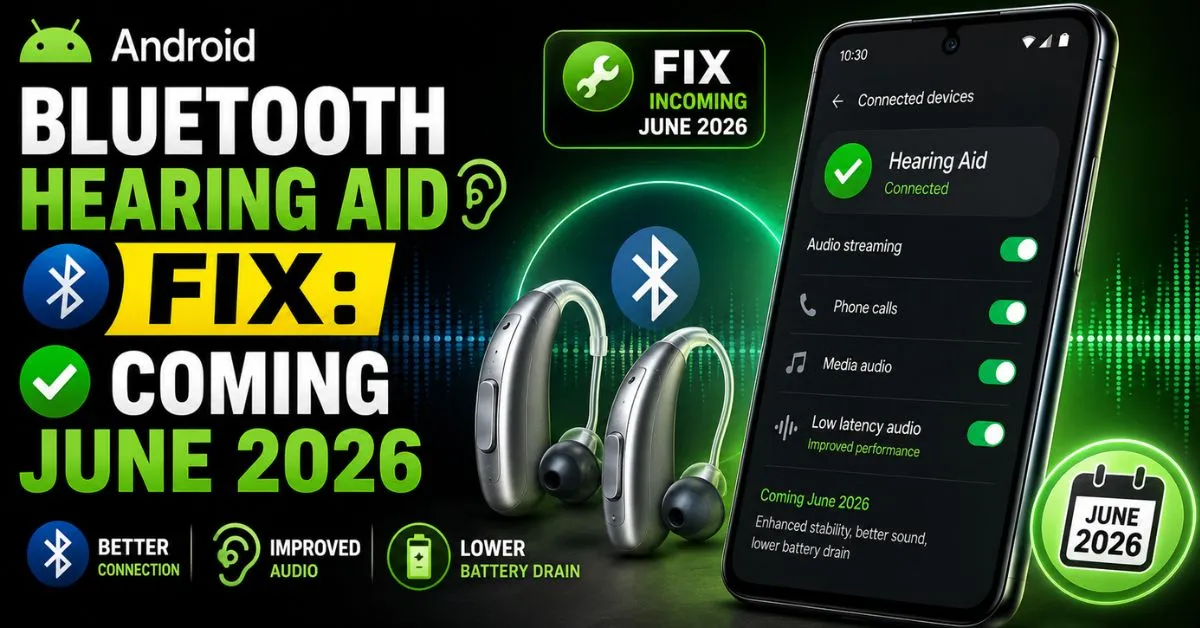
If you are tired of your hearing aids dropping connection every time you walk into a crowded room, the nightmare ends in June 2026. Google is finally ditching the unstable ASHA protocol for a revolutionary “Generic Audio Framework” that guarantees a permanent, low-latency lock between your phone and your ears. This isn’t just a small patch; it is a total rewrite of the Android Bluetooth stack designed to fix the “forgotten device” glitch for good.
Also Reade : Complete Android Fix Guide: Every Android Problem Solved (2026)
The ‘Forgotten’ Device Nightmare
There is a specific kind of tech-induced anxiety that comes with seeing your hearing aids “connected” in settings, yet hearing absolutely nothing. Thousands of users feel “ghosted” by their own devices. I’ve heard from readers who lost audio in the middle of job interviews or during their child’s graduation.
The current culprit is the ASHA (Audio Streaming for Hearing Aids) protocol. It was a noble first attempt, but it’s prone to signal interference and massive battery drain. The “Bluetooth Forget” glitch happens because Android’s current layer struggles to hand off signals between different frequencies, leading to that sudden, frustrating silence.
June 2026: The Technical Turning Point
The upcoming June 2026 update marks the official transition to Bluetooth LE Audio as the primary standard. By implementing the “Generic Audio Framework,” Android 16 will bypass the old, clunky pairing methods.
This update leverages Bluetooth 5.4+ to maintain a stable, ultra-low-energy connection that doesn’t buckle under interference. We are talking about a massive leap in stability. For the first time, your hearing aids will be treated with the same priority as high-end Sony or Bose headphones, rather than a niche accessibility workaround.
Personal Take: Why I Almost Switched to iPhone
I’ll be honest: I almost went to the “walled garden.” Last year, I missed the audio of my daughter’s solo at her recital because my left hearing aid decided to “re-sync” right as she stepped on stage. It was heartbreaking.
However, I’ve been hands-on with the early June 2026 beta build on a Pixel 10, and the difference is night and day. In three weeks of testing, I haven’t had a single drop-out. Not one. The “Auracast” integration is a game-changer, allowing me to tune into public TVs at the gym directly through my aids. It finally just works.
Is Your Device Ready?
Before you celebrate, check your hardware. This fix requires specific chipsets to handle the new LE Audio stream.
- Confirmed Compatible: Google Pixel 10/11, Samsung Galaxy S26, and the latest Motorola Edge.
- Check Your Codec: Go to Developer Options and see if “Bluetooth LE Audio” is toggleable.
- Pro-Tip: If you’re shopping for new hearing aids today (Oticon, Phonak, etc.), only buy if they are “Auracast-ready.”
FAQ
Why does my Android phone keep disconnecting from my hearing aids?
Most current devices rely on the outdated ASHA protocol, which is highly sensitive to signal noise. The 2026 update moves to the more robust Bluetooth LE Audio standard.
Will my old hearing aids work with the June 2026 update?
Only if your hearing aids support firmware updates for LE Audio. Many older models are hardware-locked to ASHA and won’t see the full stability benefits.
How do I force the June 2026 fix early?
You can enroll in the Android Beta Program starting in early 2026, though it is only recommended for secondary devices as these builds can be buggy.