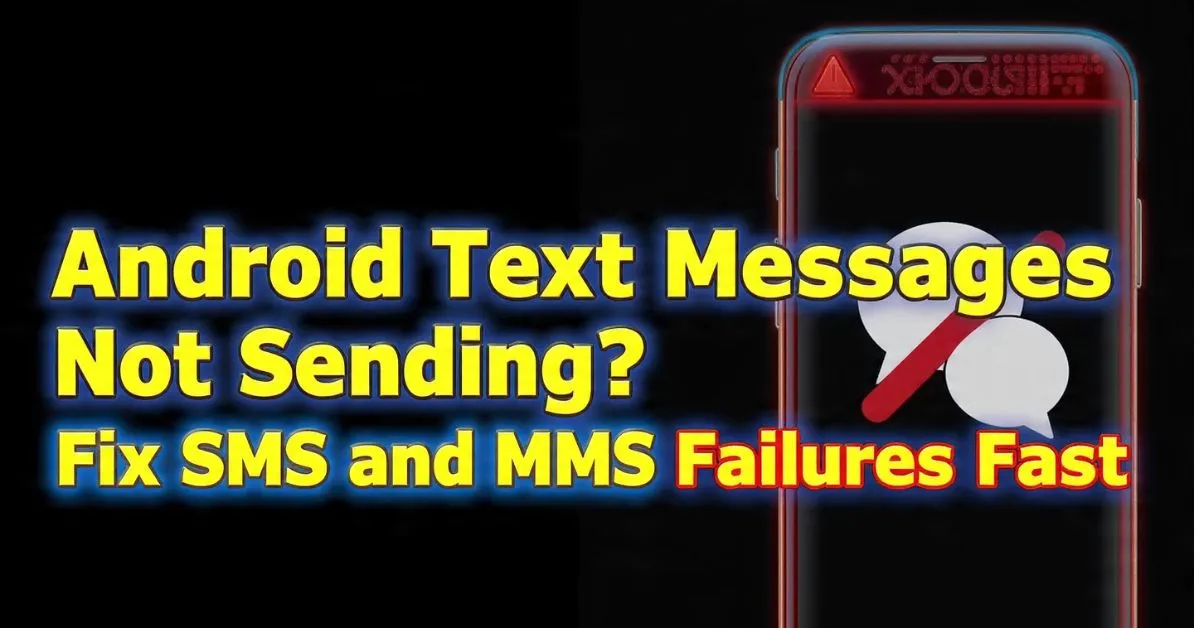
I was standing at Chicago O’Hare, terminal 3, trying to coordinate a pickup with my brother. Every time I hit send on my Pixel 8, that dreaded red exclamation point popped up: “Message failed to send.” My signal bars looked fine, my battery was at 80%, and yet, I was digitally stranded.
If you’ve ever stared at a “sending…” progress bar that never moves, you know the specific brand of “Android text messages not sending” hell I’m talking about. After a decade of ripping apart cellular radio stacks and troubleshooting IMS registration issues for major carriers, I’ve realized that 90% of these failures aren’t “broken phones”—they are tiny software hiccups in the handshake between your device and the cell tower.
Whether you’re dealing with Android SMS sending failed errors on a brand-new Samsung Galaxy S24 or your Android MMS not sending on an older Motorola, let’s get your messaging back online. We aren’t just going to “turn it off and on again”—we’re going deep into the carrier settings that actually matter.
Also Reade : Complete Android Fix Guide: Every Android Problem Solved (2026)
Quick Fixes: The 60-Second Recovery Plan
Before we start messing with the SMSC or manual APN settings, let’s try the “low-hanging fruit.” Sometimes the Cellular Radio Stack—the software that talks to the hardware—just needs a slap.
The ‘Airplane Mode’ Toggle: More Than Just a Reset
Toggling Airplane Mode isn’t just for flights. When you turn it on for 10 seconds and then off, you force the phone to re-authenticate with the nearest tower. This forces a fresh IMS Registration (IP Multimedia Subsystem), which is often the culprit when Android text messages are delayed.
Identifying the Difference: SMS vs. MMS vs. RCS
Are your “green bubbles” failing (SMS) or are your “blue bubbles” (RCS) getting stuck?
- SMS (Short Message Service): Travels over the voice signal. If you have “No Service,” SMS fails.
- MMS (Multimedia Message Service): Needs Mobile Data. If you’re on “WiFi only” and your carrier doesn’t support MMS over WiFi, your Android MMS download failed error is inevitable.
- RCS (Rich Communication Services): This is Google’s modern “Chat” feature. It needs a stable internet connection.
Check for Localized Outages
I once spent two hours troubleshooting a Xiaomi device’s SMS issue only to realize T-Mobile had a localized tower failure in my zip code. Check Downdetector or a third-party outage map before you blame your hardware.


Advanced SMSC Configuration and Hidden Menus
This is where we leave the “beginner” guides behind. Every Android phone has a Short Message Service Center (SMSC) number—it’s basically the “post office” address your phone sends texts to before they are routed to your friends. If this number is wrong or “null,” you will be unable to send SMS on Android.
Accessing the Hidden ##4636## Menu
- Open your Phone/Dialer app.
- Type
*#*#4636#*#*. (You don’t even need to hit call; the menu should just pop up). - Tap Phone Information.
- Scroll down to the SMSC field.
The “Refresh” vs. “Update” Trap
Here is a mistake I see constantly: people type in a number and hit “Update.” Don’t do that yet. First, hit “Refresh”. This pulls the current number stored on your SIM card. if it’s blank or looks like gibberish, you need to find your carrier’s specific SMSC number (e.g., Verizon’s is "+19037029920",145). Type it in with the quotes and the comma code if required, then hit Update.
Expert Insight: If you’ve recently done a SIM swap or ported your number from an iPhone to Android, the SMSC often defaults to a generic string that doesn’t work. Manually updating this is the single most effective “pro” fix for Android SMS random failures.
Fixing MMS and APN Settings Manually
If you can send “Hello” but can’t send a picture of your cat, you have an Android MMS not sending issue. This almost always boils down to Access Point Names (APN).
When you buy a phone from a carrier (like a Samsung Galaxy on AT&T), these are pre-set. But if you have an unlocked phone on an MVNO like Mint Mobile, Cricket, or Boost, the automatic settings often fail.
How to Check Your APNs:
- Go to Settings > Network & Internet > SIMs > Access Point Names.
- Look for the MMSC and MMS Proxy fields.
- If they are empty, your phone literally doesn’t know where to upload the picture.
I’ve found that after the Android 15 update, some OnePlus and Sony phones “forgot” their MMS protocols. Check your carrier’s website for the exact APN string. Make sure the MMS Port (usually 80 or 8080) matches exactly. Even a single extra space will cause an Android message failed to send error.

Messaging App Troubleshooting and Cache Management
Sometimes the hardware is fine, but the Google Messages app has “constipated” data.
Clearing Cache vs. Data
Go to Settings > Apps > Messages > Storage.
- Clear Cache: Safe. It just deletes temporary files. Do this first if your Android messaging app keeps crashing.
- Clear Data: Be careful. This might delete your message history (unless you have Google One backup enabled). However, it resets the app’s link to the Mobile Data stack, which often fixes the Android messages stuck sending loop.
Battery Optimization Conflicts
Android is aggressive about saving juice. Sometimes it puts the “Messages” app into a “restricted” background state. If your Android text messages are received late, go to the app’s battery settings and set it to “Unrestricted.” This ensures the phone stays connected to the Cellular Radio Stack even when the screen is off.

Solving RCS Chat Feature Failures
Google’s RCS (Rich Communication Services) is great—until it isn’t. If you see “Setting Up” or “Trying to verify” in your Chat settings for hours, your RCS chat is not working, and it will often block standard SMS from sending as a fallback.
The RCS “Deregister” Fix
If you switched phones recently and forgot to turn off Chat on the old one, Google’s servers still think your messages should be sent there. You can go to Google’s official RCS deactivation web portal to manually “pull” your number out of the old system. This is a lifesaver for Android SMS issues after a factory reset.
VPN and WiFi Calling Interference
I’ve noticed on Pixel phones that certain VPNs (especially those with “Kill Switch” enabled) prevent the IMS Registration needed for RCS. Try disabling your VPN and WiFi Calling to see if your texts suddenly fly out. If they do, your VPN is blocking the carrier’s MMS Protocol.
Hardware Health: The SIM Card Factor
If you’ve tried every software fix and you’re still getting Android SMS no service issues, it’s time to look at the “piece of plastic.”
Inspecting for “SIM Cancer”
Pop out your SIM tray. Do you see tiny scratches or a dull, copper-colored “wear” pattern? That’s corrosion. I’ve seen Android SMS issues on Samsung Galaxy phones solved by nothing more than rubbing the SIM card contacts with a pencil eraser (lightly!) to remove oxidation.
The ‘SIM Swap’ Test
Take your SIM card and put it into a friend’s phone.
- Does it work there? Then your phone’s internal antenna or motherboard might have a problem (common after water damage or dropping the phone).
- Does it fail there too? Your SIM card is fried, or your carrier account is flagged.
Pro Tip: If you’re on a modern phone (S21 or newer, Pixel 6 or newer), ditch the physical SIM and switch to an eSIM. It eliminates the hardware failure point entirely and often solves Android SMS issues after a SIM swap.
Final Thoughts: When the Software Isn’t the Problem
If you’ve gone through the SMSC updates, the APN manual entries, and cleared your Google Play Services cache, and you still can’t send a text, the issue might be “Account Side.”
Carriers occasionally have “stuck” provisioning on their end—especially after a number port or a security patch. Call your carrier and ask them to “Resync the SMS/MMS feature on the HLR (Home Location Register).” Use that specific technical term; it tells the support agent you aren’t a newbie, and they’ll likely escalate you to a Level 2 tech who can actually fix it.
Fixing Android text messages not sending is a game of elimination. Start at the top (Airplane mode), dive into the middle (SMSC/APN), and end at the hardware (SIM). Ninety-nine percent of the time, that red exclamation point will be gone before you even reach the end of the list.