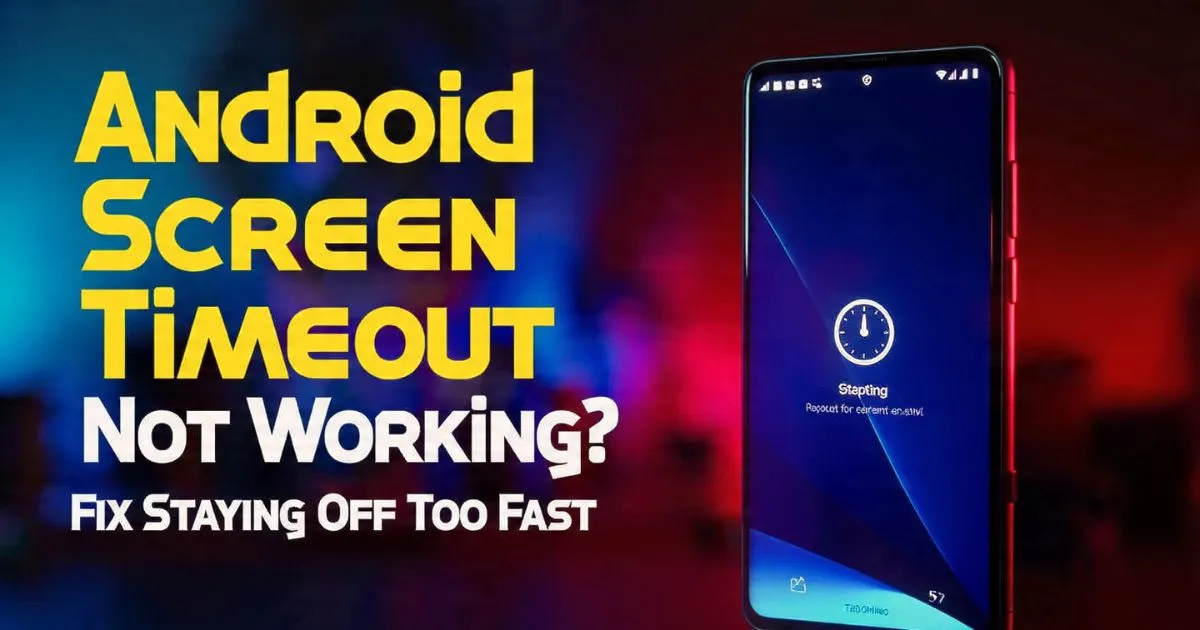
The Android screen timeout not working isn’t just a minor quirk; it’s a battery killer and a privacy nightmare. On the flip side, there’s nothing more maddening than having your Android screen turning off too fast while you’re trying to follow a complex Beef Wellington recipe with flour-covered hands.
Whether your Android display is staying on indefinitely or your Android sleep mode is not working, I’ve spent years digging through system logs and developer menus to find out why these glitches happen. From the latest Android 15 update bugs to hardware quirks on a Samsung Galaxy, let’s get your display behaving again.
Also Reade : Complete Android Fix Guide: Every Android Problem Solved (2026)
I once walked into a high-stakes client meeting with my phone tucked into my blazer pocket. Mid-presentation, I felt a strange warmth against my hip. I pulled out my Google Pixel, only to find it was scorching hot, the screen had been on at max brightness for forty minutes, and I’d accidentally sent a string of gibberish “pocket texts” to my boss.
Why Android Screen Timeout Fails: The Usual Suspects
When your Android screen timeout stopped working, it’s rarely just a “broken” setting. It’s usually a tug-of-war between the Android OS and your apps. Think of it like this: your system wants to sleep to save power, but an app is screaming, “Stay awake! I’m doing something important!”
Common culprits include:
- WakeLock API conflicts: Apps that forget to release their “hold” on your screen.
- Sensor miscalibration: The proximity sensor thinking your phone is out of your pocket when it isn’t.
- Hidden Developer Options: Settings you (or a rogue app) toggled months ago and forgot.
- Software Update Bugs: Specifically, the Android screen timeout issue after update (I’m looking at you, Android 14 and 15).
Step 1: Auditing Basic Display & Sleep Settings
Before we go full “tech-wizard,” let’s check the basics. Sometimes, the Android screen timeout keeps resetting because of a simple UI conflict.
Samsung One UI vs. Google Pixel UI
The path to fix this varies slightly. On a Samsung Galaxy, go to Settings > Display > Screen timeout. Samsung often defaults this to 30 seconds, but I’ve seen it jump to 10 minutes after a Samsung Galaxy system update.
On Google Pixel or Motorola devices, it’s under Settings > Display > Screen timeout. If you find the Android screen timeout settings missing, it’s often because a “Work Profile” or “Device Admin” app (like a corporate email app) has taken control of your security policies.
The “Smart” Features That Backfire
Modern phones use cameras and sensors to see if you’re looking at the screen.
- Smart Stay (Samsung): Keeps the screen on if it detects your face.
- Screen Attention (Pixel): Does the same thing.
If you’re wondering how to stop Android screen from turning off too fast, ensure these are ON. However, if your Android display is not sleeping properly, try turning these OFF. I’ve found that dim lighting can confuse the front camera, making it think it sees a face when it’s just looking at a shadow, causing the Android screen to never turn off.
Step 2: Identifying App Conflicts and Wake Locks
This is the technical heart of the problem. Android uses something called the WakeLock API. When you watch YouTube or use Google Maps, the app tells the Power Management system: “Do not let the display sleep.”
Tracking Down “Vampire Apps”
If your Android screen timeout is not working in apps, a third-party app is likely stuck in a loop. I once had a generic pedometer app that refused to let my phone sleep because it wanted to track steps in real-time.
How to fix:
- Go to Settings > Battery > Battery Usage.
- Look for apps with unusually high background usage.
- If an app like a random weather widget or a poorly coded game is at the top, hit Force Stop.
- Test if your screen times out naturally now.
Android screen timeout issue because of apps is the #1 reason for battery drain. If you suspect a launcher, like Nova or Niagara, is the cause, try switching back to the default system launcher to see if the Android display sleep issue persists.
Step 3: Battery Management—How Power Modes Override Settings
Your battery settings are often the “secret boss” controlling your screen.
Battery Saver vs. Adaptive Brightness
When you enable Battery Saver, the Android screen timeout issue with battery saver kicks in. Most phones will force a 15 or 30-second timeout regardless of what you’ve set in the display menu. If your Android phone screen turns off immediately, check if your battery is below 20% and if “Extreme Battery Saver” is active.
The “Stay Awake While Charging” Trap
Does your Android screen stay on while charging? This isn’t usually a bug; it’s a feature. Deep in the Developer Options, there is a toggle called Stay Awake. If this is on, the screen will never sleep as long as it’s plugged in.
To fix this:
- Go to Settings > About Phone.
- Tap Build Number seven times (yes, really).
- Go back to Settings > System > Developer Options.
- Find Stay Awake and toggle it OFF.
This is a classic Android display sleep issue due to developer options that catches even pro users off guard.
Pro Tip: The “Caffeine” Workaround If you struggle with the Android screen timeout keeps changing, download an app like “Caffeine” or use the built-in “Quick Settings” tile on some ROMs. This allows you to manually force the screen to stay on for a specific task (like reading) and then revert to your 30-second default automatically. It’s much more reliable than diving into settings every time.
Step 4: Advanced Fixes—Sensors and System Cache
If the basics didn’t work, we’re likely looking at a System UI bug or a sensor failure.
The Proximity Sensor Problem
The proximity sensor is that little dot near your earpiece. It tells the phone to turn off the screen when it’s against your ear during a call. If your Android screen timeout is not working on lock screen or during calls, your sensor might be dirty or miscalibrated.
The Tape Test: If you have a screen protector that’s peeling or dirty, it can trick the sensor. This leads to the Android screen timeout issue due to proximity sensor, where the phone thinks it’s in a pocket and refuses to wake up, or thinks it’s out and stays on.
Clearing the System Cache Partition
After a major update, like the Android screen timeout issue after Android 15 update, old temporary files can get “stuck.”
- Turn off your phone.
- Hold Volume Up + Power to enter Recovery Mode.
- Use the volume keys to select Wipe Cache Partition (Note: This is NOT a factory reset).
- Reboot.
This often fixes the Android screen timeout lagging issue where the screen stays on for several seconds after the timer should have expired.
Real-World Scenarios: Hands-On Fixes
Scenario A: Screen Turns Off While Reading (Too Fast)
You’re reading a long-form article (like this one!), and the screen dims every 30 seconds.
- Fix: Enable Screen Attention (Pixel) or Smart Stay (Samsung). If those fail, increase the timeout to 2 minutes. Don’t go higher, or you’ll forget it’s on and drain your battery later.
Scenario B: Phone Stays On in Your Bag (Never Sleeps)
You pull your phone out of your bag, and it’s on the camera app, and the battery is at 10%.
- Fix: Check for Accidental Touch Protection in settings. Also, disable Double Tap to Wake if you have a habit of bumping the screen. This is a common Android display not sleeping properly trigger.
Scenario C: The “Always On Display” Confusion
Sometimes people mistake the Always On Display (AOD) for the screen not timing out. AOD uses very little power on OLED Displays, but if it bothers you, go to Lock Screen settings and turn off Always On Display. This is frequently the cause of the Android screen timeout issue with Always On Display.
Common Pitfalls and Final Troubleshooting Steps
If you’ve tried everything and your Android display sleep bug persists, consider these “hidden” blockers:
- Accessibility Settings: Apps like Voice Access or TalkBack can keep the screen awake. Check Settings > Accessibility to see if any services have full control.
- Smart Lock: If you have Smart Lock enabled (keeping the phone unlocked near your watch or at home), it can sometimes interfere with how aggressively the screen locks itself.
- Google Play Services: This is the “everything” app. If Android screen timeout is not responding quickly, try clearing the cache for Google Play Services. It’s the invisible glue of the Android OS, and when it glitches, everything from display sleep to Bluetooth can break.
- Hardware Issues: If you recently had an Android screen replacement, the technician might have misaligned the proximity sensor. If the Android screen timeout issue started after dropping the phone, it’s likely a physical hardware fault.
The “Nuclear” Option: Factory Reset
I hate recommending this, but if your Android screen timeout is not saving settings even after a cache wipe, a factory reset is the final step. Just ensure you back up your photos first! This clears out any deep-seated malware or corrupted system files causing the Android phone screen stays awake all the time.
My Expert Take
After fixing hundreds of these issues for friends and readers, the most common fix is almost always Developer Options or a rogue third-party app. We often blame the Android OS, but the WakeLock API allows apps a lot of freedom. If your screen is acting up, start by looking at what you installed in the last 48 hours.
Android display timeout optimization isn’t about one setting; it’s about making sure your software isn’t fighting your hardware. Keep your sensors clean, your apps updated, and your Developer Options in check, and your screen will finally learn when to go to sleep.
Still having trouble? Drop your phone model and Android version in the comments—I’ve probably seen the specific bug you’re dealing with!