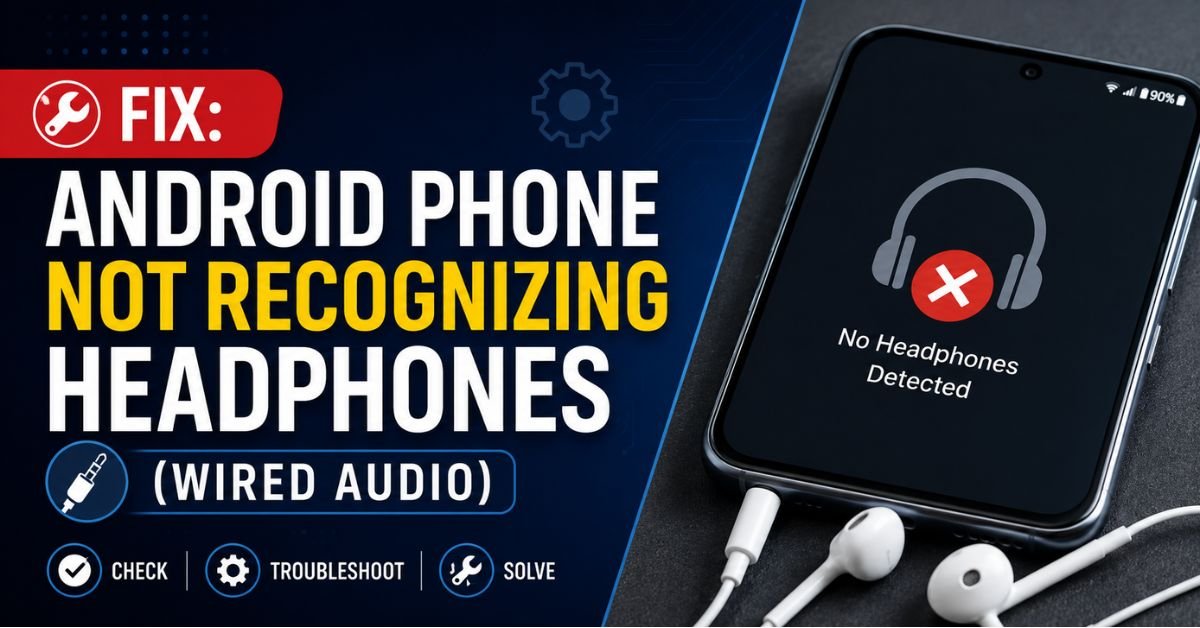
Fix: Android Phone Not Recognizing Headphones (Wired Audio).I’ve been there. You’re sitting on a crowded train, you’ve got your favorite playlist cued up, and you plug in your headphones. You hit play, expecting that sweet isolation, but instead, your phone’s external speakers blast death metal to the entire carriage. You unplug, replug, wiggle the wire, and… nothing. The phone acts like you haven’t done a thing.
As someone who has spent the last decade tearing down smartphones and troubleshooting hardware gremlins, I can tell you that “no audio detected” is one of the top three complaints I hear. It’s maddening because it feels so binary—it either works or it doesn’t. But behind that tiny port is a complex dance between a Digital-to-Analog Converter (DAC), physical Conductivity, and software-level Audio Routing.
If your Android phone is ignoring your wired headphones, don’t panic. Before you give up and buy expensive Bluetooth buds that you’ll inevitably lose, let’s walk through the actual, hands-on fixes I use on the repair bench.
Real-World Scenarios: When Audio Detection Fails
In my experience, audio detection issues usually fall into three annoying buckets.
First, there’s the “Ghost Headphone” icon. This is when your phone thinks headphones are plugged in even when they aren’t. You can’t hear anything from the earpiece during calls because the phone is sending audio to a “phantom” jack. This is usually a hardware short inside the port.
Second, we have the “Total Silence” scenario. You plug in, but there’s no icon, no sound change, and the music keeps playing out of the bottom speakers. This is often a failure of the Audio Jack Detection Pin—a tiny physical switch inside the port that tells the OS, “Hey, someone’s here!”
Finally, there’s the “Stutterer.” The audio cuts out if you breathe on the cable. This usually points to a physical obstruction or a worn-out TRS Connector (Tip-Ring-Sleeve). Identifying which one you’re dealing with is half the battle.
Step 1: Physical Inspection and Cleaning (Hands-on Tips)
Let’s start with the most common culprit: your pockets. We carry our phones in denim and cotton all day. Over time, that tiny 3.5mm hole or USB Type-C port becomes a vacuum for Pocket Debris.
The Toothpick Technique
I’ve seen people use safety pins or needles. Stop. Never put metal inside your charging or audio port. You risk shorting out the pins or scraping away the delicate gold plating that ensures Conductivity.
Take a wooden toothpick. Use a knife to shave the tip even thinner if you have to. Gently—and I mean gently—insert it and swirl it around the edges. You would be shocked at the compressed “felt” that comes out. I once pulled a piece of lint out of a Galaxy S10 that was so dense it looked like a piece of a sweater.
Feeling for the ‘Tactile Click’
When you plug your headphones in, you should feel and hear a distinct click. If the connection feels mushy or the plug doesn’t sit flush against the phone frame, there’s still Lint Accumulation at the bottom. The TRS Connector needs to make full contact with the internal pins to complete the circuit. If it’s 1mm off, the Audio Jack Detection Pin won’t trigger.
Inspecting for Corrosion
Take a bright flashlight and peer inside. Do you see green or white crusty stuff? That’s corrosion from moisture. Even “water-resistant” phones can suffer from this if you plug in headphones while the port is damp. If you see this, a quick dip of a Q-tip in 90% Isopropyl alcohol (squeeze out the excess!) can sometimes scrub that oxidation away.
Step 2: Software Glitches and OS Conflicts
Sometimes the hardware is pristine, but the “brain” of the phone is confused.
The ‘Restart’ Myth vs. Reality
People say “just restart it” like it’s a magic wand. It’s not. However, a restart does kill the “MediaServer” process in Android, which is often what’s hanging. If you’ve been switching between Bluetooth speakers and wired headphones, the Audio Routing logic can get stuck.
The Bluetooth Hijack
I’ve seen this a dozen times: someone thinks their jack is broken, but their phone is actually connected to a pair of Bluetooth headphones in their gym bag three rooms away. Android usually prioritizes the most recent connection, but sometimes it gets stubborn. Manually toggle Bluetooth off and see if the wired icon pops up.
Deep Dive: Developer Options
If you want to get technical, go to Settings > About Phone and tap “Build Number” seven times to enable Developer Options. Search for an entry called “Disable USB Audio Routing.” If this is toggled on, your phone will ignore any external USB Type-C audio device. I’ve seen this mysteriously toggle itself after a security update. Ensure it is OFF.
Pro Tip: Use a Diagnostic App Most people don’t know that Samsung phones have a built-in “Samsung Members” app. Open it, go to “Support,” then “Diagnostics.” You can run a specific test for the “Headphones” or “USB Connection” that bypasses the standard OS layers to see if the hardware is actually being “seen” by the motherboard.
Step 3: The USB-C to 3.5mm Adapter Dilemma
If your phone doesn’t have a 3.5mm jack, you’re likely using a dongle. This is where things get messy. Not all USB-C ports are created equal.
Active vs. Passive Adapters
Some phones (like older Motorolas) use “Passive” adapters. They just pass the Analog Audio signal through the USB pins. Other phones (like Google Pixels or newer Samsungs) require an “Active” adapter. These have a tiny Digital-to-Analog Converter (DAC) chip inside the actual dongle.
If you bought a $2 adapter from a gas station, it’s probably passive. If your phone expects an active one, it will simply ignore the headphones. Always check if the adapter is “DAC-compatible.”
Why Cheap Adapters Fail
I’ve noticed that cheap third-party adapters often fail after an Android OS update. Google and Samsung frequently update the USB handshake protocols for security. If the chip in your adapter isn’t “certified,” the phone might reject it as an “unsupported device” to protect the port from power surges.
Common Pitfalls: What NOT to Do
In my years of repair, I’ve seen people “fix” their phones into an early grave.
- Don’t Use WD-40: I’ve seen this. It’s a tragedy. WD-40 is an insulator and a dust magnet. It will ruin the Conductivity of the port and turn the lint into a permanent sludge.
- Don’t Blow with Your Mouth: Your breath contains moisture. Blowing into the port is essentially spitting into your phone’s motherboard. Use a can of compressed air held at a distance, or better yet, a manual rubber bulb blower.
- Don’t Force It: If the plug won’t go in, pushing harder won’t help. It will just snap the internal plastic housing of the port. If it doesn’t click with moderate pressure, there is an obstruction.
Step 4: Impedance and “Heavy” Headphones
Here’s an “Information Gain” tip you won’t find on most generic tech blogs: Impedance.
Some high-end studio headphones (like the Sennheiser HD600 series) have high impedance (measured in Ohms). Most Android phones are designed for low-impedance earbuds. When you plug in high-impedance cans, the phone’s tiny amplifier might not see enough “pull” to recognize that a device is connected.
If you’re using professional gear, you might need a portable amp or a specifically “High-Gain” USB Type-C DAC to bridge the gap. The phone isn’t broken; it’s just underpowered.
Final Solutions: When Simple Fixes Don’t Work
If you’ve cleaned the port, tried three different adapters, and toggled every setting in the book, you might be facing a hardware failure.
The Broken Solder Joint
Inside your phone, the headphone jack or USB-C port is soldered to the motherboard or a daughterboard. Every time you plug and unplug, you’re applying “mechanical stress.” Over a year or two, the solder joints can crack. If you find that the audio only works when you hold the cable at a very specific, awkward angle, your port is physically failing.
Factory Reset: The Last Resort
It’s a pain, but if a software update corrupted your audio drivers, a factory reset is the only way to clear the slate. Back up your photos first! If a reset doesn’t fix it, it’s 100% a hardware issue.
Repair vs. Replace
Most modern Android phones have the charging/audio port on a separate “sub-board.” This is a relatively cheap part (usually $15-$30) and a technician can swap it in about 30 minutes. Don’t throw away an $800 phone over a $20 part.
Frequently Asked Questions
Q1: Why does my phone say “USB device not supported” when I plug in my headphones?
This usually happens because your phone requires an “Active” USB-C adapter with an internal DAC, but you’re using a “Passive” one. It can also happen if the port is dirty, causing a poor data connection that fails the initial “handshake” between the phone and the adapter.
Q2: Can a screen protector interfere with headphone detection?
Believe it or not, yes. Some rugged cases or thick screen protectors have a small “lip” around the 3.5mm or USB-C port. This prevents the TRRS Connector from seating fully. Even if it’s off by half a millimeter, the Audio Jack Detection Pin won’t engage. Try removing the case and plugging in again.
Q3: My headphones work on my laptop but not my phone. Does that mean the phone is broken?
Not necessarily. Laptops often have more “forgiving” ports and higher power output. Your phone might have a more sensitive Audio Routing trigger or higher security standards for USB devices. It usually points to a compatibility issue with the phone’s internal Digital-to-Analog Converter requirements.
Q4: Is there an app to force audio through the headphones?
Yes, there is an app called “Lesser AudioSwitch” on the Play Store. It allows you to manually override the phone’s detection logic and force audio to the jack or speakers. It’s a great “band-aid” fix if your Audio Jack Detection Pin is physically broken but the rest of the port still works.
Q5: Can “Mono Audio” settings cause detection issues?
While it won’t stop the detection, having “Mono Audio” or “Hearing Enhancements” turned on in Accessibility settings can make it seem like the headphones are failing by cutting out half the signal. Always check Settings > Accessibility > Audio Adjustment to ensure everything is balanced.