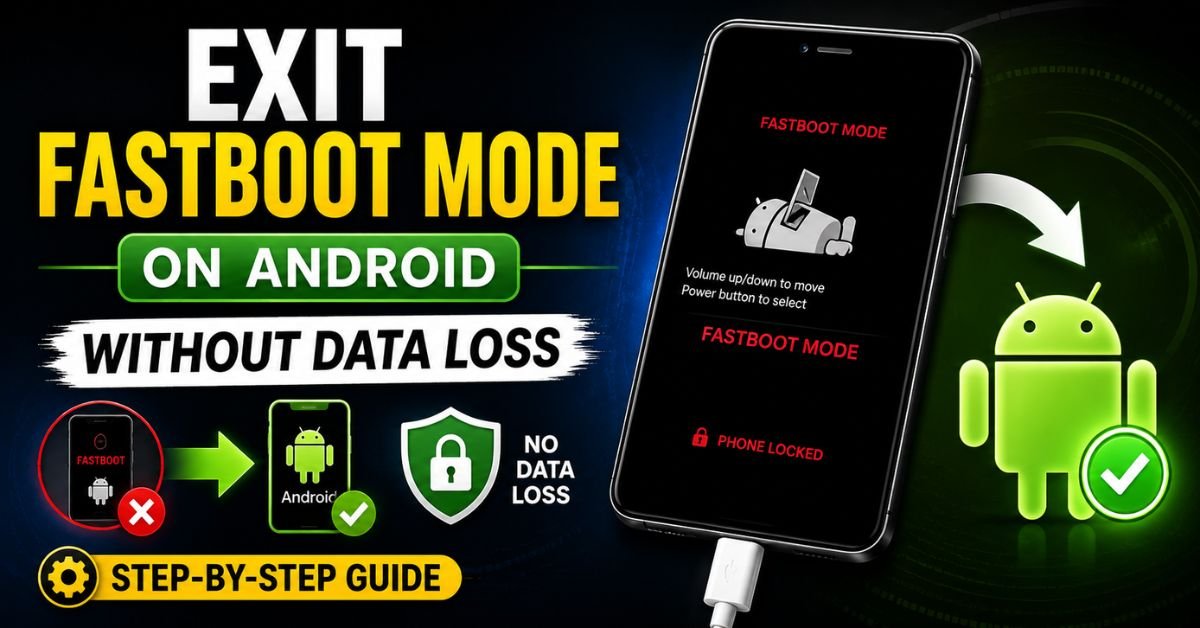
Exit Fastboot Mode on Android Without Data Loss (Step-by-Step).I remember the first time I saw the “Fastboot” bunny on an old Xiaomi Mi 3 back in 2014. I was trying to flash a custom kernel, and suddenly, there he was—that little rabbit in a Soviet-style hat, tinkering with a robot. At the time, I panicked. I thought I’d turned a $300 smartphone into a very sleek, glass-and-plastic paperweight.
Seven years and hundreds of firmware recoveries later, I can tell you one thing: seeing that screen isn’t the end of the world. In fact, if your phone is on the Fastboot screen, it’s actually in a “healthy” state of communication. It’s waiting for instructions. The problem is when it gets stuck there, refusing to boot back into the Android OS.
If you’re staring at a screen that says “Fastboot Mode” or shows a disassembled Android robot, don’t touch that “Wipe Data” option in your panic. We can get you out of this without losing a single photo, message, or app. Let’s dive into how we fix this.
Why Your Phone is Stuck in Fastboot (The “Why Me?” Moment)
Before we start pressing buttons, you need to understand what’s actually happening under the hood. Fastboot is a diagnostic protocol and a tool found in the Android SDK Platform-Tools. It allows you to modify the phone’s Firmware or write (flash) data directly to the device’s internal Partition table.
Usually, you get stuck here for one of three reasons:
- The Accidental Clamp: You pulled your phone out of your pocket, and the volume-down button was being squeezed alongside the power button. This is the “User Error” special.
- The Boot Loop: Your phone tried to update its Stock ROM, failed, and the Bootloader realized the Kernel was corrupted. Instead of crashing, it retreated to Fastboot mode as a safety net.
- The Sticky Button: Over time, the physical buttons on your device get “mushy” or stuck due to lint and grime. If the volume button is internally “pressed,” the phone will boot into Fastboot every single time you restart it.
Identifying Your Screen
Visuals vary by brand. Google Pixels usually show a dark screen with technical text and an arrow. Xiaomi has the famous “Fastboot Bunny” (though newer models are moving toward plain text). Samsung doesn’t technically use “Fastboot”—they use “Download Mode” (Odin mode), but the recovery logic remains almost identical.
Method 1: The Force Restart (The “Simple” Hardware Solution)
I always tell people to start with the easiest fix. You’d be surprised how many “broken” phones are fixed by just holding a button longer than feels comfortable.
The 15-Second Rule
Ignore the screen. Ignore the warnings. Press and hold the Power Button for a full 15 to 20 seconds.
- Why it works: Most Android devices have a hard-wired hardware reset that overrides whatever software state (like Fastboot) the device is in.
- The Nuance: If the phone vibrates and goes black, let go immediately. If it loops back to the Fastboot screen, move to the next combination.
The Power + Volume Down Combo
On many devices, holding Power + Volume Down for about 10 seconds forces a reboot out of the bootloader. If your device supports “Quick Boot” settings (found in some older developer options), this bypasses that and forces a cold start.
Pro Tip: The “Mushy Button” Test If your phone keeps returning to Fastboot after a restart, take a look at your volume rocker. Does it click? If it feels “soft” or doesn’t move much, you likely have a hardware jam. I’ve fixed this dozens of times using a tiny drop of 99% Isopropyl alcohol on a Q-tip, rubbing it around the button, and clicking it rapidly to break up the gunk. A stuck volume-down button is the #1 silent killer of Android boot cycles.
Method 2: Using ADB Commands (The Professional Approach)
If the buttons aren’t doing the trick, we need to talk to the phone from a computer. This is where the Android Debug Bridge (ADB) and Fastboot drivers come in.
Step 1: Setting Up the Environment
You don’t need to be a coder to do this. Download the “Minimal ADB and Fastboot” tool or the official Google Platform-Tools.
- Connect your phone to your PC or Mac using a high-quality USB cable. (Avoid those cheap gas-station cables; they often lack the data pins needed for Fastboot communication).
- Open your Command Prompt (CMD) or Terminal.
- Type
fastboot devices.
If you see a string of random numbers and letters followed by the word “fastboot,” you’re in business. If you see nothing, you likely have a driver issue. I’ve found that Windows 10/11 often struggles with “Android Bootloader Interface” drivers. You might need to go into Device Manager and manually update the driver to the “Google USB Driver.”
Step 2: The Magic Command
Once your device is recognized, type the following command and hit Enter: fastboot reboot
The phone should immediately go black and attempt to load the Kernel. If it boots into the OS, you’re done! No data lost.

Troubleshooting “Device Not Found”
I once spent three hours trying to fix a OnePlus phone that wouldn’t show up in ADB. The culprit? A USB 3.0 port on an AMD Ryzen motherboard. Fastboot is notoriously finicky with USB 3.0/3.1 ports. If your PC isn’t seeing the phone, plug it into an old-school USB 2.0 port (the ones that aren’t blue) or use a USB 2.0 hub. This is a weird technical quirk that many “expert” guides miss.
Expert Insight: Never, under any circumstances, type
fastboot erasefollowed by a partition name (likeuserdataorsystem) unless you are specifically trying to wipe your phone. Commands likefastboot erase cacheused to be common advice, but on modern “A/B Partition” devices, this can sometimes lead to a hard brick. Stick tofastboot reboot.
Method 3: Transitioning Through Recovery Mode
Sometimes, the Fastboot protocol is “stuck” because the bootloader is waiting for a flag that never cleared. We can often jump the fence into Recovery Mode to fix this.
- While in Fastboot, use the Volume buttons to scroll through the options (the text at the top of the screen usually changes).
- When you see “Recovery Mode,” press the Power button to select it.
- You might see a “No Command” screen with a fallen Android robot. Don’t worry. Hold the Power button and tap Volume Up once.
- You are now in the Android Recovery Menu.
Crucial Distinction:
- DO NOT select “Wipe Data/Factory Reset.” This will delete everything.
- DO select “Reboot System Now.”
Often, jumping from the Fastboot partition to the Recovery partition resets the boot flag, allowing the phone to realize it should be booting into the main OS.
Common Pitfalls to Avoid
In my 7 years of firmware recovery, I’ve seen people turn a 5-minute fix into a 5-hour nightmare. Avoid these:
- Interrupting a Flash: If you were in the middle of Flashing a Stock ROM or a custom recovery (like TWRP) and the phone got stuck, do NOT unplug the cable while the command line is active.
- Low Battery: If your phone dies while in Fastboot, it can sometimes corrupt the Bootloader. Keep it plugged into a PC or a low-voltage wall charger.
- The “One-Click” Fixer Software: You’ll see many ads for paid software that promises to “Exit Fastboot with one click.” 99% of the time, these tools are just fancy wrappers for the
fastboot rebootcommand we just did for free. Save your money.
Prevention: How to Stop It From Happening Again
Once you’re back into your phone, take these steps to ensure you don’t end up back in Fastboot limbo:
- Check for “Quick Boot”: Some older Android versions have a “Quick Boot” or “Fast Boot” setting in the Battery or Developer options. This essentially puts the phone into a deep hibernation rather than a full shutdown. If it’s buggy, it can lead to Fastboot loops. Turn it off.
- Clean Your Case: If you use a tight silicone case, check if the “bridge” of material over the volume buttons is putting constant pressure on them. I’ve seen cheap cases “shrink” over time and trigger Fastboot mode.
- Manage Your Updates: If you’re a fan of custom ROMs, always ensure your USB Debugging is toggled on in Developer Options before you start tinkering. It makes ADB recovery much easier if things go south.
Frequently Asked Questions
1. Will exiting Fastboot mode delete my photos?
No. Simply exiting Fastboot via a reboot or ADB command fastboot reboot does not touch your data partitions. Your photos, contacts, and apps are stored in the /userdata partition, which remains untouched unless you specifically run a “wipe” or “format” command.
2. My phone says “Fastboot” but my computer says “Waiting for Device.” Why?
This is almost always a driver issue. Windows often installs a generic “MTP” driver for phones, but Fastboot requires a specific “Bootloader Interface” driver. You need to download the Google USB Drivers and manually assign them via the Windows Device Manager while the phone is connected in Fastboot mode.
3. What if my Power button is broken and I’m stuck in Fastboot?
This is a tricky one. If the power button doesn’t work, you can’t “select” anything. Your only hope is the ADB method. If you use the command fastboot reboot, the phone will restart without you ever needing to touch the physical power button.
4. Can a failed Android update cause a Fastboot loop?
Yes. If an Over-The-Air (OTA) update fails to verify the Firmware signature, the bootloader will refuse to load the system to prevent a security breach or a hard brick. In this case, you might need to use a tool like MiFlash (for Xiaomi) or Pixel Repair Tool (for Google) to re-flash the Stock ROM. This usually keeps data intact if you select the “Save User Data” option in the tool.
5. Why does my phone go to Fastboot instead of charging when I plug it in?
This usually indicates a hardware failure in the volume-down button. The phone thinks you are holding the button down while plugging in the cable, which is a shortcut to Fastboot. Try cleaning the button with compressed air or a tiny amount of electronic contact cleaner.