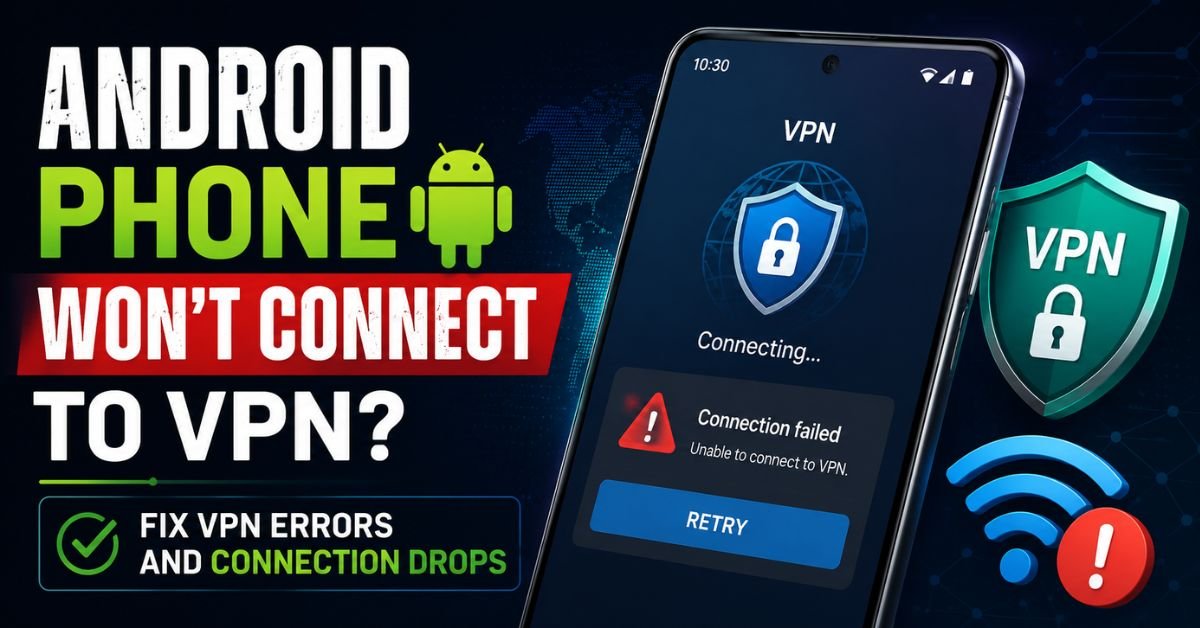
Android Phone Won’t Connect to VPN? Fix VPN Errors and Connection Drops.I remember sitting in a crowded terminal at O’Hare International, trying to hop on the public Wi-Fi to submit a report. I clicked “Connect” on my VPN app, and… nothing. Just that dreaded “Connecting…” spinner that seems to mock you while your data remains exposed. For ten years, I’ve been the guy people call when their Android devices refuse to play nice with mobile networks. I’ve seen it all—from corrupted TUN/TAP drivers to aggressive Chinese OEM battery management that kills a VPN faster than you can say “privacy.”
If your Android phone won’t connect to a VPN, or if it keeps dropping the tunnel every five minutes, you aren’t alone. It’s rarely a “broken” phone; it’s usually a conflict between the app, the Android OS version, and your carrier’s weird quirks. Let’s dive into how we actually fix this, moving past the “have you tried restarting it?” fluff.

Quick Diagnostics: Identifying the Root Cause
Before you start digging into the kernel settings or wiping your phone, we need to categorize the failure. Not all VPN errors are created equal.
‘Authentication Failed’ vs. ‘Server Unreachable’
If you see “Authentication Failed,” stop looking at your network. This is almost always a credential mismatch or an expired certificate. I’ve seen cases where the system clock on the phone was off by just three minutes, causing the security certificate handshake to fail. Android’s security protocols are picky about time synchronization.
“Server Unreachable,” on the other hand, is the real headache. This means your phone is shouting into the void, and no one is answering. This usually points to a firewall at the ISP level or a dead VPN server.
The ‘Airplane Mode’ Toggle: The Technician’s Secret
It sounds like a cliché, but toggling Airplane Mode isn’t just about resetting the signal bars. It forces the Android radio stack to re-register with the cellular tower and re-assign an IP address. In my experience, this often clears up “stuck” routing tables that prevent the VPN’s virtual interface from initializing.
Checking Google Play Services
Many modern VPN apps rely on Google Play Services for background tasks and push notifications. If your Play Services version is out of date or—worse—if you’re using a “de-Googled” phone without a proper microG setup, the VPN app might struggle to maintain a persistent connection. Always check the Play Store for a Play Services update before troubleshooting the VPN app itself.
Software Level Fixes: App Settings You Must Check
Most users treat VPN apps like a “set it and forget it” tool. As a tech, I can tell you the default settings are often garbage for stability.

Switching Protocols: WireGuard vs. OpenVPN vs. IKEv2
If your connection is dropping, your protocol is likely the culprit.
- WireGuard: This is my go-to. It’s lean (only 4,000 lines of code) and handles “roaming” between Wi-Fi and 5G incredibly well.
- OpenVPN (TCP/UDP): Use this if you are behind a restrictive firewall (like at a hotel or school). UDP is faster, but TCP is more “persistent” and less likely to be dropped by the network.
- IKEv2/IPsec: Excellent for mobile because it was designed to reconnect quickly when you lose signal, but it’s often blocked by certain carriers.
Reinstalling the TUN/TAP Driver
Inside the advanced settings of apps like OpenVPN for Android, you’ll sometimes see options to “Reset TUN/TAP.” The TUN (network tunnel) driver is the virtual interface Android uses to route traffic. If another app (like an ad-blocker or a firewall) was previously using this interface, it can get “locked.” Reinstalling the app or clearing the app data usually resets this virtual driver.
Expert Insight: Did you know that Android only allows one active VPN slot? If you have a local “Ad-Blocker” app that works via a local VPN (like AdGuard or Blokada), your actual VPN will fail to connect 100% of the time. You have to disable the ad-blocker first.
System-Level Optimization: Preventing Connection Drops
This is where most “how-to” guides fail. They ignore how Android actually manages memory.
The Xiaomi and Samsung “Gotcha” (Battery Optimization)
If your VPN connects but dies as soon as you lock your screen, Android’s “Doze Mode” is killing it.
- On Samsung (One UI): Go to Settings > Apps > [Your VPN App] > Battery. Set it to “Unrestricted.”
- On Xiaomi (MIUI/HyperOS): This is the worst offender. You have to go to the “Security” app > Battery > App Battery Saver and set it to “No Restrictions.” Xiaomi’s software is notoriously aggressive; it will kill a VPN process even if you have “Always-on” enabled unless you manually whitelist it.
Enabling ‘Always-on VPN’ and ‘Block Connections without VPN’
If you want true privacy, you need to go to Settings > Network & internet > VPN. Tap the gear icon next to your VPN and toggle on Always-on VPN. If you’re seeing “Connection Drops,” do not enable “Block connections without VPN” yet. This “Kill Switch” can sometimes prevent the VPN from re-negotiating its handshake after a signal drop, effectively locking you out of the internet entirely.
The Private DNS Conflict
Android 9 introduced “Private DNS” (DNS over TLS). I’ve spent hours troubleshooting VPNs only to realize the user had dns.adguard.com or 1.1.1.1 set in their system settings. When you use a VPN, it tries to force its own DNS. If your Android system is also trying to force a different Private DNS, the conflict often results in a “Connected, no internet” error. Fix: Set “Private DNS” to “Off” or “Automatic” while using a VPN.
Network Environments: Why Your Location Matters
Sometimes the problem isn’t your phone; it’s the air around you.
Handling Captive Portals
We’ve all been there—hotel Wi-Fi that requires a room number. Most VPNs will fail to connect because they try to encrypt traffic before you’ve “authenticated” with the hotel. The Fix: Disable your VPN, open your browser, sign into the hotel Wi-Fi, and then turn the VPN back on. If the login page won’t pop up, try navigating to http://neverssl.com—it’s a classic tech trick to force a captive portal to trigger.
Disabling IPv6
Many mobile carriers (looking at you, T-Mobile) have moved almost entirely to IPv6. However, many older VPN protocols still struggle with IPv6, leading to “DNS Leaks” where your real IP address is exposed, or the connection just stalls. In your VPN app settings, look for an option to “Disable IPv6” or “Force IPv4.” It’s a lifesaver for stability on modern 5G networks.
ISP Throttling and Port Blocking
Some ISPs recognize the “header” of a VPN packet and throttle it to oblivion. If you suspect this, try changing your VPN port to 443 (the same port used for standard HTTPS web traffic). Most ISPs won’t block 443 because it would break half the internet.
Common Pitfalls and Real-World Troubleshooting
In my decade of fixing these things, I’ve noticed three common mistakes that trip up even the tech-savvy:
- The “Kill Switch” Loop: You have the VPN Kill Switch enabled, the VPN fails to connect once, and now the Kill Switch is blocking the very connection needed for the VPN to re-authenticate. It’s a digital Ouroboros. Always disable the Kill Switch when troubleshooting.
- Split Tunneling Gone Wrong: If you use Split Tunneling (allowing some apps to bypass the VPN), and you accidentally include “System Services” or “Google Play Store” in the bypass list, it can occasionally cause routing loops that crash the VPN service.
- Overloaded Free VPNs: I cannot stress this enough—if you are using a “Free VPN” from the Play Store with 50 million downloads, the server you are hitting is likely at 99% capacity. The “error” isn’t your phone; it’s the server rejecting your handshake because it’s full.
My Personal “Nuclear” Fix
When all else fails, I do this:
- Uninstall the VPN app.
- Go to Settings > General Management > Reset > Reset Network Settings. (Warning: This wipes your saved Wi-Fi passwords!)
- Reinstall the VPN and use the WireGuard protocol on Port 51820. This clears the OS-level routing tables and starts fresh. 99% of the time, this fixes the “unfixable” connection issue.
Frequently Asked Questions
Why does my VPN connect on Wi-Fi but not on mobile data (LTE/5G)?
This is usually due to the APN (Access Point Name) settings on your phone or the carrier blocking specific protocols like IPsec. Carriers often use a protocol called NAT64, which can break older VPNs. Try switching your VPN protocol to WireGuard or OpenVPN TCP, as these are more resilient to carrier-grade NAT issues.
Can I use two VPNs at the same time on Android?
No. Android’s architecture only provides a single “VPN Tunnel” slot. If you try to activate a second VPN, the OS will automatically disconnect the first one. This includes “firewall” apps and certain ad-blockers that use a local VPN loopback.
What should I do if my VPN says “Connected” but no websites load?
This is a classic DNS conflict. Your tunnel is open, but your phone doesn’t know how to translate google.com into an IP address. Go to your Android settings and turn off “Private DNS,” then check if your VPN app has a “Custom DNS” option. Set it to 8.8.8.8 or 1.1.1.1 within the VPN app.
Does “Battery Saver” mode affect VPN performance?
Absolutely. Android’s “Battery Saver” limits background data and throttles the CPU. This can cause the VPN to time out during the handshake process or disconnect as soon as the screen turns off. Always exempt your VPN app from battery optimization for a stable experience.
Why does my VPN keep disconnecting when I switch from Wi-Fi to 4G?
This is known as a “handover” issue. Older protocols like OpenVPN aren’t great at switching IPs instantly. WireGuard and IKEv2 are designed specifically for this; they can maintain the session even when your IP address changes as you leave your house.