Last Tuesday, I was standing in a bright parking lot trying to show the guy at the carwash my digital receipt. I pulled out my Pixel, slid the brightness bar all the way to the right, and… nothing. The screen stayed stubbornly dim, like it was wearing sunglasses I couldn’t take off. I looked like an amateur, tilting my phone at odd angles just to see a QR code.
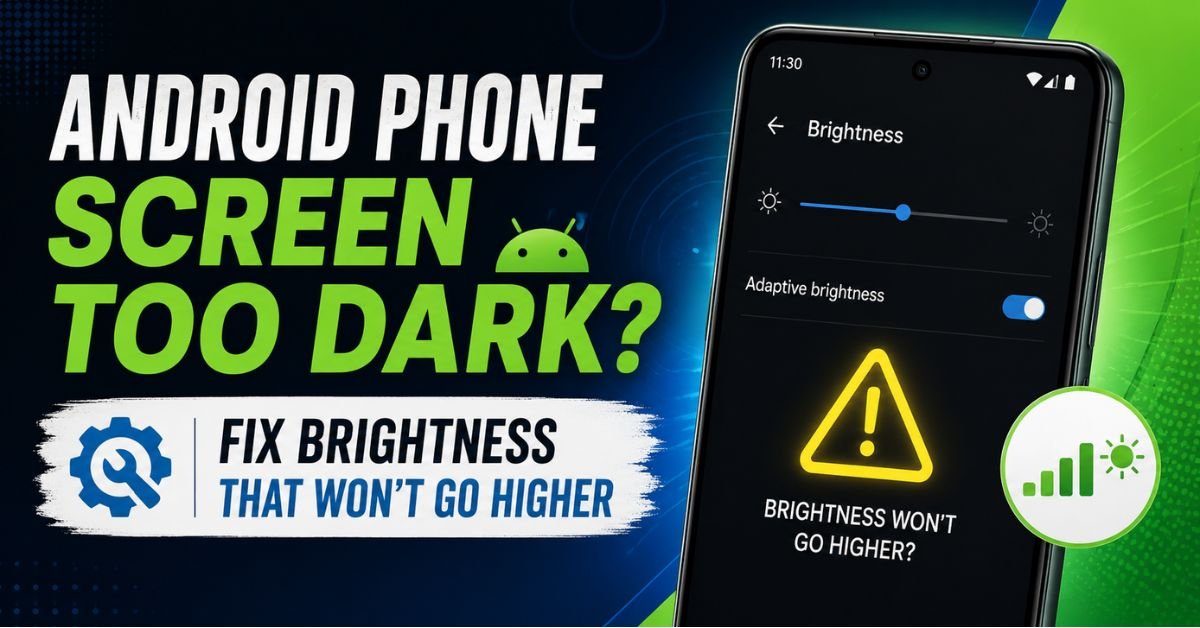
It wasn’t a broken screen. It wasn’t a “cheap phone” issue. It was a classic case of Android’s software getting in its own way. If you’ve ever found yourself squinting at your phone in broad daylight, frustrated that the brightness slider is at 100% but the display looks like it’s at 20%, you aren’t alone.
Most people assume their screen is dying. In reality, it’s usually a tug-of-war between half a dozen software layers—some meant to save your eyes, others to save your battery, and one specifically designed to prevent your phone from melting. Let’s figure out why your Android phone is holding back on the “Nits” and how to force it to show its true colors.
The Frustration of Outdoor Invisibility
There is a massive difference between what your phone can do and what it chooses to do. Most modern flagship displays (especially OLED panels from Samsung or Google) are rated for 1,500 to 2,600 Nits of peak brightness. For context, 1,000 Nits is usually enough to see clearly in direct sunlight.
However, your phone rarely hits that peak manually. If you drag the slider to the max, you’re often only hitting a “Manual Max” (say, 600-800 Nits). To get to the real “High Brightness Mode” (HBM), the phone needs to handle its own business via the Ambient Light Sensor.
But what happens when that sensor is blocked by a screen protector? Or when a hidden accessibility feature is muffling the output? This is the gap between software-based dimming and hardware limitations.
The “Extra Dim” Trap: The Secret Setting Killing Your Screen
I’ve lost count of how many times I’ve “fixed” a friend’s phone simply by digging into the Accessibility menu. Starting around Android 12, Google introduced a feature called Extra Dim.
It’s a fantastic tool for reading in bed at 2 AM, as it allows the screen to go even darker than the hardware’s minimum setting. The problem? It often gets toggled on by a shortcut or stays active when you don’t want it to. If “Extra Dim” is on, your “100% brightness” is effectively capped at a much lower intensity. It’s like putting a physical tint on your screen.
How to check:
- Open Settings.
- Go to Accessibility.
- Look for Extra Dim. If it’s on, toggle it off immediately.
- (Pro Tip) Check the “Extra Dim shortcut.” If this is on, you might be accidentally triggering it with a two-finger swipe or the volume keys.
Adaptive Brightness vs. Thermal Throttling
We’ve all been told to keep Adaptive Brightness on so the phone can learn our habits. But sometimes, the algorithm just gets… stupid. It remembers that one time you dimmed the screen in a dark room and starts applying that logic to the park at noon.
Worse than a confused algorithm is Thermal Throttling. This is the silent killer of outdoor visibility. OLED screens generate heat when they are pushed to high brightness. If you’re outside on a 90°F day and your phone is already warm from running GPS or Instagram, the system will intentionally dim the screen to prevent the internal components from overheating.
In this state, you can slide that bar all you want; the OS will override you to protect the hardware. I’ve noticed this specifically on older OnePlus and Pixel models where the cooling isn’t as robust as the newer “vapor chamber” designs.
The Role of the Ambient Light Sensor
Your phone doesn’t just “know” it’s sunny out. It relies on a tiny sensor usually tucked away near the top speaker or hidden under the display.
If you use a cheap, thick glass screen protector, or if dust has gunked up the top edge of your phone, the Ambient Light Sensor might think you’re in a dim room. It won’t trigger High Brightness Mode (HBM) because it doesn’t think it needs to.
I once spent an hour troubleshooting a Samsung Galaxy S22 only to realize the user’s rugged case had a slight overhang that cast a shadow directly onto the sensor. A quick wipe and a case adjustment, and the screen suddenly “healed” itself.
Hands-On Fixes: Step-by-Step Troubleshooting
If your screen is still too dark, let’s go through the technical manual reset. This isn’t just “turning it off and on again”—we’re clearing the logic that controls the display.
1. Reset the Adaptive Brightness Algorithm
If your phone has “learned” the wrong behaviors, you need to wipe its memory.
- On Stock Android/Pixel: Settings > Apps > See all apps > Device Health Services > Storage & Cache > Clear Storage > Reset adaptive brightness.
- On Samsung (OneUI): This is often bundled in the same “Device Health Services” or within the “Display” settings under “Adaptive Brightness” (look for a “Reset” or “Clear” option if available in your specific build).
2. Disable “Power Saving Mode” Hidden Caps
Many phones have a “Limit brightness to 90%” toggle inside their Power Saving Mode settings. Even if your battery is at 40%, if that mode is active, you’re losing 10% of your peak output. On OxygenOS, this is often even more aggressive, capping the screen significantly to squeeze out extra minutes.
3. The Developer Options Trick
If you suspect a software bug is preventing your screen from reaching its potential, you can monitor what’s happening.
- Go to Settings > About Phone and tap Build Number 7 times.
- Go to System > Developer Options.
- Look for “Strict Mode Enabled” (ensure it’s off) or use “Show Surface Updates” (temporarily) to see if the screen is being redrawn constantly, which can cause perceived dimness.
- Note: Some older phones have a “Disable HW Overlays” option. While usually for performance, it can sometimes fix brightness flickering or “stuck” dimming on older Android versions.
4. Test the Sensor with a Lux Meter
To see if your hardware is actually reading light correctly, download an app like “Sensors Toolbox” or any Lux Meter app from the Play Store.
- Hold your phone under a bright lamp.
- Watch the “Light” sensor value. It should jump significantly (into the thousands).
- If it stays low (under 100) while you’re under a bright light, your sensor is either blocked or dead.
Common Pitfalls: What Not to Do
When you’re desperate to see your screen, it’s easy to fall for “snake oil” solutions.
Avoid “Brightness Booster” Apps: Most of these apps are just malware-ridden junk. They don’t have the system-level permissions to bypass the kernel’s brightness limits. In fact, many use a “filter” overlay that can actually interfere with the system’s own High Brightness Mode.
Don’t Ignore Burn-in Warnings: If you find a way to “force” HBM permanently using a rooted app or a custom ROM, be careful. OLED panels suffer from Screen Burn-in and OLED degradation when pushed to max nits for extended periods. There’s a reason the manufacturer includes a “timeout” for peak brightness.
PWM Dimming Sensitivity: If the screen feels “dark” or “flickery” even when bright, you might be sensitive to PWM (Pulse Width Modulation) Dimming. This is how OLEDs control brightness—by flickering the screen on and off very fast. Some people perceive this as a dimmer, more “tiring” screen. If this is you, look for a phone with a “DC Dimming” or “Anti-flicker” mode in the display settings.
Hardware Signs: When the Screen Itself is the Problem
Sometimes, the software is innocent. If you see a yellowing effect or a “sepia” tint that won’t go away (and “Blue Light Filter” or “Eye Comfort Shield” are definitely off), your OLED material might be aging.
OLEDs are organic. The blue sub-pixels die faster than the red and green ones. As they degrade, the screen loses its “punch” and overall brightness. If your screen has a “ghost” of the navigation bar or a permanent yellow hue, no amount of setting-tweaking will fix it. You’re looking at a screen replacement.
Expert Insight: Before you pay for a repair, check if your phone has a “Display Tone” or “Natural vs. Vivid” setting. Sometimes, switching from “Natural” to “Vivid” gives the illusion of higher brightness because it boosts the saturation and contrast, making the screen pop more in outdoor environments.
Real-Time FAQ
Q: Why does my screen get darker when I play games?
A: This is almost certainly Thermal Throttling. Gaming puts a heavy load on the GPU/CPU, which generates heat. To keep the temperature safe, the phone dims the screen—one of the biggest heat generators—to compensate. Some “Game Mode” settings allow you to disable “Auto-brightness” while gaming, but they won’t stop the hardware-level thermal safety dimming.
Q: Can a cracked screen cause the brightness to stay low?
A: Yes. If the crack passes over the ambient light sensor, it can refract light away from the sensor, tricking the phone into thinking it’s in a dark room. Additionally, damage to the display’s digitizer or voltage layers can prevent the LEDs/OLEDs from receiving enough power to hit max brightness.
Q: My phone is bright, then suddenly drops after 2 minutes in the sun. Why?
A: This is the standard behavior for High Brightness Mode (HBM). Phones can only sustain “peak nits” for a short time before the heat becomes a risk. Once the internal temperature hits a certain threshold, the OS forces the screen back down to “Sustained Brightness” levels.
Q: Does “Dark Mode” affect how bright the screen can get?
A: Not technically, but it affects legibility. In direct sunlight, “Light Mode” (black text on white background) is actually much easier to read because of the higher overall luminance of the screen. If you’re struggling to see, flip your phone back to Light Mode temporarily.
Q: Is there a way to force my phone to stay at max brightness?
A: Without root, no. And honestly, you shouldn’t want to. Forcing max brightness 100% of the time will kill your battery in two hours and likely cause permanent image retention (burn-in) within a few months. Your best bet is ensuring the Extra Dim and Power Saving features aren’t handicapping your device.
By the way, if you’ve checked everything and it’s still too dark, try a quick restart in “Safe Mode.” If the brightness is perfect in Safe Mode, you have a third-party app (likely a battery saver or a “night shift” clone) that’s hijacking your display settings. Happy squinting-no-more!