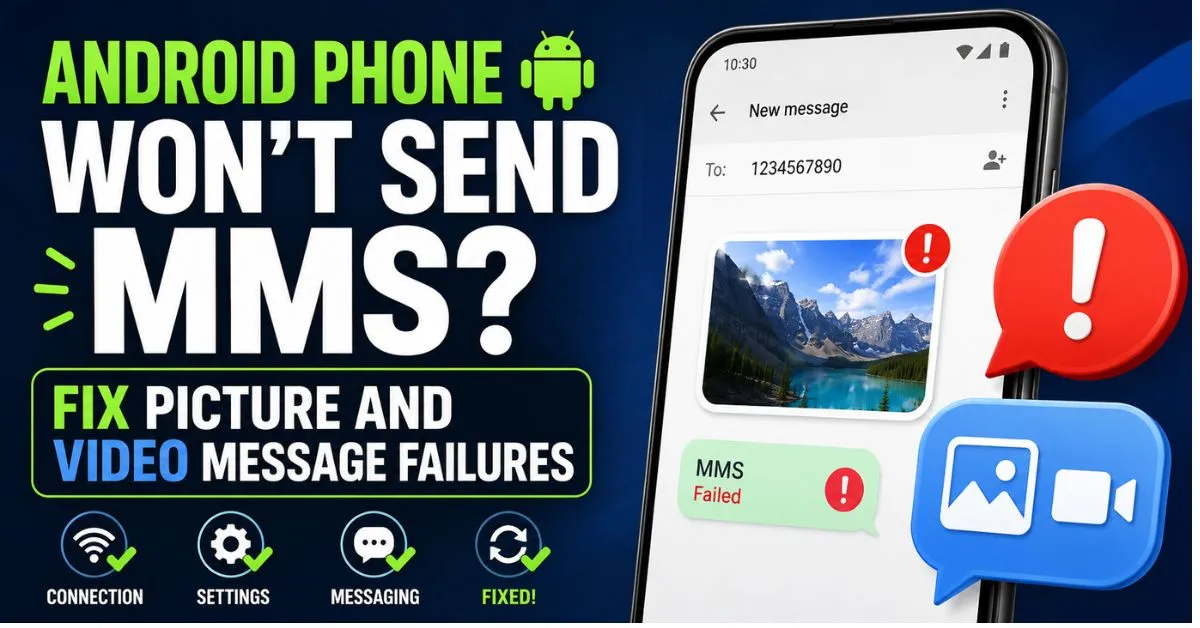
I’ve spent more hours than I’d like to admit behind a repair desk, staring at that dreaded red exclamation mark on a customer’s phone. You know the one. You’ve just snapped a perfect photo of your kid’s first steps or a hilariously bad parking job, you hit send, and then… nothing. “Message not sent. Touch to try again.” You touch it. It fails again.
It’s a specific kind of modern torture. We live in an era of folding screens and 5G speeds, yet the humble Multimedia Messaging Service (MMS)—a technology that’s literally decades old—still finds ways to break. Whether you’re rocking a brand-new Samsung Galaxy S23, a sleek Pixel 7, or an old-reliable Motorola, MMS failures are an equal-opportunity annoyance.

In my time handling tech tickets, I’ve realized that MMS isn’t just “texting with pictures.” It’s a complex handshake between your phone’s software, your carrier’s aging infrastructure, and your mobile data connection. If one link in that chain rusts, your media stays stuck in your outbox. Let’s get your phone back to actually communicating.
Also Reade : Complete Android Fix Guide: Every Android Problem Solved (2026)
The ‘Quick Wins’: Basic Connectivity Checks
Before we start tearing into deep system settings, we need to rule out the “dumb” stuff. I can’t tell you how many people have paid for a diagnostic fee only for me to toggle a single switch.
The Mobile Data Mandate
Here is the golden rule of MMS: It requires mobile data.
I’ve had countless users tell me, “But I’m on Wi-Fi!” It doesn’t matter. Unlike Short Message Service (SMS), which travels over the voice signaling channel, MMS is a data-hungry beast. While some modern carriers allow MMS over Wi-Fi (if Wi-Fi Calling is enabled), the vast majority of Android devices still need a “cellular handshake” to push that 800KB photo through.
- Try this: Swipe down your notification shade and ensure Mobile Data is toggled ON.
- The Airplane Mode Trick: This is my 40% fix. Toggle Airplane Mode ON for 10 seconds, then OFF. This forces your phone to re-authenticate with the nearest cell tower, often clearing a stuck data “pipe.”
Check for Data Throttling
If you’ve hit your “unlimited” data cap for the month, your carrier might have slowed your speeds to a crawl—sometimes so slow that the MMS server times out before the file finishes uploading. Check your carrier app (My Verizon, T-Mobile, etc.) to see if you’re being throttled.

Deep Dive: Configuring Your APN Settings Correctly
This is the “expert” territory. APN stands for Access Point Name. Think of it as a GPS coordinate that tells your phone exactly how to connect to your carrier’s gateway to the internet. If these settings are slightly off—maybe after a software update or switching SIM cards—your phone is effectively screaming into a void.
I once spent three hours troubleshooting a Pixel 7 that wouldn’t send videos. The culprit? A single missing period in the MMSC (Multimedia Messaging Service Center) URL.
How to Find Your APN Settings
The path varies slightly by brand, but generally:
- Open Settings.
- Tap Connections or Network & Internet.
- Go to Mobile Networks.
- Look for Access Point Names.
What to Look For
Inside your active APN, you’ll see fields like MMSC, MMS Proxy, and MMS Port. If these are blank or incorrect, your media won’t move.
- Verizon users: Often use
http://mms.vtext.com/servlets/mms. - T-Mobile users: Usually look for
http://mms.msg.eng.t-mobile.com/mms/wapenc. - AT&T users: Typically require
http://mmsc.mobile.att.net.
Pro Tip: Don’t try to guess these. If your settings look wrong, don’t just edit them. Tap the three dots in the corner and select “Reset to default.” This forces the phone to re-read the configuration data directly from your SIM Card. It’s the most effective way to fix APN corruption without being a network engineer.
App-Level Troubleshooting: Beyond the Basics
Sometimes the problem isn’t the network; it’s the app you’re using to talk to it. Most Android phones now ship with Google Messages, which is fantastic until it gets “confused.”
The RCS Conflict (The “Chat Features” Bug)
Google has been pushing Rich Communication Services (RCS) hard. It’s the Android equivalent of iMessage—it gives you typing indicators and high-res photos. But here’s the catch: if you’re trying to send a message to someone who doesn’t have RCS, or if your RCS connection is spotty, the app might fail to “fall back” to traditional MMS.
I’ve seen this happen a lot when moving between a Samsung and a Pixel.
- The Fix: Go into Google Messages settings > RCS Chats. Try toggling it OFF. If your message suddenly sends as a standard MMS, you know the RCS handshake was the bottleneck.
Clearing the Cache
Apps are like attics; they collect digital junk.
- Long-press your messaging app icon.
- Tap the “i” or App Info.
- Go to Storage.
- Tap Clear Cache (Do NOT tap Clear Data unless you want to risk losing your conversation history!).
Expert Insight: Don’t forget about Carrier Services. This is a background app on the Play Store that helps your phone talk to the network. If it’s outdated, MMS often fails. Search “Carrier Services” in the Google Play Store and make sure it’s updated to the latest version.
System Fixes: Resetting the Network Stack
If you’ve checked your data and your APNs, and you’ve cleared your app cache, we need to get aggressive. We’re moving from “software tweaks” to “system resets.”
Force Restart vs. Standard Restart
A standard restart just closes apps. A Force Restart (usually holding Power + Volume Down for 15 seconds) cuts power to the processor for a split second, forcing the hardware drivers for the LTE/5G modem to reload from scratch. I’ve seen this fix “Message Not Sent” errors when a standard reboot failed.
Warning: Resetting Network Settings
This is the “nuclear option” before a factory reset. It’s incredibly effective, but it comes with a price.
- What it does: Wipes all saved configurations for Wi-Fi, Bluetooth, and Mobile Data.
- What you lose: You will have to re-enter your home Wi-Fi password and re-pair your car’s Bluetooth.
- Why do it? It clears out any deep-seated bugs in the network stack that “Reset to Default” APN doesn’t touch.
To do this, go to Settings > General Management (or System) > Reset > Reset Network Settings. Use this as a last resort, but know that it works in about 80% of persistent cases.
Advanced Tips and Modern Workarounds
Let’s be honest: MMS is a dying standard. Carriers often impose a 1MB file size limit on MMS. If you’re trying to send a 4K video of a concert, the carrier is going to reject it or compress it until it looks like it was filmed on a potato.
Use Link Sharing
If MMS is being stubborn, I always tell my clients to use Link Sharing or Google Photos. Instead of sending the raw file through the carrier’s narrow pipe, you’re sending a URL.
- Open your Gallery.
- Select the video/photo.
- Tap Share and look for “Create Link” or “Google Photos Link.”
- Send that link via SMS.
Your recipient gets the full-resolution file, and you bypass the carrier’s MMS servers entirely. It’s faster, higher quality, and avoids the “failed” notification altogether.
The SIM Card Swap
In rare cases, the physical SIM Card is the culprit. SIM cards can degrade over time or suffer from “micro-scratches” on the gold contacts. If your phone is more than three years old and you’re getting “Message Not Sent” frequently, head to your carrier store and ask for a fresh SIM. They usually provide them for free, and it can solve a host of phantom connectivity issues.
Wrapping This Up
MMS failures are a relic of a fragmented ecosystem, but they don’t have to be a permanent part of your life. Start with the data toggle, check your APN defaults, and don’t be afraid to toggle off RCS if it’s acting up. If all else fails, remember that there are better ways to share media in 2024 than a protocol designed in the 90s.
Frequently Asked Questions
Why does my phone send SMS but not MMS?
SMS (text) uses a very low-bandwidth signaling channel that requires almost no signal strength. MMS (pictures/video) requires a robust mobile data connection. If your data is off, your APN is misconfigured, or your carrier plan has run out of data, SMS will work fine while MMS will fail every time.
Does MMS work on Wi-Fi?
By default, no. Most Android phones require mobile data for MMS. However, if your carrier supports Wi-Fi Calling and you have it enabled in your settings, the phone can often tunnel the MMS data through your Wi-Fi connection. If MMS is failing, try turning off Wi-Fi to force the phone to use mobile data.
Why do my pictures look blurry when I send them via MMS?
Carriers have strict file size limits (often 600KB to 1MB). When you send a 10MB photo via MMS, your phone or the carrier aggressively compresses it to fit through the “pipe.” To avoid this, use a data-based app like WhatsApp, Telegram, or share a Google Photos link.
Will clearing my messaging app data delete my texts?
Yes. If you select “Clear Data” (or “Clear Storage”) in your app settings, it will wipe your database, including all your conversations. Always stick to “Clear Cache” first. If you must clear data, ensure you have backed up your messages to your Google Account first.
Can a VPN interfere with MMS?
Absolutely. Many VPNs don’t play well with carrier-specific MMS gateways. If you use a VPN (like NordVPN or Google One VPN) and your MMS is failing, try disconnecting the VPN and sending the message again. If it works, you may need to “whitelist” your messaging app in your VPN’s split-tunneling settings.