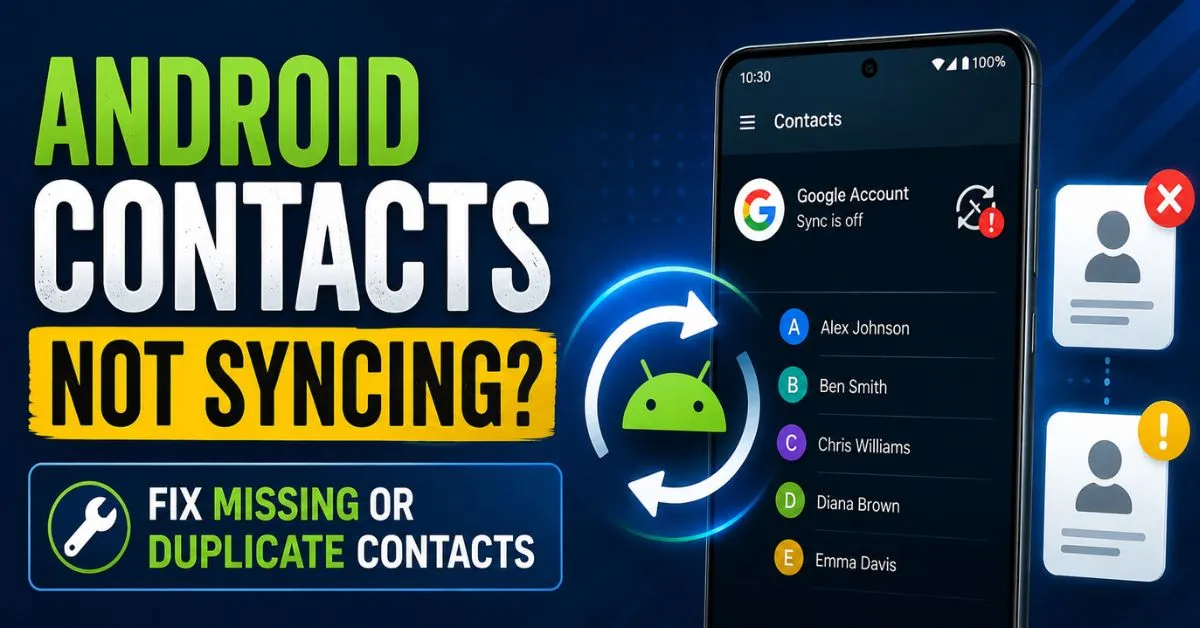
I’ve been there. You’re standing at the airport, or maybe you’re in the middle of a frantic workday, and you go to dial a client or a family member. You type their name into the search bar of your phone. Nothing. You type it again, slower this time, thinking you made a typo. Still nothing. Or worse, you see three different entries for “Dad,” each with a different fragment of a phone number or an outdated email address from 2012.
It feels like a digital ghost is haunting your phone. As someone who has spent over a decade digging through the guts of the Android Operating System, from the early days of Gingerbread to the polished modern era of Android 14, I can tell you that contact sync issues are among the most frustrating bugs users face. It’s not just a minor glitch; it’s a breakdown in the very tool we use to stay connected.
Whether you’re rocking a Google Pixel, a Samsung Galaxy with One UI, or any other OEM Skin, the underlying plumbing of your contacts relies on a complex dance between your local device and Cloud Synchronization. When that dance gets out of sync, things get messy.
Also Reade : Complete Android Fix Guide: Every Android Problem Solved (2026)
Understanding the Android Sync Ecosystem
Why do contacts just… disappear? Usually, it’s not that they’re deleted, but rather that the bridge between your Google Account and your phone has buckled. You might see the dreaded “Sync is currently experiencing problems. It will be back shortly” message in your settings. In my experience, “shortly” can sometimes mean “never” unless you intervene.
The Android sync ecosystem is a layered cake. At the bottom, you have the Android Operating System itself. On top of that sits Google Play Services, which acts as the invisible glue connecting your apps to Google’s servers. Then you have the Google Contacts App, which is just the interface you see. Finally, you have the Contact Metadata—the tiny bits of info like birthdays, job titles, and labels that can sometimes get corrupted, causing the whole sync process to hang.
I’ve found that many sync errors stem from a bottleneck in the Google Play Services cache. When this background process gets bloated, it fails to “handshake” with the cloud, leaving your local contact list stranded on an island.
Quick Fixes: The 5-Minute Checklist
Before we start performing “open-heart surgery” on your software, let’s look at the simple stuff. You’d be surprised how often a 30-second fix solves a three-day headache.
- The Toggle of Truth: Go to Settings > Passwords & Accounts, tap your Google Account, and select Account Sync. Is the “Contacts” toggle actually on? I once spent two hours troubleshooting a friend’s phone only to realize they’d accidentally flipped this switch while trying to save battery.
- Connectivity Check: This sounds basic, but are you on a restricted Wi-Fi network? Some corporate or public hotspots block the background ports used for Cloud Synchronization. Try switching to mobile data.
- Update the “Big Three”: Open the Play Store and ensure the Google Contacts App, Google Chrome, and Google Play Services are all updated. Play Services updates often contain silent fixes for sync protocols that aren’t advertised in the changelog.
- Power Cycle: Don’t just restart; do a “Hard Restart” (usually holding Power + Volume Down). This clears some temporary volatile memory that a standard reboot might miss.
SAFETY FIRST DISCLAIMER: Before you proceed to deeper fixes, please, for the love of your data, go to the Google Contacts web version on a laptop and verify that your contacts are actually there. If they are, you’re safe to tinker. If they aren’t, your phone might be the only place they live—back them up immediately to a VCF file (Settings > Export) before you clear any data.
Resolving Duplicate Contacts for Good
Duplicate contacts are the bane of a clean digital life. They usually happen because of “Account Bloat.” You have your Google contacts, then you import from a SIM Card, then WhatsApp syncs its own version, and suddenly you have four entries for the same person.
The ‘Merge and Fix’ Feature
The Google Contacts App has a built-in tool that is surprisingly robust. Tap the “Fix & manage” tab at the bottom. The “Merge and fix” option uses an algorithm to scan Contact Metadata—looking for matching emails or phone numbers—and offers to combine them. I recommend doing this once a month.
The SIM Card Import Trap
One of the biggest mistakes I see (especially with users moving from older phones) is the “SIM card import” trap. Back in 2010, saving contacts to a SIM card was the standard. In 2024, it’s a recipe for disaster. SIM cards have very limited storage for names and can’t handle multiple numbers or emails for a single person.
Pro-Tip from the Trenches: If you have duplicates, check if some are “SIM” contacts and others are “Google” contacts. Use the “Move to another account” feature to shift everything into your Google Account, then clear the SIM card entirely. This forces a single “Source of Truth” for your data.
Dealing with OEM Skins
If you’re on a Samsung, you’re dealing with One UI, which likes to push the Samsung Account alongside the Google Account. This often creates “Ghost Duplicates.” Go into the Samsung Contacts app settings and set the “Default storage location” to your Google Account. This prevents the phone from splitting your data between two different clouds.
Advanced Troubleshooting for Stubborn Sync Errors
If the basic toggles didn’t work, we need to get technical. Sometimes, the internal database that stores contacts on your phone becomes “read-only” due to a software conflict, or the sync token has expired.
Clearing the ‘Contacts Storage’ Cache
This is different from clearing the cache of the Contacts App.
- Go to Settings > Apps > See all apps.
- Tap the three dots in the corner and select “Show system.”
- Find Contacts Storage (this is the system-level database).
- Tap Storage & cache and clear both.
Wait! This will temporarily wipe the contacts on your phone, but it won’t delete them from the cloud. Once you clear this, your phone will be forced to re-download a fresh, clean copy of your contact list from Google’s servers.
The Nuclear Option: Remove and Re-add the Google Account
If you’re seeing an error related to Two-Factor Authentication (2FA) or a “Sync error” that won’t go away, your account’s security token might be stuck.
- Go to Settings > Accounts.
- Remove your Google Account (make sure you know your password!).
- Reboot the device.
- Add the account back.
This effectively resets the handshake between the Android Operating System and Google’s servers. It’s a pain, but it’s the most effective way to clear persistent sync loops.
Checking for Third-Party Interference
Apps like LinkedIn, Outlook, and WhatsApp love to “hook” into your contacts. Sometimes, a bug in the LinkedIn app can prevent the system-wide sync from completing because it’s waiting for metadata that never arrives. If your sync stopped working right after installing a specific communication app, try disabling that app’s contact sync permissions to see if the logjam clears.
Expert Insight: The Cache Partition Myth You’ll see many old-school forums telling you to “Wipe the Cache Partition” from the Recovery Menu. While this was helpful on Android 5.0, modern versions of Android (using A/B partitions) don’t even use a traditional cache partition in the same way. Don’t waste your time fumbling with volume rockers and power buttons for this specific issue; focusing on the Google Play Services and Contacts Storage data is far more effective.
Pro-Active Tips: Never Lose a Contact Again
Once you’ve fixed the mess, you need to ensure it doesn’t happen again. The goal is to make your contact list “bulletproof.”
- Set the Default Save Location: Whenever you add a new person, look at the top of the “New Contact” screen. It usually asks where you want to save it (Device, SIM, or Google). Always, always choose Google.
- The Monthly VCF Export: I’m a bit paranoid, but every few months, I export my entire contact list to a VCF file and upload it to a separate cloud service like Dropbox or even just email it to myself. It’s a 2MB file that can save your life if your Google Account ever gets locked or hacked.
- The ‘Undo Changes’ Secret Weapon: Did you accidentally delete 50 contacts or merge things you shouldn’t have? Go to the Google Contacts website, click the Cog icon (Settings), and select “Undo changes.” You can roll back your entire contact list to any state it was in over the last 30 days. It’s like a time machine for your phone book.
- CSV Formats for Bulk Edits: If you have a massive mess of contacts, don’t try to fix them on your phone. Export them to a CSV format, open it in Excel or Google Sheets on a desktop, use “Find and Replace” to clean up formatting, and then re-import them. It’s much faster than tapping on a 6-inch screen.
Frequently Asked Questions
Q: Why are my Google contacts not showing up on my new Samsung phone?
A: This is usually because the Samsung “Contacts” app is looking at the Samsung Account storage by default. Go into the Contacts app settings, look for “Manage contacts,” and ensure your Google Account is selected under “Sync contacts.” Also, check if Google Play Services needs an update, as it handles the background data transfer.
Q: Can a full phone storage prevent contacts from syncing?
A: Absolutely. If your phone’s internal storage is at 99% capacity, the Android Operating System will often disable background sync processes to prevent the device from crashing. Free up at least 1GB of space, and you’ll likely see the sync resume automatically.
Q: I have duplicates, but “Merge and Fix” says there are none. What now?
A: This happens when the Contact Metadata is slightly different—for example, one entry has a phone number as “(123) 456-7890” and the other as “+11234567890.” The AI might not realize they are the same. In this case, you’ll have to manually select the contacts in the app and choose “Merge” from the top menu.
Q: Will clearing “Contacts Storage” data delete my photos or messages?
A: No. Contacts Storage is a specific system database only for names, numbers, and addresses. However, it will temporarily empty your contact list. As long as your contacts are synced to your Google Account online, they will reappear within a few minutes once the phone re-syncs.
Q: Why does my phone keep saying “Sync is currently experiencing problems”?
A: This is a generic error that usually points to a server-side glitch at Google or a corrupted sync token on your phone. Try toggling Airplane Mode on and off, or check if you have a “Data Saver” mode turned on that is restricting Google Play Services from using background data. If it persists for more than 24 hours, the “Remove and Re-add Account” method is your best bet.