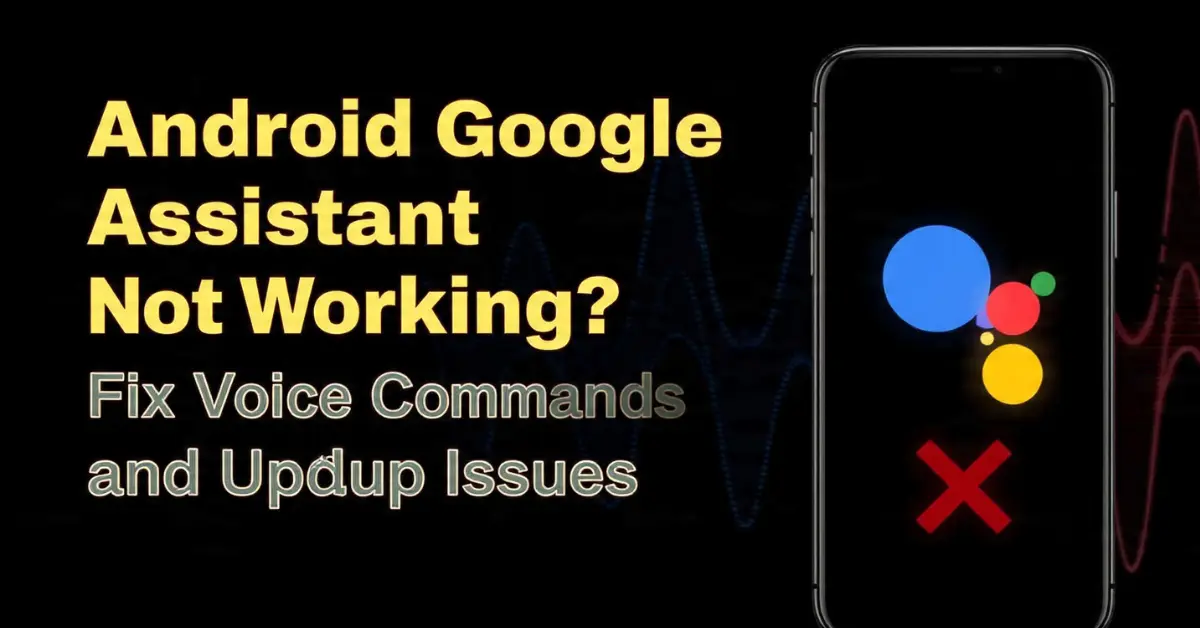
I was knee-deep in a messy lasagna recipe last Tuesday, hands coated in flour and tomato sauce, when I realized I’d forgotten how long the noodles needed to boil. “Hey Google, set a timer for eight minutes,” I barked at my Pixel 7 Pro resting on the counter.
Nothing.
I tried again, louder this time, sounding like a crazy person shouting at a slab of glass. Still nothing. The screen stayed dark. My Digital Assistant had effectively gone on strike at the exact moment I needed it most.
If you’ve ever found yourself in this “silent treatment” loop with your phone, you know it’s not just a minor glitch; it’s a genuine disruption of the hands-free life we’ve grown used to. Whether your Google Assistant is flat-out ignoring your voice, or it’s throwing those cryptic “Something went wrong” errors, the fix is usually buried in a setting you haven’t touched in three years. I’ve spent the last decade tearing down Android OS builds and troubleshooting everything from the original Nexus to the latest Samsung Galaxy S24 Ultra, and I’ve learned that the solution is rarely a single “on/off” switch.
Also Reade : Complete Android Fix Guide: Every Android Problem Solved (2026)
The Frustration of a Silent Assistant
Before we start digging into the software guts, we have to identify what kind of failure we’re looking at. Is it a “Silent Fail” or an “Error Message” scenario?
A silent fail is when you say the wake word and… crickets. This usually points toward hardware issues or the Microphone Permissions being revoked. An error message, like “Wait until your device is ready” or “I can’t reach Google right now,” usually implies a conflict with Google Play Services or a shaky internet connection.
Don’t overlook the obvious, either. I once spent forty minutes debugging a friend’s phone only to realize a speck of pocket lint had jammed itself perfectly into the top microphone hole. Pro-tip: Take a soft-bristled toothbrush or a wooden toothpick and gently—gently—sweep the microphone ports. You’d be surprised how much “Google Assistant failure” is actually just a physical blockage.

Also, check your background data. If you’re on a strict data saver mode, the Google App might not have the “juice” to process your voice request in the cloud. Artificial Intelligence is powerful, but it’s not magic; it needs a stable pipeline to Google’s servers to turn your speech into action.
Mastering Voice Match and Detection
The most common culprit for the “Hey Google” command failing is a corrupted Voice Match model. Over time, your voice changes—maybe you have a cold, maybe you’re more tired, or maybe the phone just “forgot” the specific frequency of your speech.
I’ve found that retraining the model in a perfectly silent room actually hurts accuracy. Why? Because you never use the Assistant in a vacuum. I recommend retraining it in a room with a slight amount of ambient noise—like a fan or a distant TV—so the Voice Recognition engine learns to isolate your voice from the background.
To do this:
- Open the Google App and tap your profile picture.
- Go to Settings > Google Assistant > Hey Google & Voice Match.
- Toggle “Hey Google” off and then back on.
- Tap Voice Model and then Retrain voice model.
When you speak the prompts, don’t use your “robot voice.” Speak like you normally would when you’re frustrated or in a rush. That’s the voice the Assistant needs to recognize.
Hidden Android Settings That Block Voice Commands
Sometimes the problem isn’t the Assistant at all; it’s the Android OS trying to be too helpful. There are a few “ninja” settings that frequently kill the Assistant process.
The Battery Optimization Trap
Android’s “Adaptive Battery” or “Battery Optimization” is designed to kill apps that eat power in the background. Unfortunately, it often views the Google App as a resource hog and puts it to sleep. If the app is asleep, it isn’t listening. Go to Settings > Apps > See all apps > Google > Battery > and set it to Unrestricted.
The Language Paradox
This is a weird one I discovered while traveling. If your system language is set to English (Canada) but your Assistant language is set to English (US), the Voice Recognition can get caught in a logic loop. They need to match. Make sure both your phone’s regional settings and the Assistant’s language settings are identical to avoid this weird linguistic friction.
Overlay Permissions
Google Assistant needs to “draw” over other apps to appear. If you’ve recently installed a security app or a “cleaner” app (which you should probably delete anyway), it might have revoked the Display over other apps permission. Without this, the Assistant might be “working” in the background, but it literally cannot show you the interface.
Deep Tech Fixes: Cache, Data, and App Updates
If the basics didn’t work, it’s time to move into the deeper layers of the software. This is where we look at the Cache Memory and the foundational services that keep Android running.
Clear the Google App Cache (The Safe Way): Don’t just hit “Clear Data” immediately! That wipes your preferences and offline maps. Start by clearing the Cache Memory. Settings > Apps > Google > Storage & cache > Clear cache. This removes the temporary “junk” files that might be causing the app to stutter. If that fails, then—and only then—use “Clear All Data.”
The Critical Role of Google Play Services: Think of Google Play Services as the nervous system of your phone. It handles the communication between the Assistant and the hardware. If Play Services is outdated or glitchy, everything breaks. Search for “Google Play Services” in the Play Store. If there’s an update button, hit it immediately.
Android System WebView: This is an often-ignored component that renders web content inside apps. Surprisingly, a bug in WebView can cause the Google App to crash the moment it tries to show you a search result via voice command. Keeping this updated is a non-negotiable for a stable phone.
Advanced Troubleshooting & Third-Party Conflicts
If you’re a Samsung user, you’re living in a house with two masters: Google Assistant and Samsung Bixby. I’ve seen countless cases where Bixby’s “Voice Wake-up” competes for the microphone, causing Google Assistant to fail.
If you prefer Google, I recommend disabling Bixby’s wake-up feature entirely. Go into Bixby settings and toggle off “Voice wake-up.” This frees up the microphone’s hardware priority for Google.
The “Unlock to Use” Prompt
Nothing kills the mood like saying “Hey Google, text Mom” and having your phone say, “Actually, you need to unlock your device first.” To fix this, look into Smart Lock (now often called “Extend Unlock” on newer versions of Android). You can set your home as a “Trusted Place” or your smartwatch as a “Trusted Device.” When these conditions are met, the Assistant can execute commands without you needing to fumble with a fingerprint scanner.
Driving Mode Issues: If your Assistant works fine until you hop in the car, the culprit is likely the Android Auto or “Driving Mode” settings. Google recently transitioned from the old “Driving Mode” to a more integrated experience within Google Maps. Check your Maps settings under Navigation Settings > Google Assistant settings to ensure “Hey Google” detection isn’t accidentally disabled specifically for driving.
Expert Insight: I’ve found that on many budget-to-midrange Android devices, the “Hey Google” detection is disabled the moment you turn on “Battery Saver” mode. Unlike “Battery Optimization” for specific apps, the system-wide Battery Saver often cuts off the low-power processor that listens for the wake word. If you’re low on juice, you might have to go back to the old-fashioned way: long-pressing the power button.
Frequently Asked Questions
Q: Why does my Assistant say “Wait until your device is ready”?
This is almost always a synchronization issue with your Google Account. Try removing your Google Account from the phone entirely and then re-adding it. It forces a fresh handshake between your hardware and Google’s servers.
Q: Can I use Google Assistant without an internet connection?
Yes, but it’s limited. Basic commands like “Set an alarm,” “Turn on flashlight,” or “Open Spotify” work offline if you have the “Offline Speech Recognition” packs downloaded in your Google App settings. For everything else, you need a data connection.
Q: Why did my Assistant stop working after the last Android update?
Updates can sometimes reset Microphone Permissions. Go to Settings > Privacy > Permission Manager > Microphone and ensure “Google” is set to “Allow only while using the app” or “Ask every time” (though “Allow only while using” is better for the wake word).
Q: Does using a third-party launcher like Nova or Niagara break the Assistant?
Generally, no. However, some gestures in those launchers might conflict with the “Swipe from corner” gesture used to trigger the Assistant. If you use a custom launcher, check its gesture settings to ensure they aren’t overriding the digital assistant triggers.
Q: My Assistant works, but it’s not “talking back.” How do I fix the silence?
Check the “Speech Output” setting. Go to Assistant Settings > Assistant Voice & Sounds > Speech Output. Make sure it’s set to “Full” or “On.” If it’s set to “None” or “Hands-free only,” your phone will process the command silently.