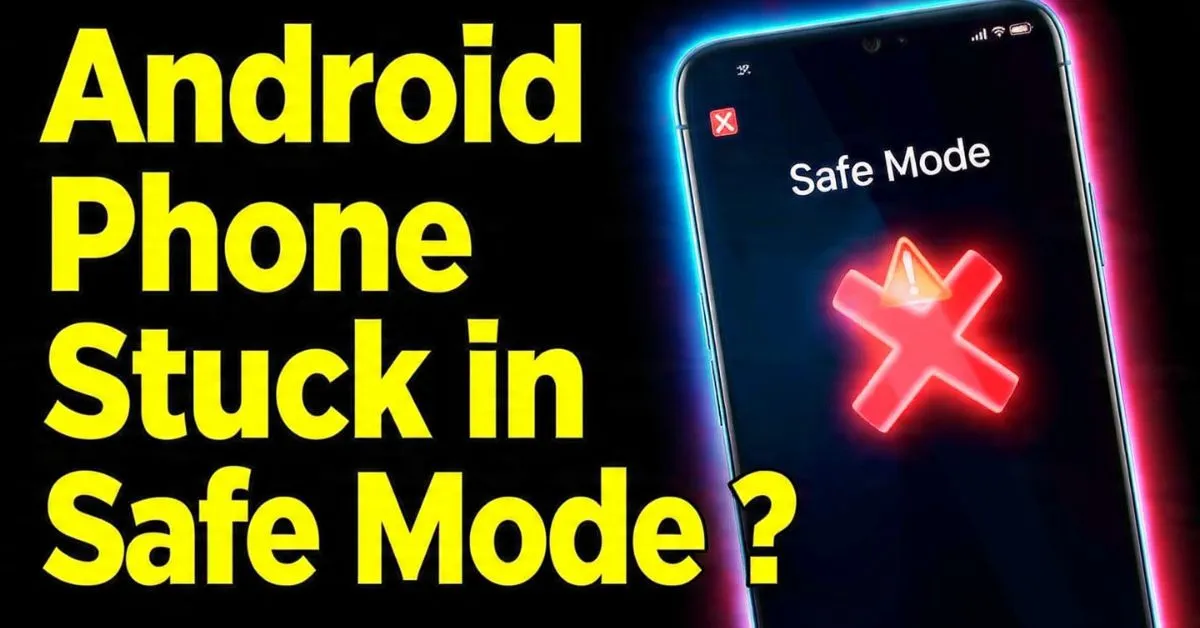
You wake up, reach for your phone to kill that annoying alarm, and notice something feels… off. The wallpaper is gone, half your widgets have vanished into the digital void, and there’s a persistent, ghostly watermark in the bottom-left corner: Safe Mode.
I’ve spent the better part of a decade behind a repair bench, and I can tell you that the “Android phone stuck in Safe Mode” panic is real. People come into my shop thinking their phone is bricked or that a virus has wiped their photos. Relax. Your data is likely fine. Think of Safe Mode as the Android Operating System’s “clean room.” It strips away the noise—no third-party applications, no custom launcher apps, no fancy widgets—leaving only the core system UI to run.

But why is your Android Safe Mode not turning off? Why does it keep booting back into this stripped-down state even after you’ve restarted it five times? Whether you’re dealing with an Android Safe Mode issue on Samsung Galaxy, a Pixel, or a Xiaomi, the logic remains the same. Let’s get you out of this loop.
Also Reade : Complete Android Fix Guide: Every Android Problem Solved (2026)
Quick Fixes: The “Did You Try Turning It Off and On?” Phase
Before we dive into the guts of the Bootloader or Recovery Mode, let’s start with the obvious. You’d be surprised how often a “failed” exit is just a user error or a minor software hiccup.
- The Standard Restart: Hold the power button and select “Restart.” It sounds basic, but an Android stuck in Safe Mode after reboot often just needs a second, clean handshake with the OS.
- The Notification Toggle: Swipe down your notification shade. Some devices (looking at you, Samsung and older Motorola builds) actually show a notification saying “Safe Mode is on.” Tap it. Often, there’s a “Turn Off” button right there.
- The “Soft Reset” Combo: If the screen is unresponsive or you’re facing an Android Safe Mode no response issue, force a reboot. Hold the Power Button and Volume Down simultaneously for about 10-15 seconds. This simulates a battery pull—essential for those Android Safe Mode random failures where the system UI hangs.
Hardware Inspection: The “Ghost” Button Press
Here is the secret I tell my customers: 90% of the time, when an Android phone keeps booting into Safe Mode, it’s a physical hardware problem, not a software bug.
Android enters Safe Mode when it detects the Volume Down button being held during the boot sequence. If your Android Safe Mode because of volume button stuck is the culprit, the phone thinks you’re asking for Safe Mode every single time it starts up.
- Check Your Case: I’ve seen cheap silicone cases or rugged “tough” cases that lose their alignment. If the case is pressing even slightly on the Volume Rocker, you’re stuck. Strip the case off and try restarting.
- Sticky/Mushy Buttons: Did you spill a soda on it? Is there pocket lint jammed in the crevice? If the button doesn’t “click” when you press it, it’s likely engaged. A tiny drop of 99% isopropyl alcohol and a toothbrush can work wonders here.
- The Dropped Phone Syndrome: An Android Safe Mode issue after dropping phone usually means the internal bracket for the volume keys is bent. Even if the button looks fine on the outside, the internal switch might be permanently closed.
- Water Damage: If you’re seeing Android Safe Mode issue after water damage, there might be a short on the motherboard or the flex cable. This often leads to an Android Safe Mode because of damaged motherboard diagnosis, which is a bit more serious.
Software Troubleshooting: Finding the Culprit
If your buttons are clicking perfectly and the phone is clean, we move to the software. Sometimes, a software update or a corrupted cache causes the system to fail its integrity check, forcing a Safe Mode boot to protect itself.

Identifying Problematic Apps
Since Safe Mode disables third-party applications, if the phone runs perfectly in Safe Mode but crashes or loops in normal mode, an app is the villain.
- Recently Installed Apps: Think back. Did you just install a new VPN app, a custom launcher, or a screen overlay app? These are notorious for triggering an Android Safe Mode issue because of app conflicts.
- Malware: An Android Safe Mode issue because of malware is rare but possible. Some malicious apps try to hijack the User Interface, causing the OS to retreat into Safe Mode for stability.
- Accessibility Apps: Weirdly, I’ve found that Android Safe Mode because of accessibility apps or specific accessibility settings can cause weird boot behaviors on Android 14.
The Cache Partition Trick
This is my favorite “pro” move before reaching for the factory reset button.
- Turn off your phone.
- Hold Power + Volume Up (on most phones) to enter Recovery Mode.
- Use the volume keys to navigate to Wipe Cache Partition.
- Select it with the Power button. Note: This does not delete your photos or data. It just clears out the temporary system files. An Android Safe Mode issue because of corrupted cache is often fixed instantly by this.
Pro Tip: If you just updated to a new OS version (like the Android Safe Mode issue after Android 15 update), wiping the cache partition is almost mandatory. Leftover files from the previous version can clash with the new Operating System files, leading to “boot loops” or forced Safe Mode.
Brand-Specific Nuances (Samsung, Pixel, Xiaomi, OnePlus)
Not all Androids are created equal.
- Samsung Galaxy: Often gets stuck due to Smart Lock conflicts or Always On Display bugs. If you’re facing a Samsung Safe Mode troubleshooting nightmare, try disabling “Auto Optimization” in the battery settings once you finally get back into normal mode.
- Pixel Phones: Google’s own phones are sensitive to Google Play Services updates. An Android Safe Mode after Google Play update is common on Pixels. Ensure all system apps are updated in the Play Store while in Safe Mode (if WiFi is working).
- Xiaomi/OnePlus: These brands use aggressive RAM management. An Android Safe Mode issue due to RAM overload can happen if you have too many background apps set to auto-start.
The “Nuclear Option”: Advanced Recovery
If you’ve checked the buttons, wiped the cache, and uninstalled every app you can find, and you’re still asking how to get out of Safe Mode, we’re looking at deeper system corruption.
Factory Data Reset
I hate suggesting this, but sometimes it’s the only way. If the Android Safe Mode issue because of system file corruption is deep enough, a fresh start is required.

- Back up your data first! Even in Safe Mode, you can usually plug your phone into a PC and drag your photos off.
- Go to Settings > System > Reset options > Erase all data (Factory Reset).
- This will fix an Android Safe Mode issue after factory reset (if the first reset was interrupted) or issues caused by a failed update.
Bootloader and ADB
For the tech-savvy, you might need to use the Android Debug Bridge (ADB). If you’ve been messing with a custom ROM, rooting phone, or unlocking bootloader, your partition table might be a mess. Commands like adb reboot can sometimes kick the phone out of its stuck state when the physical buttons fail. An Android Safe Mode issue because of bootloader errors usually requires reflashing the outdated firmware.
Why Does This Keep Happening? (Preventative Care)
Once you’re out, let’s make sure you don’t go back.
- Low Storage: An Android Safe Mode issue because of low storage is a real thing. If your internal memory is 99% full, the OS can’t create the temporary files it needs to boot properly. Keep at least 10% free.
- Overheating: If you’re seeing Android Safe Mode because of overheating phone or thermal throttling, the phone is protecting its hardware. Stop gaming while charging!
- Faulty Accessories: Believe it or not, I’ve seen an Android Safe Mode issue because of damaged charging port or a counterfeit battery send weird voltage spikes that trip the Safe Mode trigger. Use original chargers.
Final Thoughts from the Workbench
Getting stuck in Safe Mode is an inconvenience, but it’s rarely a death sentence for your device. Most of the time, it’s just your phone trying to tell you that something—either a physical button or a stray piece of code—is getting in its way.
Before you run to a repair shop and pay a $50 “diagnostic fee,” check those volume buttons. Give them a good cleaning. Check that screen protector—sometimes an Android Safe Mode because of screen protector pressure on the edge of the screen can mimic a touch input that interferes with boot.
If you’ve tried everything—the Soft Reset, the Cache Wipe, and checking for Malware—and you’re still stuck, it might be time to look at the damaged charging port or internal board issues. But for 95% of you? A solid restart and a clean button will have you back to your apps in no time.
Have you ever had a phone get stuck in Safe Mode for a weird reason? I once had a client whose phone stayed in Safe Mode because their cat had chewed on the corner of the case! Let me know your horror stories in the comments.